
Data Center Testing and Commissioning: IST, Load Banks, Failure Scenarios, and Handover Readiness
Data center testing and commissioning should not be treated as the final ceremony after construction. It is the process that proves whether the facility can actually operate under load, fail safely, recover predictably, alert correctly, and be handed over to operations with evidence.
A data center can look physically complete and still be unready. If power failover is untested, cooling response is unclear, BMS/DCIM alarms are incomplete, fire interfaces are not validated, network routes are not proven, security systems are not integrated, and operations has not witnessed the tests, the facility is not ready for handover.
This is the testing-and-commissioning article in AakashX's Data Center Project Management in India series. It depends on the workstreams set up earlier — power planning, project governance, and vendor procurement strategy — from the pillar guide.
Table of Contents
- What is the practical answer for data center testing and commissioning?
- Why does commissioning need to start before construction is complete?
- What is the difference between FAT, SAT, pre-commissioning, IST, and certification?
- What should the commissioning governance model include?
- How should load-bank testing be planned?
- Which failure scenarios should be tested?
- How should fire, BMS/DCIM, EPMS, network, and security systems be tested?
- How should snags, punch lists, and retesting be controlled?
- What evidence is needed before handover acceptance?
- What usually fails in data center commissioning?
- Data Center Commissioning Readiness Checklist
- FAQ
- Key Takeaways
What is the practical answer for data center testing and commissioning?
Data center testing and commissioning is the controlled process of verifying that individual systems and integrated systems are installed correctly, perform as intended, fail safely, recover predictably, and can be operated by the handover team.
The project manager should treat commissioning as a workstream that starts during design and procurement. It should include test scripts, witness plans, vendor obligations, load-bank plans, failure scenarios, issue severity rules, retesting rules, evidence storage, and operations sign-off.
Snippet-ready answer: Data center testing and commissioning should verify equipment, systems, integrations, failover behavior, alarms, load performance, fire interfaces, network readiness, security systems, documentation, snag closure, and operations handover evidence.
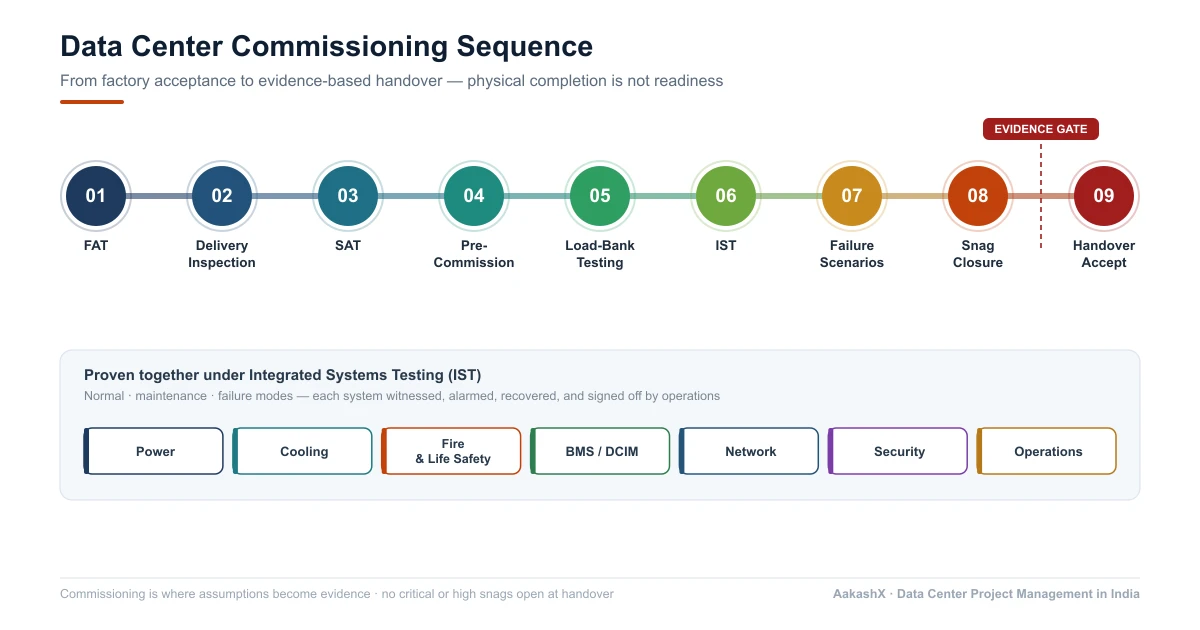
Why does commissioning need to start before construction is complete?
Commissioning starts before construction is complete because testability must be designed, procured, and scheduled.
If commissioning is planned too late, the project may discover that:
- vendors are not contractually required to attend tests,
- FAT requirements were not included in purchase orders,
- load-bank access was not planned,
- temporary power or test equipment is unavailable,
- BMS/DCIM points are incomplete,
- fire interfaces were never mapped,
- network carriers are not ready,
- operations has not been trained,
- test scripts do not match the actual design,
- snags have no severity or retest logic.
A data center commissioning plan should begin during design and become more detailed through procurement, construction, pre-commissioning, integrated systems testing, and handover. This is why commissioning readiness should be visible in project governance from the start, not surfaced at the end.
What is the difference between FAT, SAT, pre-commissioning, IST, and certification?
The project team should use commissioning terms precisely.
| Term | Meaning | Why it matters |
|---|---|---|
| FAT | Factory Acceptance Testing before dispatch | catches major equipment issues before shipment |
| SAT | Site Acceptance Testing after delivery and installation | verifies equipment at site |
| Pre-commissioning | readiness checks before integrated testing | ensures systems are safe and ready to test |
| IST | Integrated Systems Testing | proves systems work together under real scenarios |
| Certification | validation against a defined external framework or standard | separate from commissioning, though it may use commissioning evidence |
FAT vs SAT
FAT happens before equipment leaves the factory or vendor facility, where applicable. It checks whether equipment meets agreed specifications before dispatch.
SAT happens after delivery and installation. It checks whether the equipment has arrived correctly, been installed properly, and can operate at site.
SAT vs IST
SAT is system or equipment acceptance. IST is integrated behavior testing.
For example, a UPS can pass SAT as an individual system. IST asks what happens when utility power fails, the UPS carries load, the DG starts, switchgear transfers, cooling remains stable, alarms trigger, BMS/DCIM records the event, and operations follows the response procedure.
Commissioning vs certification
Commissioning proves readiness against the project's design and operating requirements. Certification, if pursued, validates against a defined external framework such as a Tier or TIA-942 pathway.
Do not leave certification evidence until the end. If certification is intended, commissioning scripts, witness records, test evidence, and design conformance should be aligned early.
What should the commissioning governance model include?
Commissioning needs governance, not only test scripts.
A commissioning governance model should define the commissioning owner, the independent commissioning agency where used, vendor attendance obligations, the test sequence, witness requirements, safety controls, authority inspection dependencies, test acceptance criteria, issue severity levels, retest rules, the evidence repository, operations participation, and handover acceptance gates.
Commissioning roles
| Role | Responsibility |
|---|---|
| Project sponsor | accepts go-live risk and final handover decision |
| PMO | controls schedule, dependencies, issues, evidence |
| Commissioning agency | prepares/reviews scripts, witnesses tests, records results |
| Owner's engineer | reviews technical adequacy and system behavior |
| EPC / contractors | prepare systems and close defects |
| OEM vendors | support equipment-level and integrated tests |
| MEP consultants | validate design intent and test logic |
| BMS/DCIM team | validates points, alarms, dashboards, reporting |
| Operations team | witnesses tests and confirms maintainability |
| Safety / fire team | validates emergency and fire-related test controls |
How should load-bank testing be planned?
Load-bank testing simulates electrical and thermal load so the facility can be tested before production IT load is installed.
The project should define load-bank strategy early because it affects temporary equipment, cabling, heat rejection, access routes, safety, scheduling, vendor attendance, and test scripts.
Load-bank testing should answer:
- What load level will be simulated?
- Will the test cover day-one load, full design load, or phased load?
- Which systems will be stressed?
- How long will each test run?
- Where will load banks be placed?
- How will cables be routed safely?
- How will heat be rejected?
- Which vendors must attend?
- What measurements will be captured?
- What is the pass/fail criterion?
- What happens if a system trips?
- Who approves retesting?
Load-bank test areas
| Area | What to validate |
|---|---|
| UPS | load support, transfer, battery behavior, bypass behavior |
| DG | start sequence, load acceptance, synchronization, runtime behavior |
| Switchgear | transfer logic, protection, metering, alarms |
| Cooling | response under heat load, redundancy, high-temperature behavior |
| BMS/DCIM | alarm capture, dashboard accuracy, event logs |
| Operations | response procedure, escalation, communication |
Which failure scenarios should be tested?
A data center should be tested for normal operation, maintenance mode, and failure mode.
Electrical failure scenarios
Test scenarios may include utility power failure, UPS transfer, battery discharge behavior, DG start and load acceptance, DG failure to start, generator synchronization issues, switchgear transfer, maintenance bypass, single UPS module failure, single transformer or feeder outage, loss of one distribution path, and restoration to normal power.
Cooling failure scenarios
Test scenarios may include chiller failure, pump failure, CRAH/CRAC failure, cooling tower or dry cooler failure, loss of one cooling path, high-temperature alarm, loss of the chilled-water loop, BMS control failure, and cooling recovery after a power transition.
Fire and life-safety scenarios
Test scenarios may include fire alarm activation, detector response, suppression interlock, emergency shutdown logic, access-door release logic, alarm propagation, fire panel integration, evacuation communication, and fire pump readiness where applicable.
Network and security scenarios
Test scenarios may include fiber route readiness, carrier handoff, meet-me-room access, failover route validation, CCTV recording, access-control logs, visitor management, emergency access override, and security alarm escalation.
Not every scenario applies to every facility. The test plan should be risk-based and aligned with design, redundancy target, customer requirement, certification intent, and operations model.
How should fire, BMS/DCIM, EPMS, network, and security systems be tested?
Commissioning must include support systems because operations depends on them.
Fire-system testing
Fire testing should validate detection, alarm, suppression, evacuation, system interfaces, fire-panel signals, shutdowns, access behavior, and authority observations.
Fire testing should involve the fire consultant, fire contractor, electrical contractor, BMS/DCIM team, security team, operations team, and the local fire authority where required.
BMS/DCIM and EPMS testing
BMS/DCIM and EPMS testing should verify point-to-point mapping, sensor accuracy, alarm thresholds, event timestamps, escalation logic, dashboard views, trend logs, reports, user roles, integration with UPS, DG, cooling, fire, fuel, and security systems, backup and restore procedures, and credentialed, secure handover.
A system that displays dashboards but misses critical alarms is not commissioned.
Network readiness testing
Network readiness should include physical fiber route validation, carrier handoff, meet-me-room readiness, cross-connect readiness, path diversity, latency and bandwidth testing where required, failover route testing, documentation, and a carrier escalation matrix.
Security-system testing
Security testing should include access control, CCTV coverage, recording and retention settings, visitor flow, mantrap or turnstile operation where applicable, emergency override, server hall access, loading bay access, audit logs, guard procedures, and incident escalation.
Security readiness is part of data center readiness, not a separate facilities task.
How should snags, punch lists, and retesting be controlled?
Commissioning will produce defects. The quality of commissioning depends on how defects are classified, owned, closed, and retested.
Snag severity levels
| Severity | Meaning | Handover impact |
|---|---|---|
| Critical | unsafe condition or failure of a critical function | blocks handover |
| High | affects redundancy, reliability, monitoring, or maintainability | usually blocks handover unless formally risk-accepted |
| Medium | operational inconvenience or incomplete non-critical function | may allow conditional handover |
| Low | documentation, labeling, cosmetic, or minor correction | can be closed post-handover if tracked |
Snag closure rules
Every snag should have a unique ID, system, description, severity, owner, root cause, corrective action, target date, retest requirement, evidence required, and closure approver.
Do not close commissioning snags by verbal confirmation. Closure should require evidence.
Conditional acceptance
Conditional acceptance may be allowed for non-critical items, but only when risk is documented, the owner accepts it, a closure date is defined, an operational workaround exists, the customer or sponsor accepts the condition, and it does not compromise safety, uptime, security, or compliance.
What evidence is needed before handover acceptance?
Handover acceptance should be evidence-based.
Before accepting handover, the owner should have an approved commissioning plan; FAT, SAT, pre-commissioning, and IST records; load-bank test reports; failure scenario test results; fire-system test results; BMS/DCIM/EPMS point validation; network test evidence; security-system test evidence; the open snag register and closed snag evidence; risk-accepted open items; as-built drawings; O&M manuals; warranty certificates; AMC documents; the spares list; training records; operations SOPs/MOPs/EOPs; emergency contacts; the escalation matrix; the asset register; monitoring dashboard access; and credential and configuration handover through a secure process.
A data center should not be handed over because the building is complete. It should be handed over because the operating team can run it safely, with evidence.
What usually fails in data center commissioning?
1. Commissioning starts too late
Late commissioning usually means weak scripts, missing vendor obligations, poor load-bank planning, and weak retest discipline.
2. Vendors are not contractually required to attend tests
Critical OEMs and integrators must support FAT, SAT, IST, troubleshooting, and retesting. If this is not in the contract, the PMO loses leverage.
3. Load-bank planning is incomplete
Load-bank testing needs space, cabling, heat rejection, safety planning, temporary equipment, and schedule coordination.
4. BMS/DCIM is treated as dashboard setup
BMS/DCIM commissioning requires point validation, alarm logic, thresholds, escalation paths, trend logs, reports, and operations training.
5. Fire interfaces are not tested end to end
Detection, suppression, emergency access, shutdown logic, alarm propagation, and authority observations must be coordinated.
6. Network readiness is left outside commissioning
A facility without validated carrier routes, meet-me-room readiness, and failover testing is not truly ready.
7. Operations only receives documents
Operations should witness tests, practice procedures, review alarms, understand failure modes, and approve maintainability.
8. Snags are closed without evidence
A closed snag without retest evidence is only an opinion.
Use the operational Excel-ready tracker
The article explains the decisions and failure modes. The downloadable Data Center Testing and Commissioning Checklist turns them into assignable work packages with dependencies, accountable roles, blank start and end dates, completion evidence, status and stage-gate impact.
Open the interactive tracker and download the CSV →
Data Center Commissioning Readiness Checklist
Use this checklist before starting integrated systems testing and before handover acceptance.
A. Commissioning governance
- Commissioning owner assigned
- Commissioning agency appointed
- Commissioning schedule approved
- Test sequence approved
- Witness matrix approved
- Safety plan approved
- Issue severity rules approved
- Retest rules approved
- Evidence repository ready
- Operations team included
B. Vendor readiness
- Vendor test obligations included in contracts
- OEM attendance confirmed
- FAT requirements completed
- SAT requirements completed
- Vendor documentation submitted
- Vendor escalation matrix available
- Spares and tools available
- AMC terms drafted or agreed
C. Power readiness
- Utility supply ready
- UPS tested
- Batteries tested
- DG sets tested
- Switchgear tested
- Transfer logic tested
- Metering verified
- Alarms mapped
- Load-bank plan approved
D. Cooling readiness
- Chillers / cooling units tested
- Pumps tested
- Valves and controls verified
- Temperature sensors verified
- Cooling redundancy tested
- High-temperature response tested
- BMS integration tested
- Water systems ready
E. Fire and life safety
- Fire detection tested
- Fire alarm tested
- Suppression system tested
- Fire-panel integration tested
- Emergency exits verified
- Shutdown / interlock logic tested
- Authority inspection observations tracked
- Fire documentation ready
F. BMS/DCIM/EPMS
- Point-to-point validation complete
- Alarm thresholds approved
- Dashboards configured
- Reports configured
- User roles configured
- Event logs validated
- Backup / restore process documented
- Operations trained
G. Telecom and security
- Carrier handoff tested
- Fiber route evidence available
- Meet-me-room ready
- Cross-connects tested
- Network failover tested where applicable
- Access control tested
- CCTV tested
- Security logs verified
H. Handover evidence
- FAT records complete
- SAT records complete
- IST records complete
- Load-bank reports complete
- Failure scenario reports complete
- Snag register updated
- Critical and high snags closed or formally risk-accepted
- As-built drawings submitted
- O&M manuals submitted
- SOP/MOP/EOP drafts ready
- Training records complete
- Warranty and AMC documents available
- Asset register complete
Frequently Asked Questions About Data Center Testing and Commissioning
What is data center testing and commissioning?
Data center testing and commissioning is the process of verifying that equipment, systems, integrations, failover behavior, alarms, monitoring, safety systems, and operations procedures work as intended before handover.
What is IST in a data center?
IST means Integrated Systems Testing. It tests how power, cooling, fire, BMS/DCIM, network, security, and operations behave together under normal, maintenance, and failure scenarios.
What is the difference between FAT and SAT?
FAT, or Factory Acceptance Testing, happens before equipment dispatch where applicable. SAT, or Site Acceptance Testing, happens after equipment delivery and installation at the project site.
Why is load-bank testing important?
Load-bank testing simulates electrical and thermal load before production IT load is installed. It helps validate UPS, DG, switchgear, cooling response, alarms, controls, and operations procedures under realistic stress.
Is commissioning the same as certification?
No. Commissioning proves readiness against the project's design and operating requirements. Certification validates the facility against a defined external framework or standard, if the project chooses to pursue it.
Who should witness data center commissioning tests?
The PMO, commissioning agency, owner's engineer, EPC, relevant OEM vendors, MEP consultants, BMS/DCIM team, fire and security teams, and operations team should witness relevant tests. The exact witness matrix should be defined before commissioning starts.
Can handover happen with open snags?
Only non-critical open snags should be considered for conditional handover, and only if risk is documented, ownership is clear, a closure date exists, and operations can safely run the facility. Critical safety, uptime, monitoring, security, or compliance issues should block handover.
What is the biggest commissioning mistake?
The biggest mistake is starting commissioning after construction completion. Commissioning should influence contracts, vendor obligations, test scripts, load-bank planning, safety planning, BMS/DCIM integration, and operations readiness from earlier phases.
Key Takeaways
- Data center testing and commissioning should begin as a planned workstream during design and procurement.
- FAT, SAT, pre-commissioning, IST, load-bank testing, failure scenarios, and handover acceptance serve different purposes.
- Integrated systems testing proves system behavior, not only equipment performance.
- Load-bank testing should validate power, cooling, alarms, controls, and operations response under realistic load.
- Fire, BMS/DCIM, EPMS, network, and security systems must be commissioned as part of facility readiness.
- Snag closure should require evidence and retesting, not verbal confirmation.
- Handover should happen only when operations can run the facility safely with documentation, training, monitoring, spares, warranties, AMCs, and escalation paths.
This article is part of AakashX's Data Center Project Management in India field manual. Start with the master guide, Project Managing a Data Center Setup in India, revisit Data Center Project Governance, continue with Data Center Certification Planning, and work through the rest of the series. Before announcing handover readiness, use the commissioning checklist above. If integrated systems testing, load-bank testing, failure scenarios, snag closure, and operations sign-off are incomplete, the facility is not ready — it is only physically built.
Track every task above with the Data Center Testing and Commissioning Checklist, an interactive, Excel-ready CSV tracker with dependencies, accountable roles and completion evidence.
References
- Uptime Institute — Tier Certification — built environment, operational approach, and Tier Certification framing.
- Uptime Institute — Tier Certification: Operational Sustainability — operational sustainability requires design-document and constructed-facility certification first.
- ANSI/TIA-942 Standard (TIA) — physical infrastructure requirements covering site, architectural, electrical, mechanical, fire safety, telecommunication, and security.
- ASHRAE TC 9.9 — Mission Critical Facilities, Data Centers — data center environmental knowledge and best-practices context.
Part of the series
Data Center Project Management in India- 1.Project Managing a Data Center Setup in India: From Feasibility to Operations Handover
- 2.Data Center Site Selection in India: Land, Power, Water, Fiber, Climate, and Risk
- 3.Power Planning for Data Centers in India: Grid, Redundancy, DG Backup, Renewables, and Critical Path Risk
- 4.Cooling and Water Planning for Indian Data Centers: Design Choices, Water Risk, and Operating Tradeoffs
- 5.Data Center Approvals in India: A Project Manager's Checklist for Land, Power, Fire, Building, Environment, and Telecom
- 6.Data Center Project Governance: How to Run Workstreams, Vendors, Risks, Decisions, and Escalations
- 7.Data Center Procurement Strategy: How to Package Vendors, Track Long-Lead Equipment, and Avoid Commissioning Risk
- 8.Data Center Testing and Commissioning: IST, Load Banks, Failure Scenarios, and Handover Readiness← you are here
- 9.Data Center Certification Planning: Tier III, Tier IV, TIA-942, Design Reviews, and Commissioning Evidence
- 10.Data Center Operations Handover: SOPs, Staffing, Monitoring, Maintenance, Security, and Incident Readiness

Aakash Ahuja
Enterprise AI, Cybersecurity & Platform Engineering
Aakash writes about secure AI agents, microservices architecture, enterprise platforms, and production engineering. He has 20+ years of experience building and operating software systems across banking, cloud, cybersecurity, AI, and enterprise workflow automation. He is Director of Technology at itmtb Technologies and teaches AI, Big Data, and Reinforcement Learning at top institutes in India.