
Data Center Site Selection in India: Land, Power, Water, Fiber, Climate, and Risk
The wrong data center site does not become right because the design team is good. If land, power, water, fiber, climate risk, approvals, and expansion capacity are weak, the project will carry that weakness into every later phase.
Data center site selection in India should be treated as a formal project gate. A site should move forward only when the team has evidence for title, zoning, grid feasibility, water source, cooling fit, fiber diversity, flood exposure, seismic risk, approval path, access, security, and long-term expansion.
This is the second article in AakashX's Data Center Project Management in India series, expanding the site gate from the pillar guide.
Table of Contents
- What is the practical answer for data center site selection in India?
- Why is site selection the first major project gate?
- What makes India-specific data center site selection different?
- How should teams evaluate land, title, zoning, and access?
- How should power availability shape data center site selection?
- Why do water and cooling assumptions matter before site finalization?
- How should fiber and connectivity be validated?
- How should climate, flood, seismic, and local hazard risks be checked?
- How do approvals and state policies affect site readiness?
- Data Center Site Selection Scorecard
- Common mistakes in data center site selection
- FAQ
- Key Takeaways
What is the practical answer for data center site selection in India?
A data center site in India should be selected only after scoring it across eight dimensions: land, power, water, fiber, climate risk, approvals, security, and expansion. The best site is not the cheapest land parcel; it is the site where infrastructure readiness and operating risk are both acceptable.
The project manager should insist on a site gate before commercial commitment. That gate should include legal diligence, DISCOM (power distribution company) feasibility, water-source validation, fiber-route validation, flood and seismic checks, local approval mapping, access review, and operations input.
Snippet-ready answer: Data center site selection in India is the process of evaluating whether a land parcel can reliably support high-density IT infrastructure across power, cooling, water, fiber, approvals, hazard exposure, security, and long-term operations.
Why is site selection the first major project gate?
Site selection decides the limits of the project before design begins.
Once the land is committed, many later decisions become constrained:
| Later decision | Site dependency |
|---|---|
| Electrical design | grid capacity, substation distance, feeder availability, right-of-way |
| Cooling design | ambient temperature, water availability, site footprint |
| Civil design | soil, flood level, road access, load-bearing requirements |
| Network design | fiber carrier presence, path diversity, duct access |
| Approval plan | land use, state policy, local authority process, fire path |
| Operations | access, security, staffing, maintenance logistics |
| Expansion | extra land, modular phasing, future power and cooling capacity |
This is why the first article in this series framed data center setup as a multi-workstream infrastructure program, not a normal construction project: project managing a data center setup in India.
What makes India-specific data center site selection different?
India-specific site selection is difficult because policy attractiveness and execution readiness are not the same thing.
A state may offer incentives, but the site still needs practical feasibility: usable land, clear title, grid readiness, water source, fire approval path, local authority coordination, and physical fiber access. CEEW's 2026 study notes that India does not yet have a binding national data center policy framework and that states have taken the lead in sector policy development; it also reports stakeholder concerns around delays in land acquisition, building approvals, grid connectivity, and fire safety clearances despite single-window mechanisms. (CEEW)
CEEW also notes that stakeholders increasingly factor climate risk assessments, including heat stress, flooding, and seismic risk, into data center siting decisions. That matters because data centers are long-life infrastructure assets; a site decision made today can lock in energy, water, and resilience consequences for decades. (CEEW)
The practical implication:
Do not shortlist a site only because it is in a "data center-friendly" state. Shortlist it because the land, power, water, fiber, climate, approval, and operating assumptions have been tested.
How should teams evaluate land, title, zoning, and access?
Land evaluation should start before technical design. The project team needs to know whether the site can legally, physically, and operationally support the facility.
Land and title checks
The site-selection team should validate:
- title ownership,
- encumbrances,
- land-use classification,
- conversion requirement, if any,
- zoning compatibility,
- right-of-way issues,
- access road ownership,
- easements,
- nearby restrictions,
- litigation or acquisition risk.
This should be done by local counsel, land consultants, and the owner's engineer. The project manager should not treat "land available" as "land usable."
Physical access checks
A data center needs reliable access for construction, fuel, equipment delivery, maintenance, security, and emergency response.
Check:
- road width,
- turning radius for heavy equipment,
- bridge and culvert limits,
- construction traffic movement,
- emergency vehicle access,
- fuel truck access,
- monsoon access reliability,
- last-mile road ownership,
- local congestion risk.
A site that looks attractive on a map can become difficult when transformers, generators, chillers, racks, or fuel systems need to move through the last mile.
Neighbourhood and adjacency checks
Do not evaluate the plot in isolation. Check what surrounds it.
Avoid or carefully assess:
- flood-prone drains or low-lying land,
- chemical or industrial hazard zones,
- high-dust environments,
- heavy vibration sources,
- dense residential areas with access constraints,
- politically sensitive or protest-prone locations,
- airports or defence restrictions where relevant,
- future land-use uncertainty.
The question is not only "Can we build here?" It is "Can we operate critical infrastructure here for 10–20 years?"
How should power availability shape data center site selection?
Power is often the real site-selection filter.
A data center consumes large, continuous power and requires resilience across utility supply, backup systems, internal distribution, and maintenance. Uptime Institute's Tier Certification scope includes electrical systems, site location, on-site power production, makeup water, ambient design conditions, distribution paths, physical security, and operations factors, which shows how site-level infrastructure connects directly to reliability goals. (Uptime Institute)
During site selection, the PMO (project management office) should ask:
- What is the estimated IT load and total facility load?
- Is the required load feasible from the local DISCOM?
- Where is the nearest substation?
- Is substation capacity available or only planned?
- What is the expected connection path?
- Are there right-of-way dependencies?
- Can the site support redundant power paths if needed?
- What is the backup power strategy?
- Is fuel storage and fuel delivery feasible?
- Are open access or renewable options relevant and practical?
Power due diligence evidence
The site gate should require:
| Evidence | Why it matters |
|---|---|
| Load estimate | Prevents vague power conversations |
| DISCOM feasibility discussion | Tests grid reality |
| Substation proximity review | Exposes connection complexity |
| Feeder route review | Exposes right-of-way risk |
| Backup power concept | Tests land and approval needs |
| Fuel logistics review | Tests operating continuity |
| Expansion load assumption | Prevents day-one-only planning |
This is why the next article in the series is power planning for data centers in India.
Why do water and cooling assumptions matter before site finalization?
Cooling is not only an engineering decision. It is a site decision.
The same IT load can create very different site requirements depending on cooling strategy, rack density, redundancy, water availability, ambient temperature, and maintainability. A site that works for one cooling design may be weak for another.
Teams should evaluate:
- ambient temperature profile,
- peak summer conditions,
- water source,
- water reliability,
- groundwater permission dependency,
- municipal water availability,
- wastewater handling,
- cooling tower placement,
- air quality and dust exposure,
- maintainability,
- future rack density,
- liquid cooling readiness if relevant.
CEEW's 2026 study frames siting, power sourcing, and cooling technologies as decisions that can lock in land, energy, and water impacts for decades. It also states that power and water availability, together with climate risk profile, are primary parameters for site selection. (CEEW)
Where groundwater is part of the plan, regulatory validation is required. A 2026 PIB release states that the Central Ground Water Authority (CGWA) regulates groundwater withdrawal in 19 States/UTs through NOCs (no-objection certificates), while State Ground Water Authorities regulate groundwater in the rest. It also notes enforcement for extraction without valid NOC or beyond approved quantities. (Press Information Bureau)
Practical rule:
Do not finalize a data center site until the cooling concept and water-source dependency have been reviewed together.
How should fiber and connectivity be validated?
A data center site needs connectivity that is reliable, redundant, and physically diverse.
Do not accept "fiber available" as sufficient. The PMO should validate both commercial carrier availability and physical route diversity.
Logical diversity vs physical diversity
| Concept | Meaning | Why it matters |
|---|---|---|
| Logical diversity | Different circuits, providers, or service contracts | Useful but not enough |
| Physical diversity | Different ducts, paths, trenches, bridges, entries, and risk zones | Critical for resilience |
Fiber validation checklist
Ask:
- Which carriers are present nearby?
- Where is the nearest fiber point of presence?
- What is the last-mile route?
- Are there two physically separate entry paths?
- Are routes exposed to road widening, metro work, drainage work, or frequent digging?
- Can meet-me-room or carrier-neutral access be supported?
- Is international connectivity relevant for the business case?
- What latency targets are required?
- Is there physical security around duct entry and cable chambers?
ANSI/TIA-942 is relevant here because it covers physical data center infrastructure, including site location, telecommunication, security, electrical, mechanical, fire safety, and other requirements. (TIA Online)
A site with cheap land and weak fiber should be treated as a risk, not an opportunity.
How should climate, flood, seismic, and local hazard risks be checked?
Climate risk should not be a sustainability footnote. It is an uptime and insurance issue.
CEEW specifically notes that heat stress, flooding, and seismic risk are increasingly factored into data center siting decisions, and that climate risk profiles should be prioritized in planning. (CEEW)
Flood and drainage risk
Urban flooding deserves special attention in India. NDMA states that urban flooding has been experienced over decades, that major Indian cities have been affected, and that urban flood causes and strategies differ from riverine floods. NDMA also points to monsoon rainfall, storm surges, dam releases, high-intensity rainfall, and coastal sea-level concerns as relevant flood-risk factors. (NDMA)
Check:
- historical flood records,
- local drainage capacity,
- site elevation,
- surrounding road elevation,
- nearby lakes, rivers, canals, drains,
- stormwater outfall,
- coastal inundation risk,
- basement feasibility,
- equipment plinth levels,
- emergency access during monsoon.
Heat and ambient conditions
Heat affects cooling capacity, energy use, equipment stress, and peak demand planning.
Check:
- summer design temperatures,
- heat-wave exposure,
- urban heat island effect,
- dust exposure,
- cooling equipment derating,
- maintenance access during peak heat,
- water stress during summer.
Seismic and soil risk
Seismic and geotechnical conditions affect structural design, equipment anchoring, and facility resilience.
Check:
- seismic zone,
- soil investigation,
- liquefaction risk where relevant,
- differential settlement risk,
- nearby fault or instability concerns,
- equipment anchoring requirements,
- structural design assumptions.
Local hazard checklist
Also review:
- industrial hazard adjacency,
- airport or defence constraints,
- high-voltage line corridors,
- pipeline corridors,
- railway or highway expansion plans,
- fire station proximity,
- police and emergency response access,
- local law-and-order sensitivity.
The output should be a site risk memo, not a verbal discussion.
How do approvals and state policies affect site readiness?
State policy can improve project economics, but it does not automatically make a site executable.
The site-selection team should separate four things:
- Policy eligibility — whether the project qualifies for state incentives.
- Approval path — which approvals are needed and from whom.
- Execution readiness — whether authorities, utilities, and local infrastructure can support the project.
- Evidence — documents, meetings, filings, and written confirmations.
CEEW reports that states have led data center policy development in India, and that implementation challenges remain around land acquisition, building approvals, grid connectivity, and fire safety clearances. (CEEW)
For site selection, approvals to map may include:
- land-use conversion or zoning,
- building plan approval,
- fire NOC,
- power connection,
- DG and fuel storage permissions,
- water and drainage permissions,
- groundwater NOC where relevant,
- environmental obligations where relevant,
- telecom/fiber right-of-way,
- factory/labour/safety registrations where relevant,
- local municipal permissions,
- state incentive applications.
This is not legal advice. Exact requirements vary by state, city, land type, design, water source, power architecture, facility size, and operating model. Validate with local counsel, owner's engineer, state industrial authority, DISCOM, fire consultant, environmental consultant, and regulatory consultants.
Use the operational Excel-ready tracker
The article explains the decisions and failure modes. The downloadable Data Center Site Selection Scorecard — India turns them into assignable work packages with dependencies, accountable roles, blank start and end dates, completion evidence, status and stage-gate impact.
Open the interactive tracker and download the CSV →
What should a data center site selection scorecard include?
The scorecard should force evidence-based comparison.
Do not compare sites only by land cost. Compare them by project viability.
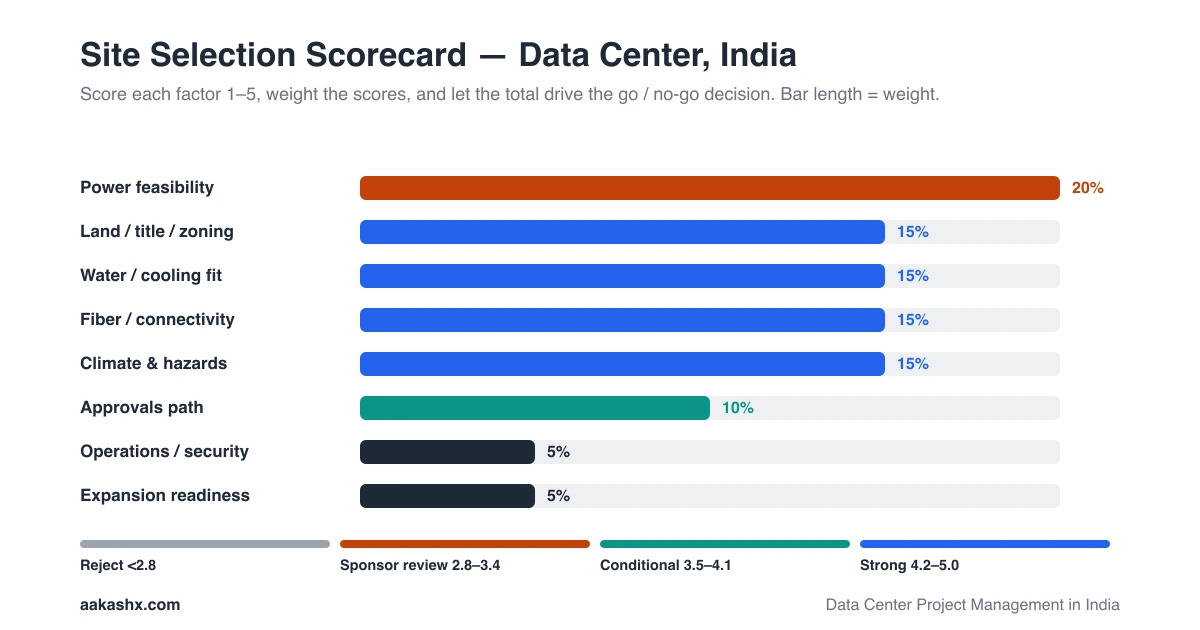
Original asset — Data Center Site Selection Scorecard. Score each factor from 1 to 5, then weight the scores.
| Category | Weight | What to check | Score |
|---|---|---|---|
| Land/title/zoning | 15% | title clarity, zoning fit, conversion needs, encumbrances, usable area | 1–5 |
| Power feasibility | 20% | DISCOM feasibility, substation proximity, load path, redundancy, fuel logistics | 1–5 |
| Water/cooling fit | 15% | water source, cooling strategy fit, ambient heat, water permissions, wastewater | 1–5 |
| Fiber/connectivity | 15% | carrier availability, route diversity, last-mile risk, meet-me-room feasibility | 1–5 |
| Climate and hazards | 15% | flood, heat, seismic, soil, coastal, industrial, road disruption risk | 1–5 |
| Approvals path | 10% | approval inventory, authority map, fire/building/power path, state policy fit | 1–5 |
| Operations/security | 5% | access control, emergency response, staffing, maintenance logistics | 1–5 |
| Expansion readiness | 5% | future land, future power, future cooling, phased build feasibility | 1–5 |
Suggested scoring rule
| Total weighted score | Decision |
|---|---|
| 4.2–5.0 | Strong candidate; proceed to deeper diligence |
| 3.5–4.1 | Conditional candidate; resolve red flags before commitment |
| 2.8–3.4 | High-risk candidate; sponsor review required |
| Below 2.8 | Reject unless strategic reason is overwhelming |
Site gate evidence pack
Before approving a site, collect:
- legal title memo,
- zoning and land-use note,
- power feasibility note,
- water-source note,
- cooling concept fit note,
- fiber route map,
- flood and drainage memo,
- seismic/geotechnical note,
- approval tracker,
- state policy eligibility note,
- expansion layout,
- site risk register.
Common mistakes in data center site selection
1. Choosing cheap land before testing power
Cheap land is not cheap if grid connection becomes the critical path. Power feasibility should be one of the first filters, not a later engineering task.
2. Confusing state policy with site readiness
A state incentive can support the business case. It does not prove land title, grid capacity, water availability, fiber diversity, or fire approval readiness.
3. Accepting fiber diversity on paper
Two providers do not guarantee two physical paths. Validate ducts, roads, entry points, and common failure zones.
4. Treating flood risk as a civil-engineering detail
Flood risk affects electrical rooms, fuel systems, emergency access, insurance, uptime, and operating continuity. It should be part of the site gate.
5. Ignoring water until cooling design
Water, cooling, and power must be evaluated together. A cooling strategy that depends on uncertain water availability creates operating risk.
6. Not involving operations early
The operations team should review access, security, maintainability, emergency response, spares movement, staffing, monitoring, and incident handling before site approval.
7. Leaving expansion as a future problem
Expansion is cheapest to reserve during site selection. Later expansion can be blocked by land limits, grid limits, water limits, or physical layout.
Frequently Asked Questions About Data Center Site Selection in India
What is the most important factor in data center site selection in India?
Power feasibility is usually one of the most important factors because it affects design, cost, timeline, redundancy, commissioning, and operations. But it should not be evaluated alone; the site must also work for water, cooling, fiber, approvals, climate risk, and expansion.
Is cheap land a good reason to choose a data center site?
No. Cheap land can become expensive if it has poor grid access, weak fiber, flood risk, title issues, approval delays, water constraints, or no expansion path. Project-ready land is usually more valuable than cheap land.
How should fiber connectivity be checked?
Fiber should be checked through carrier availability and physical route validation. The team should verify whether routes are genuinely diverse or whether different providers share the same duct, bridge, road crossing, or last-mile corridor.
Why does water matter in data center site selection?
Water matters because many cooling strategies depend on reliable water availability, water permissions, and wastewater handling. If water assumptions are weak, the cooling design and operating model may become risky.
Should state data center incentives drive site selection?
State incentives should influence the business case, but they should not override site feasibility. A site still needs clear land, feasible power, usable water, fiber diversity, approval clarity, and manageable climate risk.
What climate risks should be checked before selecting a site?
At minimum, check flood exposure, heat stress, seismic risk, drainage, coastal inundation where relevant, soil movement, and emergency access during extreme weather. These risks affect uptime, insurance, structural design, cooling, and operations.
When should the operations team be involved?
The operations team should be involved before site finalization. They should review maintainability, security, access, emergency response, staffing, spares movement, monitoring, and handover implications.
What should be included in a data center site selection report?
The report should include site maps, title and zoning notes, power feasibility, water-source review, cooling fit, fiber route validation, climate and hazard assessment, approval tracker, expansion plan, risk register, and a scorecard-based recommendation.
Key Takeaways
- Data center site selection in India should be treated as a formal project gate, not a real-estate shortlist.
- The strongest site is not the cheapest; it is the one with validated land, power, water, fiber, approvals, climate resilience, security, and expansion readiness.
- Power feasibility should be tested early because it can dominate the project's critical path.
- Water and cooling assumptions must be reviewed before land commitment.
- Fiber diversity must be physically validated, not accepted only as a provider claim.
- Climate risks such as heat, flooding, and seismic exposure are site-selection issues, not late-stage design details.
- State incentives matter, but execution readiness matters more.
This article is part of AakashX's Data Center Project Management in India field manual. Start with the master guide, Project Managing a Data Center Setup in India, then continue to Power Planning for Data Centers in India. Before committing to land, use the site selection scorecard above and force every site assumption into evidence.
Track every task above with the Data Center Site Selection Scorecard — India, an interactive, Excel-ready CSV tracker with dependencies, accountable roles and completion evidence.
References
- CEEW — How Is Data Centre Infrastructure in India Shaping Power and Water Use? — siting, climate risk, power, water, state policy, and approval challenges.
- TIA — ANSI/TIA-942 Standard — physical infrastructure scope including site location, architecture, electrical, mechanical, fire safety, telecom, and security.
- Uptime Institute — Tier Certification — certification scope and Tier classification context.
- NDMA — Urban Floods — India-specific urban flood-risk context.
- Press Information Bureau (Ministry of Jal Shakti) — groundwater regulation and CGWA/SGWA roles.
Part of the series
Data Center Project Management in India- 1.Project Managing a Data Center Setup in India: From Feasibility to Operations Handover
- 2.Data Center Site Selection in India: Land, Power, Water, Fiber, Climate, and Risk← you are here
- 3.Power Planning for Data Centers in India: Grid, Redundancy, DG Backup, Renewables, and Critical Path Risk
- 4.Cooling and Water Planning for Indian Data Centers: Design Choices, Water Risk, and Operating Tradeoffs
- 5.Data Center Approvals in India: A Project Manager's Checklist for Land, Power, Fire, Building, Environment, and Telecom
- 6.Data Center Project Governance: How to Run Workstreams, Vendors, Risks, Decisions, and Escalations
- 7.Data Center Procurement Strategy: How to Package Vendors, Track Long-Lead Equipment, and Avoid Commissioning Risk
- 8.Data Center Testing and Commissioning: IST, Load Banks, Failure Scenarios, and Handover Readiness
- 9.Data Center Certification Planning: Tier III, Tier IV, TIA-942, Design Reviews, and Commissioning Evidence
- 10.Data Center Operations Handover: SOPs, Staffing, Monitoring, Maintenance, Security, and Incident Readiness

Aakash Ahuja
Enterprise AI, Cybersecurity & Platform Engineering
Aakash writes about secure AI agents, microservices architecture, enterprise platforms, and production engineering. He has 20+ years of experience building and operating software systems across banking, cloud, cybersecurity, AI, and enterprise workflow automation. He is Director of Technology at itmtb Technologies and teaches AI, Big Data, and Reinforcement Learning at top institutes in India.