
Data Center Certification Planning: Tier III, Tier IV, TIA-942, Design Reviews, and Commissioning Evidence
Data center certification planning should not start after construction is complete. By then, the project may have already locked design decisions, vendor packages, equipment substitutions, commissioning scripts, operating procedures, and documentation habits that do not support the intended certification path.
The practical question is not "Should we get Tier III, Tier IV, or TIA-942?" The real project question is: "Which certification target matches the business need, and what design, construction, commissioning, vendor, and operations evidence must be controlled from the beginning?"
This is the certification-planning article in AakashX's Data Center Project Management in India series. It builds directly on project governance and testing and commissioning, within the pillar guide.
Table of Contents
- What is the practical answer for data center certification planning?
- Why should certification intent be decided early?
- What is the difference between certification, commissioning, and handover?
- What should teams know about Tier III and Tier IV?
- How should teams think about Uptime Tier vs TIA-942?
- What evidence is needed for design review?
- What evidence is needed for constructed facility validation?
- What operating evidence is needed before handover?
- What usually fails in data center certification planning?
- Data Center Certification Evidence Tracker
- FAQ
- Key Takeaways
What is the practical answer for data center certification planning?
Data center certification planning means deciding the target certification path early, translating it into design requirements, assigning evidence ownership, aligning vendor documentation, shaping commissioning scripts, and preparing operations for audit and handover.
Certification should be managed as a project workstream. It should not be treated as a label to be pursued after the facility is built.
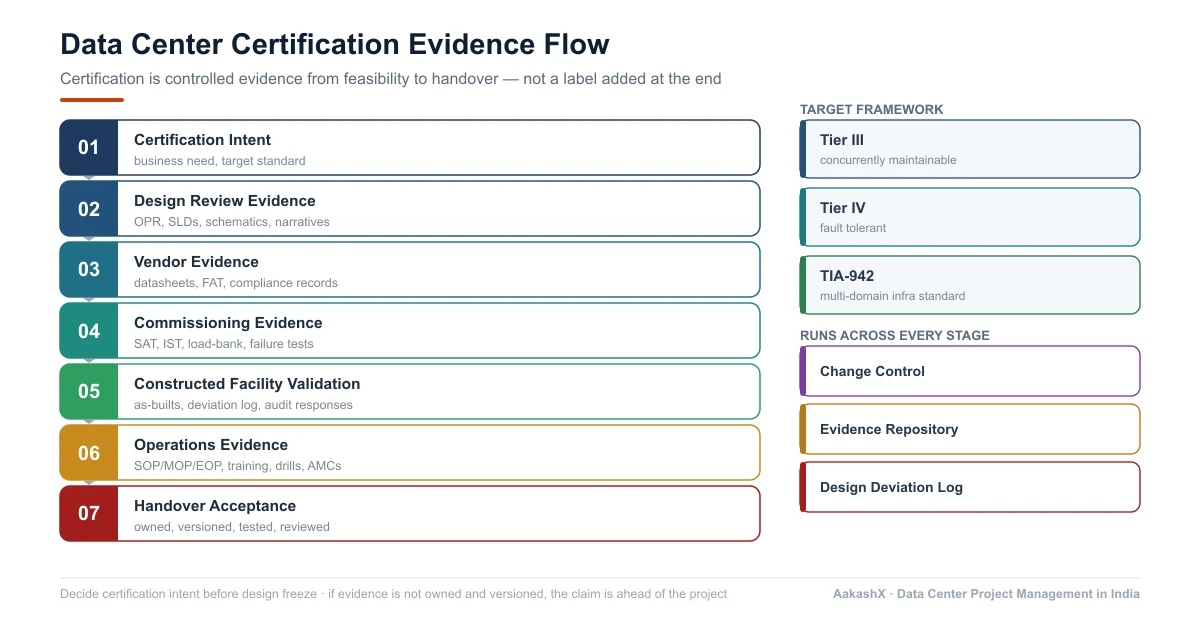
Snippet-ready answer: Data center certification planning should define the target standard, design intent, evidence requirements, vendor deliverables, commissioning records, operations procedures, and audit-readiness gates before design freeze and procurement release.
Why should certification intent be decided early?
Certification intent should be decided early because it affects architecture, redundancy, equipment selection, physical separation, maintainability, commissioning, documentation, vendor scope, and operations.
A late certification decision can create expensive rework.
| Late certification decision | Possible impact |
|---|---|
| Higher resilience target chosen after design | redesign of power, cooling, pathways, space, and redundancy |
| Certification body engaged late | missing design evidence and audit trail |
| Vendor documents not specified | missing FAT/SAT, compliance, and commissioning records |
| Equipment substitution approved casually | certification conformance risk |
| Commissioning scripts written without certification intent | weak evidence for constructed facility validation |
| Operations not involved early | weak MOP/EOP/SOP and maintenance evidence |
| Design and as-built mismatch | audit and handover risk |
The PMO should ask this question at feasibility:
Are we building to an internal resilience target, a customer requirement, a certification target, or a marketing claim?
Those are not the same thing.
What is the difference between certification, commissioning, and handover?
Certification, commissioning, and handover are connected, but they are not the same.
| Concept | Meaning | Output |
|---|---|---|
| Commissioning | Proves systems work as designed, individually and together | test records, issue closure, readiness evidence |
| Certification | Validates against a defined external standard or framework | certification report/certificate where achieved |
| Handover | Transfers operating responsibility to the operations team | SOPs, MOPs, EOPs, training, spares, AMCs, monitoring access |
Commissioning vs certification
Commissioning proves that the facility works according to project requirements. Certification evaluates the facility against the selected framework or standard.
A facility can be commissioned but not certified. A facility can also have design-level certification but still need constructed-facility validation and operational readiness. The evidence generated during testing and commissioning is what feeds the certification audit.
Certification vs handover
Certification does not replace handover. Operations still needs documentation, staffing, monitoring, spares, preventive maintenance, emergency procedures, escalation paths, and training.
The cleanest sequence is:
Certification Intent
  -> Design Requirements
  -> Design Review Evidence
  -> Procurement and Vendor Evidence
  -> Construction Quality Evidence
  -> Commissioning Evidence
  -> Constructed Facility Validation
  -> Operations Readiness Evidence
  -> Handover Acceptance
What should teams know about Tier III and Tier IV?
Tier III and Tier IV are often discussed casually. That is risky.
At a project level, Tier III is associated with concurrent maintainability, and Tier IV adds fault tolerance. The exact design implications must be reviewed with the certification body and specialist consultants.
Tier III: concurrent maintainability
Concurrent maintainability means planned maintenance can be performed on capacity components and distribution paths without disrupting IT operations, assuming the facility is designed and operated to that standard.
Project implications may include maintainable power paths, maintainable cooling paths, planned maintenance procedures, physical access for maintenance, bypass arrangements, redundancy in critical systems, a clear isolation strategy, and commissioning tests that prove maintenance scenarios.
Tier IV: fault tolerance
Fault tolerance means the facility is designed so that an individual equipment failure or distribution path interruption should not affect IT operations, subject to the standard's requirements and the actual certified design.
Project implications may include stronger separation, more complex power and cooling topology, higher capital cost, more space, more commissioning complexity, more operational discipline, and stronger monitoring and response procedures.
Tier III vs Tier IV
| Decision factor | Tier III planning implication | Tier IV planning implication |
|---|---|---|
| Design goal | maintainability without planned downtime | tolerate individual failure events |
| Complexity | high | higher |
| Capex impact | material | higher |
| Space impact | material | higher |
| Commissioning burden | strong | stronger |
| Operations discipline | required | stricter |
| Good fit when | business needs maintainability and resilience | business requires stronger fault tolerance |
How should teams think about Uptime Tier vs TIA-942?
Uptime Tier and TIA-942 are different certification frameworks. Do not treat them as interchangeable labels.
Uptime Tier
The Uptime Institute Tier framework focuses on infrastructure topology, availability, and operational sustainability through defined certification pathways such as design documents, constructed facility, and operational sustainability.
Use it when the project's main certification question is resilience, maintainability, fault tolerance, and operational alignment against the Tier framework.
TIA-942
ANSI/TIA-942 is a data center infrastructure standard. It covers physical infrastructure areas including site location, architecture, electrical, mechanical, fire safety, telecommunications, security, and other requirements. TIA also notes that TIA-942 Design Certification is valid for one year and Facilities Certification for three years, with surveillance audits before year one and year two and recertification by year three — so certification is an ongoing commitment, not a one-time event.
Use it when the project wants a broad infrastructure-standard approach covering multiple physical domains.
Uptime Tier vs TIA-942
| Factor | Uptime Tier | TIA-942 |
|---|---|---|
| Main orientation | availability / topology / operational sustainability | physical data center infrastructure standard |
| Common language | Tier I–IV | Rated levels / design and facility certification |
| Scope emphasis | power/cooling topology and operational sustainability | site, architecture, electrical, mechanical, telecom, fire, security |
| Project concern | resilience and maintainability evidence | multi-domain infrastructure conformance |
| Planning need | early design and operations alignment | broad design, build, and audit evidence |
What evidence is needed for design review?
Design review evidence should be collected before procurement and construction decisions become hard to reverse.
Design evidence checklist
| Evidence | Why it matters |
|---|---|
| certification target | defines evaluation path |
| owner's project requirements | aligns business and technical intent |
| design basis report | explains load, redundancy, cooling, site, and operations assumptions |
| single-line diagrams | shows electrical topology |
| mechanical schematics | shows cooling topology |
| architectural drawings | shows space, access, separation, fire, security |
| telecom/network design | shows carrier, meet-me-room, pathway, diversity |
| fire/life-safety strategy | shows detection, suppression, access, exits |
| BMS/DCIM/EPMS strategy | shows monitoring and operations visibility |
| redundancy narrative | explains N, N+1, 2N, or other assumptions |
| maintainability narrative | shows how planned maintenance will be performed |
| failure-mode assumptions | shows expected behavior during failures |
| approval alignment | shows authority and code dependencies |
| certification gap log | captures open design gaps |
What evidence is needed for constructed facility validation?
Constructed facility validation needs proof that the facility was built according to the certified or reviewed design intent.
The project should collect approved-for-construction drawings, as-built drawings, a deviation log, change-control records, vendor submittals, material approval records, equipment datasheets, factory test records, site test records, installation certificates, inspection records, commissioning scripts, integrated systems testing records, load-bank test reports, failure scenario results, snag and closure records, BMS/DCIM point validation, fire-system test evidence, network route and testing evidence, security system test evidence, photo evidence where useful, and auditor observation responses.
Design intent vs as-built reality
A certification risk appears when design intent and as-built reality diverge.
| Design intent | As-built risk |
|---|---|
| physically diverse paths | cables or pipes routed through common point |
| maintainable components | access blocked by layout or equipment placement |
| redundant cooling | controls create hidden common failure mode |
| fire separation | unsealed penetrations or late civil changes |
| network diversity | carriers share physical last-mile path |
| operations monitoring | alarms missing or incorrectly mapped |
What operating evidence is needed before handover?
Operations evidence matters because certification and reliability are not only about design. A well-designed facility can still be operated poorly.
The operations team should prepare a staffing model, shift coverage plan, roles and responsibilities, SOPs, MOPs, EOPs, a preventive maintenance plan, a vendor AMC matrix, a spare parts list, an escalation matrix, an incident response process, access control procedures, a change-control procedure, monitoring dashboards, alarm response runbooks, a drill schedule, training records, an asset register, a maintenance calendar, a compliance calendar, and an audit evidence repository.
MOP, SOP, and EOP
| Document | Meaning | Example |
|---|---|---|
| SOP | Standard Operating Procedure | routine monitoring, access process, shift handover |
| MOP | Method of Procedure | planned maintenance on UPS, chiller, generator |
| EOP | Emergency Operating Procedure | utility failure, cooling failure, fire alarm, security incident |
What usually fails in data center certification planning?
1. Certification is discussed after procurement
By then, equipment selection, topology, physical routing, and vendor documents may already be locked.
2. Design certification is confused with facility certification
A design review does not prove that the facility was built and commissioned exactly as required.
3. Teams use "Tier III-like" language
Loose phrases such as "Tier III compliant" or "Tier IV ready" can create buyer and audit confusion. Use precise language and verify claims with the certification body.
4. Vendor evidence is not contractually required
If FAT, SAT, datasheets, compliance records, test scripts, and commissioning support are not included in vendor scope, evidence collection becomes difficult.
5. Commissioning does not align with certification
Commissioning scripts should generate evidence for certification and handover. If scripts are generic, important failure scenarios may remain unproven.
6. Changes are approved without certification impact review
A seemingly small change in routing, equipment, access, controls, or vendor selection can affect certification evidence.
7. Operations is treated as a post-handover issue
Operations procedures, maintenance methods, staffing, training, escalation, monitoring, and drills should be prepared before handover.
8. Evidence is scattered
Certification planning fails when evidence lives in vendor emails, consultant folders, site chat groups, and disconnected PDFs. A central evidence tracker is mandatory.
Data Center Certification Evidence Tracker
Use this tracker from feasibility onward.
A. Certification decision gate
| Question | Decision / evidence |
|---|---|
| What certification path is being pursued? | Uptime / TIA-942 / internal / other |
| What level/rating is targeted? | define clearly |
| Why is certification needed? | customer, investor, internal, commercial, risk |
| Who is the certification body or advisor? | named party |
| Who owns evidence tracking? | named owner |
| What is the budget impact? | approved estimate |
| What is the schedule impact? | integrated into master plan |
| What claims can be made publicly? | legal/commercial review |
B. Design evidence tracker
| Evidence item | Owner | Status | Certification impact |
|---|---|---|---|
| owner's project requirements | sponsor/PMO | pending | high |
| design basis report | owner's engineer | pending | high |
| electrical SLDs | electrical consultant | pending | high |
| mechanical schematics | MEP consultant | pending | high |
| architectural drawings | architect | pending | high |
| fire strategy | fire consultant | pending | high |
| telecom/network design | network lead | pending | medium/high |
| security design | security consultant | pending | medium/high |
| maintainability narrative | owner's engineer | pending | high |
| failure-mode narrative | commissioning agency | pending | high |
C. Construction and commissioning evidence tracker
| Evidence item | Owner | Status | Certification impact |
|---|---|---|---|
| as-built drawings | EPC / consultants | pending | high |
| change-control log | PMO | pending | high |
| deviation log | PMO / owner's engineer | pending | high |
| FAT records | vendors | pending | medium/high |
| SAT records | vendors | pending | medium/high |
| IST records | commissioning agency | pending | high |
| load-bank test reports | commissioning agency | pending | high |
| failure scenario reports | commissioning agency | pending | high |
| BMS/DCIM validation | BMS/DCIM team | pending | high |
| fire system test evidence | fire contractor | pending | high |
| snag closure records | PMO / contractors | pending | high |
D. Operations evidence tracker
| Evidence item | Owner | Status | Certification / handover impact |
|---|---|---|---|
| SOPs | operations | pending | high |
| MOPs | operations / vendors | pending | high |
| EOPs | operations | pending | high |
| staffing model | operations | pending | high |
| training records | operations / vendors | pending | medium/high |
| AMC matrix | procurement / operations | pending | medium/high |
| spares list | operations / vendors | pending | medium/high |
| escalation matrix | operations | pending | high |
| monitoring dashboards | BMS/DCIM team | pending | high |
| drill records | operations | pending | high |
Frequently Asked Questions About Data Center Certification Planning
What is data center certification planning?
Data center certification planning is the process of choosing the certification target and managing the design, construction, commissioning, vendor, and operations evidence needed to support it. It should start during feasibility and design, not after construction.
What is the difference between Tier III and Tier IV?
At a project level, Tier III is associated with concurrent maintainability, while Tier IV adds fault tolerance. The detailed implications depend on the selected certification framework, design, and certifying body review.
Is commissioning the same as certification?
No. Commissioning tests whether the facility performs according to project requirements. Certification validates the facility against a selected external framework or standard.
What is the difference between design certification and facility certification?
Design certification reviews whether the design meets the selected standard or framework. Facility certification validates whether the constructed facility matches the required design and performance expectations.
What is TIA-942 certification?
TIA-942 certification validates a data center against the ANSI/TIA-942 data center infrastructure standard. The standard covers multiple physical infrastructure domains, including architecture, electrical, mechanical, telecommunications, fire safety, security, and site-related requirements.
When should the certification body be engaged?
The certification body or certification advisor should be engaged before design freeze. Early engagement helps prevent design, procurement, commissioning, and documentation decisions from drifting away from the certification target.
Can a data center claim Tier III or Tier IV without certification?
Teams should be careful with public claims. Phrases such as "Tier III-like" or "Tier IV ready" can be misleading unless the scope, standard, and certification status are clear. Legal, commercial, and certification-body review should govern external claims.
What is the biggest certification planning mistake?
The biggest mistake is treating certification as an end-stage audit. Certification affects design, procurement, construction, commissioning, operations, documentation, and public claims from the beginning.
Key Takeaways
- Data center certification planning should begin before design freeze and procurement release.
- Certification, commissioning, and handover are related but different.
- Tier III, Tier IV, and TIA-942 should not be used as loose marketing labels.
- Design certification does not automatically prove the constructed facility or operations model.
- Vendor evidence, commissioning scripts, change control, and as-built documentation must support the certification path.
- Operations evidence such as SOPs, MOPs, EOPs, staffing, training, AMCs, spares, and drills should be prepared before handover.
- A certification evidence tracker should be active from feasibility through handover.
References
- Uptime Institute — Tier Classification System — Tier III concurrent maintainability and Tier IV fault tolerance topology.
- Uptime Institute — Tier Certification: Operational Sustainability — design-document, constructed-facility, and operational-sustainability certification phases.
- Uptime Institute — Tier Certification — Tier Standards consider both the built environment and the operations team's approach.
- ANSI/TIA-942 Standard (TIA) — physical infrastructure requirements across site, architecture, electrical, mechanical, fire safety, telecom, and security.
- TIA-942 Certifications & Ratings (TIA) — design and facility certification validity, surveillance audits, and recertification cycle.
Part of the series
Data Center Project Management in India- 1.Project Managing a Data Center Setup in India: From Feasibility to Operations Handover
- 2.Data Center Site Selection in India: Land, Power, Water, Fiber, Climate, and Risk
- 3.Power Planning for Data Centers in India: Grid, Redundancy, DG Backup, Renewables, and Critical Path Risk
- 4.Cooling and Water Planning for Indian Data Centers: Design Choices, Water Risk, and Operating Tradeoffs
- 5.Data Center Approvals in India: A Project Manager's Checklist for Land, Power, Fire, Building, Environment, and Telecom
- 6.Data Center Project Governance: How to Run Workstreams, Vendors, Risks, Decisions, and Escalations
- 7.Data Center Procurement Strategy: How to Package Vendors, Track Long-Lead Equipment, and Avoid Commissioning Risk
- 8.Data Center Testing and Commissioning: IST, Load Banks, Failure Scenarios, and Handover Readiness
- 9.Data Center Certification Planning: Tier III, Tier IV, TIA-942, Design Reviews, and Commissioning Evidence← you are here
- 10.Data Center Operations Handover: SOPs, Staffing, Monitoring, Maintenance, Security, and Incident Readiness

Aakash Ahuja
Enterprise AI, Cybersecurity & Platform Engineering
Aakash writes about secure AI agents, microservices architecture, enterprise platforms, and production engineering. He has 20+ years of experience building and operating software systems across banking, cloud, cybersecurity, AI, and enterprise workflow automation. He is Director of Technology at itmtb Technologies and teaches AI, Big Data, and Reinforcement Learning at top institutes in India.