
Cooling and Water Planning for Indian Data Centers: Design Choices, Water Risk, and Operating Tradeoffs
Cooling and water planning for Indian data centers should not start after the MEP consultant begins detailed design. Cooling choices affect site selection, power planning, water dependency, approvals, equipment layout, operating cost, sustainability posture, commissioning, and long-term reliability.
The practical question is not "which cooling technology is best?" The real question is: "Which cooling strategy can support the intended IT load, rack density, site climate, water availability, redundancy target, approval path, and operations team over the life of the facility?"
This is the fourth article in AakashX's Data Center Project Management in India series, building on the site selection gate and the power planning workstream from the pillar guide.
Table of Contents
- What is the practical answer for cooling and water planning?
- Why do cooling and water decisions become project risks in India?
- What should be known before choosing a cooling strategy?
- What are the main cooling options for Indian data centers?
- How should teams compare air cooling, chilled water, evaporative cooling, and liquid cooling?
- What is the difference between PUE and WUE?
- How should water availability and permissions be validated?
- How should redundancy and maintainability be planned?
- What usually fails in cooling and water planning?
- Data Center Cooling and Water Decision Matrix
- FAQ
- Key Takeaways
What is the practical answer for cooling and water planning?
Cooling and water planning means converting the IT load, rack density, site climate, redundancy target, and operations model into a cooling strategy that can be built, approved, commissioned, maintained, and operated reliably.
For Indian data centers, this must be treated as a project-management workstream, not only as a mechanical-design decision. The project team should evaluate ambient temperature, water availability, water permissions, cooling technology, power impact, redundancy, maintainability, monitoring, sustainability expectations, and future rack density before freezing site or design decisions.
Snippet-ready answer: Cooling and water planning for Indian data centers should evaluate IT load, rack density, climate, water source, cooling technology, power impact, redundancy, approvals, WUE, PUE, maintainability, and commissioning evidence before design freeze.
Why do cooling and water decisions become project risks in India?
Cooling and water decisions become project risks because they are tied to three constraints at once: climate, power, and water.
A cooling strategy that looks efficient on paper may be weak if the site has unreliable water, high summer temperatures, poor maintainability, limited space, or difficult approvals. A site that works for one cooling method may not work for another.
India-specific data center planning must account for high ambient temperatures in many regions, heat-wave exposure, monsoon and humidity variation, water stress in several urban and industrial clusters, groundwater permissions, municipal water reliability, power cost and grid stress, sustainability expectations, higher rack densities from AI and compute-intensive workloads, and local approval variation.
CEEW's 2026 India data center analysis highlights that decisions on siting, power sourcing, and cooling technologies will shape India's long-term land, energy, and water footprint. It also reports that data centers accounted for around 0.5% of national electricity consumption and approximately 150 billion litres of annual water use, with both expected to more than double by 2030. Use those figures carefully: they describe national-level resource context, not the consumption profile of any single facility. (CEEW)
The project implication:
A cooling strategy is not approved until the water, power, site, approval, and operations assumptions behind it are approved.
This is why cooling planning connects directly back to data center site selection in India and power planning for data centers in India.
What should be known before choosing a cooling strategy?
Before comparing cooling technologies, the project team needs a reliable design basis.
1. IT load and rack density
Cooling follows IT load. A low-density enterprise DR site and a high-density AI compute facility may require very different cooling approaches.
Define day-one IT load, full-build IT load, average rack density, peak rack density, future high-density zones, redundancy target, heat rejection requirement, and the phased expansion plan.
Do not size the cooling strategy only for average rack density. Hot spots and high-density rows often drive design risk.
2. Site climate
Cooling strategy depends on the local climate. Assess peak summer temperature, wet-bulb temperature, humidity, dust, air quality, monsoon conditions, heat-wave exposure, water stress, and flood and drainage risk.
The same design choice may behave differently in Mumbai, Chennai, Hyderabad, Noida, Pune, Bengaluru, or an industrial park in a semi-arid region.
3. Water source
Before selecting a water-dependent cooling strategy, identify the water source: municipal water, industrial water, treated wastewater, groundwater, private tanker supply, on-site storage, or hybrid arrangements. Each source has reliability, quality, permission, cost, and reputational implications.
4. Redundancy and maintainability
Cooling failure can become IT outage risk. The design should answer what cooling redundancy is required, whether equipment can be maintained without disrupting critical load, whether there are common points of failure, whether physically separate paths exist where needed, whether the operations team has the skill to run the system, and whether spares and vendor support are available.
5. Sustainability and reporting expectations
Customers, investors, regulators, and enterprise boards increasingly ask for energy and water visibility. Even when no formal reporting requirement applies, the project should define what it will measure.
Track at minimum energy use, water use, PUE, WUE, cooling uptime, alarm incidents, maintenance events, water-source dependency, and cooling capacity utilization.
What are the main cooling options for Indian data centers?
The right cooling option depends on facility size, rack density, site climate, water availability, redundancy target, operating model, and budget.
Air cooling
Air cooling removes heat by moving conditioned air through server rooms, racks, rows, or containment zones. Common patterns include room-based cooling, row-based cooling, hot aisle containment, cold aisle containment, CRAC/CRAH (computer room air conditioner / air handler) units, DX-based systems, and chilled-water air handlers.
Air cooling is familiar and widely used, but it may become harder for very high rack densities unless airflow management, containment, and supplemental cooling are strong.
Chilled water cooling
Chilled water systems use chillers and chilled water loops to remove heat through air handlers or cooling units. They can support larger facilities and efficient centralized cooling, but they add mechanical complexity, water treatment needs, pumps, controls, maintenance requirements, and redundancy planning.
Chilled water design must be coordinated with chiller plant layout, cooling towers or dry coolers, water treatment, pump redundancy, pipe routing, leak detection, maintenance bypass, BMS integration, and commissioning scripts.
Evaporative cooling
Evaporative cooling uses water evaporation to remove heat. It can reduce energy use in suitable climates, but it increases water dependency.
For Indian sites, evaporative cooling must be evaluated carefully against water availability, water quality, humidity, water permissions, treatment requirements, scaling and corrosion risk, seasonal performance, WUE impact, and operational capability. It may be useful in some contexts and risky in others. Do not select it only because it looks energy-efficient.
Liquid cooling
Liquid cooling removes heat closer to the chip, server, rack, or immersion environment. It is becoming more relevant as AI, GPU, and high-density compute loads increase.
Liquid cooling can reduce airflow constraints and support higher density, but it introduces design and operations questions: which workloads need it, direct-to-chip or immersion, facility water loop compatibility, leak detection, serviceability, vendor ecosystem, rack-level integration, emergency procedures, staff training, and the warranty and support model.
For many enterprise projects, liquid cooling may start as a high-density zone rather than an all-facility strategy.
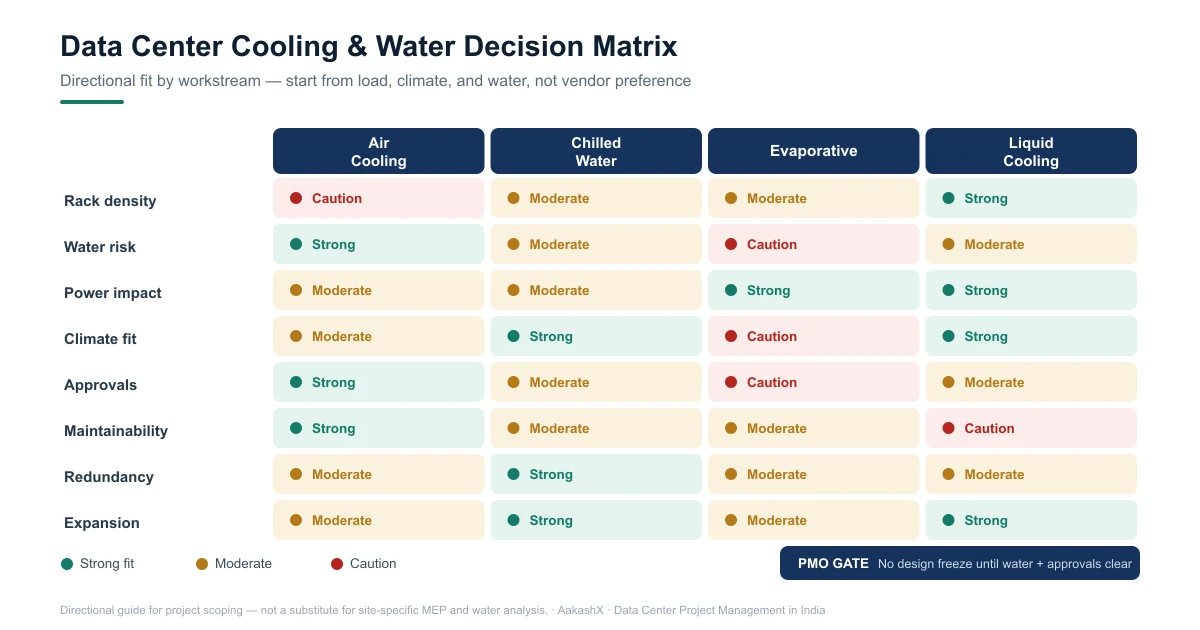
How should teams compare air cooling, chilled water, evaporative cooling, and liquid cooling?
Use a decision matrix instead of vendor preference.
| Cooling approach | Good fit when | Main risks |
|---|---|---|
| Air cooling | moderate rack densities, familiar operations, simpler deployment | airflow leakage, hot spots, limits at high density |
| Chilled water | larger facilities, centralized cooling, scalable design | water treatment, mechanical complexity, maintenance |
| Evaporative cooling | site climate and water source support it | water dependency, humidity, permissions, treatment |
| Liquid cooling | high-density AI/GPU workloads, rack-density pressure | skills, vendor maturity, leak/service procedures, integration |
| Hybrid cooling | mixed workloads and phased density growth | operational complexity and design coordination |
What is the difference between PUE and WUE?
PUE and WUE measure different resource questions.
PUE
Power Usage Effectiveness (PUE) is a data center energy-efficiency metric. At a simplified level, it compares total facility energy to IT equipment energy. PUE helps teams understand how much energy is being used beyond the IT load, including cooling and facility systems.
WUE
Water Usage Effectiveness (WUE) is a metric proposed by The Green Grid to address water use in data centers. It complements energy metrics such as PUE because water use can become a significant design, location, and operations issue.
WUE is important because a cooling strategy can reduce energy use while increasing water dependency. A project that optimizes only PUE may miss water risk.
PUE vs WUE
| Metric | Main question | Risk if used alone |
|---|---|---|
| PUE | How efficiently does the facility use energy? | May ignore water intensity |
| WUE | How much water does the facility use relative to IT energy? | May ignore total energy or reliability |
| Both together | What is the energy-water tradeoff? | Still needs uptime, cost, approvals, and maintainability review |
How should water availability and permissions be validated?
Water availability should be validated before design freeze. Do not treat "water available" as a yes/no answer. The team needs to know the source, permission, volume, quality, reliability, storage, treatment, discharge path, and backup arrangement.
Water-source validation checklist
Check the source type, legal right to use, permitted quantity, seasonal reliability, water quality, treatment requirement, storage requirement, tanker dependency, wastewater handling, discharge permission, drought restrictions, groundwater NOC requirement, and expansion availability.
If groundwater is part of the plan, the Central Ground Water Authority (CGWA) and state groundwater authority rules must be checked. The CGWA NOC portal points to consolidated guidelines for regulating and controlling groundwater extraction, including amendments. CGWA regulates groundwater extraction in specified jurisdictions, while state groundwater authorities regulate in others.
Water quality matters
Cooling systems are sensitive to water quality. Poor water quality can create scaling, corrosion, biological growth, equipment damage, and maintenance risk.
The project should ask for water test reports, treatment design, blowdown management, a water-treatment vendor plan, monitoring frequency, spare chemicals and consumables, and clear operating responsibility.
Avoid invisible tanker dependency
Tanker water can look like a backup plan, but it creates risks: cost volatility, availability issues during drought, traffic and site-access dependency, water-quality variation, operational uncertainty, and reputational concerns. Tanker dependency should be visible in the risk register.
How should redundancy and maintainability be planned?
Cooling redundancy should match the business availability target.
If the facility needs concurrent maintainability, cooling equipment, pumps, power feeds, controls, piping, and maintenance paths need to support that intent. The Uptime Institute Tier framework distinguishes design documentation, constructed facility validation, and operational sustainability, which is useful even for projects that do not formally pursue certification.
Redundancy is more than extra equipment
The project team should check the redundancy target (N, N+1, 2N, or other), chiller redundancy, pump redundancy, CRAH/CRAC redundancy, cooling tower / dry cooler redundancy, pipe route redundancy, valve isolation, control system redundancy, make-up water redundancy, power feed redundancy, maintenance bypass, spare parts, and vendor support.
Maintainability should be tested during design
Ask whether one unit can be isolated without overheating critical zones, whether filters, pumps, valves, sensors, and control components can be serviced safely, whether high-density racks are still protected during maintenance, whether alarms are mapped to operations procedures, whether spares are available locally, whether the MOPs (methods of procedure) are written before handover, and whether the operations team has reviewed the design.
A cooling system that is efficient but hard to operate is still a project risk.
What usually fails in cooling and water planning?
1. Cooling is selected before rack density is clear
If the IT load and rack-density profile are unclear, the cooling strategy becomes guesswork. This creates risk for AI/GPU zones, future expansion, and commissioning.
2. Water dependency is hidden inside efficiency claims
A design may reduce energy consumption while increasing water use. The project should compare PUE and WUE together.
3. Site climate is generalized
India is not one climate profile. Peak temperature, humidity, dust, heat waves, monsoon, and water stress differ by region.
4. Groundwater assumptions are not validated
Groundwater use may require NOC and must be checked under CGWA or state groundwater authority rules. Do not assume borewell access is a guaranteed operating source.
5. Operations team is involved too late
The operations team must review maintainability, spares, alarms, MOPs, emergency response, and vendor support before design freeze.
6. Commissioning scripts are written too late
Cooling commissioning should include load simulation, failure scenarios, pump/chiller sequencing, alarm validation, BMS/DCIM checks, and high-temperature response procedures.
7. Sustainability is treated as branding
Energy and water metrics should be designed into monitoring. Do not claim sustainability without measurement.
Use the operational Excel-ready tracker
The article explains the decisions and failure modes. The downloadable Data Center Cooling and Water Planning Checklist — India turns them into assignable work packages with dependencies, accountable roles, blank start and end dates, completion evidence, status and stage-gate impact.
Open the interactive tracker and download the CSV →
Data Center Cooling and Water Decision Matrix
Use this matrix before site approval, design freeze, and procurement release.
| Decision factor | Questions to ask | Evidence required |
|---|---|---|
| IT load | What is day-one, phase-two, and full-build load? | Load basis document |
| Rack density | What are average and peak rack densities? | Rack-density plan |
| High-density zones | Are AI/GPU zones expected? | High-density zone map |
| Climate | What are peak temperature, humidity, dust, and monsoon conditions? | Climate-risk memo |
| Water source | What source will support the design? | Water-source note |
| Water permission | Is NOC or local permission needed? | Legal/regulatory note |
| Water quality | Is treatment required? | Water test and treatment plan |
| Cooling technology | Which cooling approach fits the site and load? | Technology comparison |
| Power impact | What is the cooling impact on facility load? | MEP load model |
| PUE | What energy-efficiency target is realistic? | PUE basis |
| WUE | What water-use profile is acceptable? | WUE basis |
| Redundancy | What redundancy target is required? | Redundancy narrative |
| Maintainability | Can equipment be serviced without operational disruption? | Maintainability review |
| Monitoring | What will BMS/DCIM track? | Monitoring point list |
| Commissioning | How will cooling performance be proven? | Test scripts |
| Operations | Can the team run and maintain the system? | Ops readiness review |
Suggested scoring rule
Score each candidate strategy from 1 to 5 across site climate fit, water risk, power impact, rack-density fit, redundancy fit, maintainability, approval complexity, operational skill requirement, and expansion readiness.
Reject any strategy with a severe water-source, approval, or maintainability risk unless the sponsor explicitly accepts it in the risk register.
Frequently Asked Questions About Cooling and Water Planning for Indian Data Centers
What is the first step in data center cooling planning?
The first step is defining the IT load and rack-density profile. Cooling cannot be planned properly until the team understands day-one load, full-build load, peak rack density, redundancy target, and future high-density zones.
Why does water matter in data center cooling?
Water matters because many cooling strategies depend on reliable water availability, water quality, treatment, storage, and permissions. A cooling system can be energy-efficient but still create water-risk exposure.
What is WUE in a data center?
WUE, or Water Usage Effectiveness, is a metric used to understand water use in data center operations. It helps teams evaluate water dependency alongside energy metrics such as PUE.
Is liquid cooling required for every data center?
No. Liquid cooling is most relevant where rack density, AI/GPU workloads, or chip-level heat loads exceed what conventional air cooling can handle efficiently. Many facilities may use hybrid approaches rather than full liquid cooling.
What is the difference between air cooling and chilled water cooling?
Air cooling moves conditioned air to remove server heat, often through room, row, or containment strategies. Chilled water cooling uses chilled water loops and cooling equipment to remove heat, often in larger or more centralized systems.
Should evaporative cooling be used in India?
Evaporative cooling can be useful in suitable climates, but it increases water dependency. It should be evaluated against water availability, humidity, water quality, permissions, WUE impact, and operating capability.
When should groundwater permissions be checked?
Groundwater permissions should be checked during site selection and before design freeze. If the cooling concept depends on groundwater, NOC requirements and local authority rules must be validated early.
What should be included in cooling commissioning?
Cooling commissioning should include equipment tests, control sequencing, BMS/DCIM alarm checks, load simulation, failure scenarios, pump/chiller sequencing, high-temperature response, and documented issue closure.
Key Takeaways
- Cooling and water planning should start during site selection, not after detailed MEP design begins.
- Cooling decisions affect power, water, approvals, layout, commissioning, operations, and sustainability.
- PUE and WUE should be reviewed together because energy-efficient cooling can still create water risk.
- India-specific planning must account for heat, humidity, monsoon, dust, water stress, and local permissions.
- Liquid cooling should be evaluated where rack density and AI/GPU workloads justify it, not adopted as a trend.
- Groundwater, tanker water, and municipal water assumptions should be converted into evidence.
- The operations team should review maintainability before design freeze.
Track every task above with the Data Center Cooling and Water Planning Checklist — India, an interactive, Excel-ready CSV tracker with dependencies, accountable roles and completion evidence.
References
- CEEW — How Is Data Centre Infrastructure in India Shaping Power and Water Use? — energy, water, siting, cooling technologies, and climate-risk implications.
- The Green Grid — Water Usage Effectiveness (WUE) — the WUE metric introduced to address data center water use alongside PUE.
- ASHRAE TC 9.9 — Thermal Guidelines for Data Processing Environments — temperature, thermal design, and data-processing environment considerations.
- Central Ground Water Authority (CGWA) — NOC Guidelines — groundwater extraction regulation and NOC requirements.
- Uptime Institute — Tier Certification — redundancy, maintainability, constructed-facility validation, and operational sustainability framing.
Part of the series
Data Center Project Management in India- 1.Project Managing a Data Center Setup in India: From Feasibility to Operations Handover
- 2.Data Center Site Selection in India: Land, Power, Water, Fiber, Climate, and Risk
- 3.Power Planning for Data Centers in India: Grid, Redundancy, DG Backup, Renewables, and Critical Path Risk
- 4.Cooling and Water Planning for Indian Data Centers: Design Choices, Water Risk, and Operating Tradeoffs← you are here
- 5.Data Center Approvals in India: A Project Manager's Checklist for Land, Power, Fire, Building, Environment, and Telecom
- 6.Data Center Project Governance: How to Run Workstreams, Vendors, Risks, Decisions, and Escalations
- 7.Data Center Procurement Strategy: How to Package Vendors, Track Long-Lead Equipment, and Avoid Commissioning Risk
- 8.Data Center Testing and Commissioning: IST, Load Banks, Failure Scenarios, and Handover Readiness
- 9.Data Center Certification Planning: Tier III, Tier IV, TIA-942, Design Reviews, and Commissioning Evidence
- 10.Data Center Operations Handover: SOPs, Staffing, Monitoring, Maintenance, Security, and Incident Readiness

Aakash Ahuja
Enterprise AI, Cybersecurity & Platform Engineering
Aakash writes about secure AI agents, microservices architecture, enterprise platforms, and production engineering. He has 20+ years of experience building and operating software systems across banking, cloud, cybersecurity, AI, and enterprise workflow automation. He is Director of Technology at itmtb Technologies and teaches AI, Big Data, and Reinforcement Learning at top institutes in India.