
Data Center Approvals in India: A Project Manager's Checklist for Land, Power, Fire, Building, Environment, and Telecom
Data center approvals in India should not be managed as paperwork after design is complete. Approvals are a critical-path workstream because land use, building plan approval, fire NOC, power connection, DG backup, fuel storage, water, environmental permissions, and telecom right-of-way can directly affect site selection, design freeze, procurement, commissioning, and go-live.
The practical mistake is to create an approval list without creating an approval dependency map. A project manager needs to know who owns each approval, which authority is involved, which documents are needed, what design decisions affect the approval, what the evidence will look like, and which milestone is blocked if approval slips.
This is the fifth article in AakashX's Data Center Project Management in India series, building on the site selection gate, the power planning workstream, and cooling and water planning from the pillar guide.
Table of Contents
- What is the practical answer for data center approvals in India?
- Why do approvals become a critical-path risk?
- What makes data center approvals in India location-specific?
- Which land, zoning, and building approvals should be mapped?
- How should fire NOC and life-safety approvals be handled?
- Which power, DG, fuel, and electrical approvals affect the project?
- Which water, sewerage, groundwater, and environmental approvals may apply?
- How should telecom and fiber right-of-way be planned?
- How should state incentives and single-window systems be used?
- What usually fails in data center approval management?
- Data Center Approvals Tracker Template
- FAQ
- Key Takeaways
What is the practical answer for data center approvals in India?
Data center approvals in India should be managed as an integrated approval tracker covering land, zoning, building plan, fire NOC, power connection, electrical safety, DG backup, fuel storage, water, groundwater, sewerage, environmental and pollution permissions, telecom right-of-way, labour and safety registrations, local municipal permissions, and state incentive applications.
The exact approval list varies by state, city, land type, facility size, power architecture, water source, cooling design, DG capacity, fuel system, telecom layout, and operating model. Treat this article as a project-management framework, not legal advice.
Snippet-ready answer: Data center approvals in India are not a single permit. They are a set of land, building, fire, power, environmental, water, telecom, safety, and local-authority approvals that must be tracked as project dependencies from feasibility to handover.
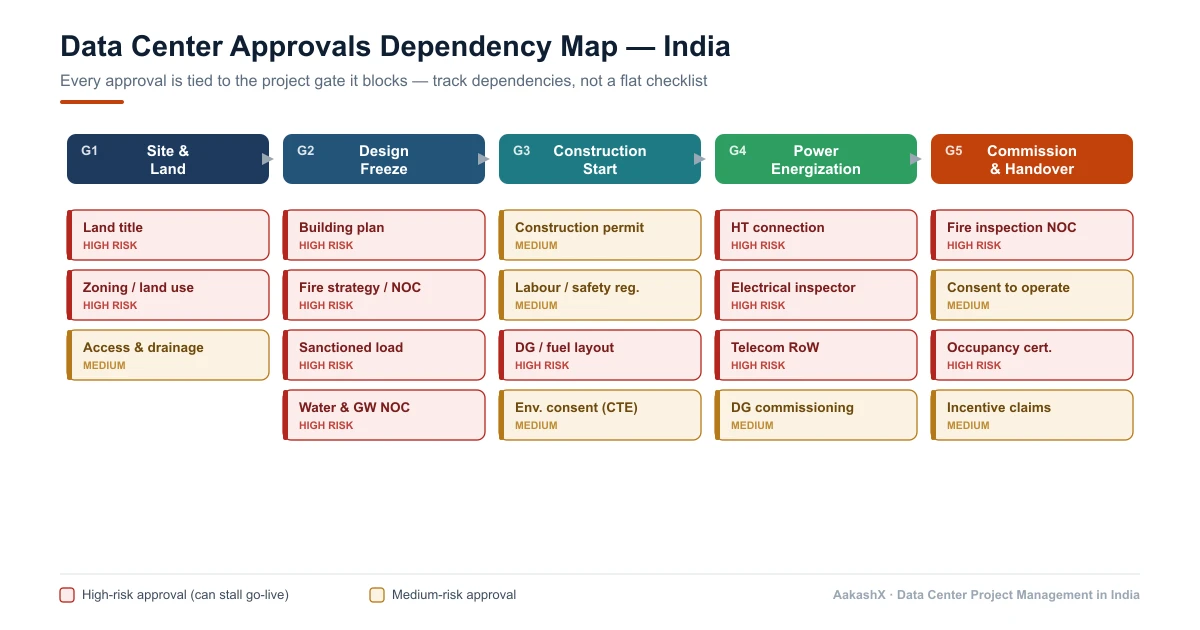
Why do approvals become a critical-path risk?
Approvals become a critical-path risk because they are tied to design, site, power, construction, commissioning, and operations.
| Approval dependency | What it can block |
|---|---|
| Land use / zoning | site commitment, building plan, financing, construction start |
| Building plan approval | civil construction start |
| Fire NOC / fire approval | occupancy, commissioning, go-live, insurance confidence |
| Power connection / sanctioned load | energization, testing, commissioning |
| DG / fuel permissions | backup power readiness |
| Water / groundwater / sewerage | cooling design and operations |
| Pollution / environment approvals | construction, DG, wastewater, operation |
| Telecom right-of-way | fiber availability and network readiness |
| Labour / safety registrations | construction and operational compliance |
| State incentive approvals | business case, financial assumptions, policy benefits |
The project-management rule is simple:
If an approval can block construction, energization, commissioning, occupancy, or operations, it belongs on the critical path.
What makes data center approvals in India location-specific?
Data center approval requirements in India are location-specific because land, buildings, fire services, electricity distribution, water, local municipal matters, and industrial permissions are often handled through state, local, or utility-specific processes.
MeitY's Draft Data Centre Policy 2020 proposed several enabling ideas, including Data Centre Parks, single-window clearances, published approval lists, pre-provisioned clearances in data centre parks, quality power, renewable energy, and robust connectivity. (MeitY Draft Data Centre Policy 2020)
That policy direction matters. But project teams should not confuse policy intent with approval completion.
A data center PMO should distinguish four things:
| Concept | Meaning | Project risk |
|---|---|---|
| Policy incentive | A state or central benefit that may apply | May not remove local approvals |
| Single-window system | A portal or facilitation mechanism | Does not automatically eliminate authority-level review |
| Approval granted | Formal approval / NOC issued | May still have conditions |
| Compliance maintained | Ongoing adherence after approval | Requires operations discipline |
Which land, zoning, and building approvals should be mapped?
Land and building approvals should be mapped before the site is treated as final.
The project team should validate:
- land title,
- encumbrances,
- permitted land use,
- zoning classification,
- land conversion requirement,
- industrial or commercial use permission,
- layout approval,
- building plan approval,
- height and setback conditions,
- access road conditions,
- stormwater and drainage requirements,
- occupancy or completion certificate requirements.
Land approval checklist
| Item | Why it matters |
|---|---|
| Title diligence | Prevents ownership and litigation risk |
| Zoning / permitted use | Confirms whether a data center use is allowed |
| Land conversion | May be needed if current land use does not fit |
| Building plan approval | Controls construction start and compliance |
| Access road status | Affects heavy equipment, emergency access, and operations |
| Drainage and stormwater | Affects flood and civil design risk |
| Completion / occupancy conditions | Affects handover and go-live |
How should fire NOC and life-safety approvals be handled?
Fire approval should start during concept design, not after construction.
Data centers have electrical rooms, UPS and battery systems, generators, fuel systems, cable trays, server halls, cooling equipment, security zones, and restricted access areas. Fire and life-safety planning therefore has to be integrated with architecture, MEP, power, security, and operations.
The National Building Code fire and life-safety material covers fire prevention, life safety, and fire protection requirements for buildings. (National Building Code of India — Part 4 Fire and Life Safety) Exact fire NOC process and enforcement vary by state and local fire authority, so the local fire consultant should be involved early.
Fire approval should review
- occupancy classification,
- fire access road,
- fire tender movement,
- fire water tanks,
- hydrants,
- sprinklers,
- detection and alarm systems,
- clean-agent or suitable suppression system where applicable,
- battery room safety,
- generator and fuel areas,
- emergency exits,
- compartmentation,
- cable penetration sealing,
- smoke management,
- fire command center where applicable,
- emergency lighting and signage,
- evacuation procedures,
- fire system testing and maintenance.
Fire NOC as a project gate
Do not treat fire NOC as a late-stage inspection item. Track it through:
- concept fire strategy,
- fire consultant appointment,
- fire drawings,
- authority consultation,
- submission,
- inspection,
- observations,
- closure,
- NOC,
- renewal or periodic compliance, where applicable.
Which power, DG, fuel, and electrical approvals affect the project?
The power workstream can contain several approval dependencies.
Depending on state, utility, capacity, and design, the project may need to manage:
- sanctioned load application,
- HT connection approval,
- substation or feeder work,
- right-of-way for electrical line or cable,
- transformer and switchgear approvals or inspections,
- electrical inspector approval,
- metering approval,
- energization permission,
- DG installation permissions,
- fuel storage permissions,
- fire approval for DG and fuel areas,
- emissions and noise compliance,
- open access approvals if applicable.
The Central Pollution Control Board maintains genset notification material covering generator-set emission and noise requirements and certified equipment references. DG backup should therefore be treated as both a power-readiness dependency and a compliance dependency.
Power approval tracker
| Dependency | Owner | Evidence |
|---|---|---|
| Sanctioned load | electrical consultant / DISCOM liaison | application, correspondence, sanction letter |
| HT connection | electrical consultant | technical terms, approved drawings, connection process |
| Electrical inspector | licensed contractor / consultant | inspection records, approval |
| Substation / feeder | DISCOM / STU / owner | scope, timeline, right-of-way note |
| DG installation | MEP / electrical vendor | approved specs, site layout, compliance records |
| Fuel storage | safety / fire consultant | permission, layout, safety compliance |
| Open access | energy consultant | application, approvals, agreements |
Which water, sewerage, groundwater, and environmental approvals may apply?
Water and environmental approvals depend on the site, cooling method, water source, wastewater discharge, DG backup, fuel storage, and local regulatory classification.
The approval tracker may need to cover:
- municipal water connection,
- industrial water permission,
- groundwater NOC,
- treated wastewater supply arrangement,
- water storage permission where applicable,
- sewerage connection,
- wastewater discharge permission,
- consent to establish and consent to operate where applicable,
- DG emissions and noise compliance,
- hazardous waste or battery waste handling,
- fuel storage and spill control,
- stormwater drainage approval.
Cooling and water planning should therefore be linked to approvals from the start: cooling and water planning for Indian data centers.
Water and environment approval checklist
| Question | Why it matters |
|---|---|
| What is the water source? | Determines permission path |
| Is groundwater involved? | May trigger NOC requirements |
| Is treated wastewater used? | Requires supply and quality validation |
| Where does wastewater go? | Determines discharge / sewerage approvals |
| Does DG backup trigger pollution or noise compliance? | Affects equipment, layout, and approvals |
| Is fuel storage present? | Affects fire, safety, spill control |
| Are batteries used? | Affects disposal and safety requirements |
How should telecom and fiber right-of-way be planned?
Telecom approval risk is often underestimated because project teams assume fiber is commercially available.
For a data center, the PMO should distinguish:
- carrier availability,
- physical route diversity,
- right-of-way permissions,
- duct access,
- road-cutting permissions,
- building entry path,
- meet-me-room readiness,
- last-mile security,
- restoration responsibility.
For project management, the key issue is not only legal permission. It is physical readiness.
Telecom and fiber tracker
| Item | Evidence required |
|---|---|
| Carrier shortlist | commercial proposals |
| Route map | physical route drawings |
| Diversity validation | confirmation of separate paths |
| RoW requirement | authority and filing requirement |
| Road-cutting permissions | local approval records |
| Building entry | approved entry plan |
| Meet-me-room | layout and access control plan |
| Testing | OTDR / test reports and handover records |
How should state incentives and single-window systems be used?
State incentives and single-window systems are useful, but they should not replace approval governance.
Use them for approval discovery, application filing, policy eligibility, incentive claims, escalation visibility, and document management.
Do not use them as a reason to weaken the PMO tracker.
CEEW notes that state policies are a major driver of data center investments and capacity build-out in India, but also reports implementation delays around practical approvals. (CEEW)
A project team should create a separate state incentive tracker covering:
- eligibility criteria,
- minimum investment condition,
- employment condition, if any,
- power tariff or duty benefit,
- stamp duty or land benefit,
- capital subsidy, if any,
- renewable power benefit,
- application timeline,
- documents required,
- approval conditions,
- compliance obligations after approval.
What usually fails in data center approval management?
1. The team creates an approval list but not a dependency map
An approval list says what is needed. A dependency map says what gets blocked if approval slips.
2. Fire review starts too late
Fire strategy affects layout, access roads, electrical rooms, battery areas, DG yards, fuel systems, suppression, exits, and commissioning. Late fire observations can force redesign.
3. Power approval is treated as a utility follow-up
Sanctioned load, HT connection, feeder path, substation readiness, inspection, and energization can become project blockers. These should be reviewed weekly.
4. Land-use assumptions are accepted too early
A site is not ready just because land is available. Permitted use, zoning, conversion, access, and building approval must be validated.
5. DG and fuel are treated as procurement items
DG backup creates compliance dependencies around emissions, noise, fuel storage, fire safety, acoustic treatment, exhaust, testing, and maintenance.
6. Telecom right-of-way is ignored until network buildout
If road-cutting, duct access, or right-of-way permissions are delayed, network readiness can slip even after the building is complete.
7. State incentives are assumed before eligibility is proven
An incentive is not real for the project until eligibility, application, approval conditions, and compliance obligations are clear.
8. Approval evidence is not stored centrally
Emails, meeting notes, consultant updates, portal screenshots, NOCs, drawing approvals, and inspection observations should be stored in a central approval evidence repository.
Use the operational Excel-ready tracker
The article explains the decisions and failure modes. The downloadable Data Center Approvals Tracker — India turns them into assignable work packages with dependencies, accountable roles, blank start and end dates, completion evidence, status and stage-gate impact.
Open the interactive tracker and download the CSV →
Data Center Approvals Tracker Template
Use this tracker from feasibility onward.
| Approval area | Possible approval / NOC | Authority / stakeholder | Owner | Dependency | Evidence | Status | Risk |
|---|---|---|---|---|---|---|---|
| Land | title diligence | local counsel / land authority | legal | site commitment | title memo | pending | high |
| Land use | zoning / conversion | local / state authority | legal / real estate | building plan | approval note | pending | high |
| Building | building plan approval | municipal / local authority | architect | construction start | approved drawings | pending | high |
| Fire | fire NOC / fire approval | fire authority | fire consultant | construction / go-live | NOC, inspection report | pending | high |
| Power | sanctioned load | DISCOM | electrical consultant | design / procurement | sanction letter | pending | high |
| Electrical | HT connection / inspector approval | DISCOM / electrical inspector | electrical consultant | energization | approval / inspection | pending | high |
| DG | generator compliance | CPCB / state pollution / fire / safety | MEP / vendor | backup readiness | compliance documents | pending | medium-high |
| Fuel | fuel storage permission | fire / safety / local authority | safety consultant | DG operation | approval / NOC | pending | high |
| Water | municipal / industrial water | local authority | utilities lead | cooling operation | connection / permission | pending | high |
| Groundwater | groundwater NOC | CGWA / state authority where applicable | water consultant | cooling operation | NOC | pending | high |
| Sewerage | discharge / sewerage | municipal / pollution authority | civil / MEP | operations | approval | pending | medium |
| Environment | consent / clearance where applicable | SPCB / MoEFCC / local authority | environment consultant | construction / operation | CTO / CTE / approval | pending | medium-high |
| Telecom | fiber RoW / road cutting | local authority / carrier | telecom lead | network readiness | permission, route map | pending | high |
| Labour/safety | construction labour / safety registrations | labour / safety authority | EPC / admin | construction | registration | pending | medium |
| Incentives | state data center incentive application | state nodal agency | finance / legal | business case | application / approval | pending | medium |
Approval tracker operating rhythm
Review the tracker weekly during feasibility, site selection, design, and construction.
Each approval should have:
- named owner,
- authority,
- document list,
- submission date,
- expected evidence,
- dependency,
- risk rating,
- escalation path,
- latest status,
- next action.
Approval dependency sequence
Site Shortlist
  -> Land / Zoning / Access Validation
  -> Concept Design
  -> Building Plan + Fire Strategy + Power Application
  -> Detailed Design
  -> Construction Permissions + Utility Coordination
  -> Power Energization + Fire Inspection + Telecom RoW
  -> Testing and Commissioning
  -> Occupancy / Operations Readiness / Handover
Frequently Asked Questions About Data Center Approvals in India
What approvals are needed for a data center in India?
Data center approvals in India may include land-use approval, building plan approval, fire NOC, power connection, electrical inspector approval, DG and fuel permissions, water and sewerage permissions, groundwater NOC where applicable, pollution and environment approvals, telecom right-of-way, and state incentive applications. The exact list depends on state, city, land type, design, water source, power architecture, and operating model.
Is there a single approval for setting up a data center in India?
No. A data center usually requires multiple approvals from different authorities, utilities, and local bodies. A single-window system may help identify and apply for approvals, but it does not remove the need for project-level approval tracking.
When should fire NOC planning start?
Fire NOC planning should start during concept design. Fire access, electrical rooms, UPS and battery areas, DG yards, fuel storage, cable routes, suppression systems, exits, and emergency procedures can all affect design.
Who should own the data center approval tracker?
The PMO should own the tracker, but each approval should have a named functional owner. Legal, real estate, architect, MEP consultant, electrical consultant, fire consultant, environmental consultant, telecom lead, EPC contractor, and finance may each own different approval items.
Are state data center incentives automatic?
No. State incentives usually depend on eligibility conditions, application procedures, investment thresholds, compliance requirements, and approval by the relevant authority. They should be tracked separately and not assumed in the business case until validated.
Do data centers need environmental approvals?
They may, depending on site, size, DG backup, fuel storage, water use, wastewater discharge, construction activity, and state pollution-control requirements. Validate this with an environmental consultant and the relevant pollution-control authority.
Why are telecom right-of-way approvals important?
A data center needs reliable and diverse fiber connectivity. If right-of-way, road-cutting, duct access, or building-entry permissions are delayed, network readiness can slip even if the facility construction is complete.
What is the biggest approval-management mistake?
The biggest mistake is treating approvals as a checklist instead of a dependency system. Each approval should be tied to the milestone it can block, the owner responsible, the evidence required, and the escalation path.
Key Takeaways
- Data center approvals in India must be managed as a critical-path PMO workstream, not as paperwork.
- The approval list varies by state, city, land type, design, water source, power model, DG and fuel system, and telecom route.
- Fire NOC, power approval, building approval, water permissions, and telecom right-of-way can directly affect go-live.
- Single-window systems are useful, but they do not replace a project-specific approval tracker.
- DG backup creates compliance dependencies around emissions, noise, fuel storage, fire safety, and maintenance.
- State incentives should be tracked separately from statutory approvals.
- Every approval should have an owner, authority, document list, dependency, evidence type, status, risk rating, and escalation path.
Track every task above with the Data Center Approvals Tracker — India, an interactive, Excel-ready CSV tracker with dependencies, accountable roles and completion evidence.
References
- CEEW — How Is Data Centre Infrastructure in India Shaping Power and Water Use? — practical delays around land acquisition, building approvals, grid connectivity, and fire safety clearances, plus the role of state policy.
- MeitY — Draft Data Centre Policy 2020 — policy direction on single-window clearances, data centre parks, power, renewable energy, and connectivity.
- National Single Window System (NSWS) — official portal for identifying and applying for regulatory approvals.
- Central Electricity Authority — Safety and Electric Supply Regulations, 2023 — national electrical-safety reference for supply, inspection, and energization.
- National Building Code of India — Part 4 Fire and Life Safety — fire prevention, life safety, and fire protection requirements.
- Indian Telegraph Right of Way Rules, 2016 — telecom infrastructure right-of-way framework.
- Central Pollution Control Board — generator-set emissions and noise compliance material.
Part of the series
Data Center Project Management in India- 1.Project Managing a Data Center Setup in India: From Feasibility to Operations Handover
- 2.Data Center Site Selection in India: Land, Power, Water, Fiber, Climate, and Risk
- 3.Power Planning for Data Centers in India: Grid, Redundancy, DG Backup, Renewables, and Critical Path Risk
- 4.Cooling and Water Planning for Indian Data Centers: Design Choices, Water Risk, and Operating Tradeoffs
- 5.Data Center Approvals in India: A Project Manager's Checklist for Land, Power, Fire, Building, Environment, and Telecom← you are here
- 6.Data Center Project Governance: How to Run Workstreams, Vendors, Risks, Decisions, and Escalations
- 7.Data Center Procurement Strategy: How to Package Vendors, Track Long-Lead Equipment, and Avoid Commissioning Risk
- 8.Data Center Testing and Commissioning: IST, Load Banks, Failure Scenarios, and Handover Readiness
- 9.Data Center Certification Planning: Tier III, Tier IV, TIA-942, Design Reviews, and Commissioning Evidence
- 10.Data Center Operations Handover: SOPs, Staffing, Monitoring, Maintenance, Security, and Incident Readiness

Aakash Ahuja
Enterprise AI, Cybersecurity & Platform Engineering
Aakash writes about secure AI agents, microservices architecture, enterprise platforms, and production engineering. He has 20+ years of experience building and operating software systems across banking, cloud, cybersecurity, AI, and enterprise workflow automation. He is Director of Technology at itmtb Technologies and teaches AI, Big Data, and Reinforcement Learning at top institutes in India.