
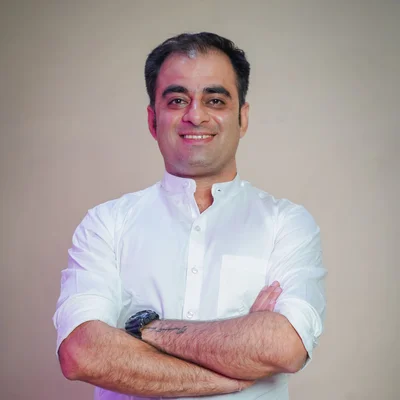
I'm Aakash Ahuja. For over 20 years I've built technology at global scale — and, just as often, owned what happens after it ships: the architecture, the delivery, the customer on the other side of the table, and the 2 a.m. call when something's on fire. (Translation: I've broken things at scale, then fixed them before anyone noticed. Usually.)
It started with a job ad. I was 17, flipping through The Economic Times, when I saw a listing for a software engineer in Dubai. The pay was astronomical for a small-town boy like me, and I had to know — what are these people doing, coding gold? Google wasn't an option back then, so I just kept asking around. The more I learned about engineers solving problems with nothing but a keyboard, the more it felt like sorcery: one keystroke, one spell, and the world behaves differently. I was hooked.
So even though I graduated as an Electrical Engineer from NIT Raipur, my heart had already defected to software. That defection dragged me — willingly — through banking, consulting, and global enterprises, each year arriving with a harder problem and the occasional "why did I say yes to this?" By 25 I'd designed a disaster-recovery system for a global bank, which is a polite way of saying if something blew up, I was the reason billions didn't vanish.
Somewhere along the way I learned the thing they don't teach you: past a certain level, the job stops being about the code. It becomes about holding the room when a release goes wrong, keeping a customer steady when a regulator gets involved, and making the call when everyone's looking at you and the data is still coming in. The hardest problems I've solved weren't technical — they were human problems wearing technical clothes.
Today I'm Director of Technology at itmtb Technologies, where I own technology end to end — strategy, architecture, delivery, and the customer relationships that come with them — across AI, cloud, and security. Our rule there is simple: build tech that works, scales without drama, and solves real problems, not the imaginary ones invented for slide decks. Most recently I built and shipped Orchestrik, a platform that lets enterprises put AI agents into production without having to own all the security, auditability, and compliance plumbing themselves. Along the way I've devised a few algorithms, built autonomous bots on reinforcement learning before GPT was cool, and served on government committees helping shape India's AI future — work I take as seriously as anything I've done.
What drives me is the same thing that lit me up at 17: the belief that good technology, built right, genuinely shapes a better future. (And yes, I still think it's magic. The wand just looks like a laptop now.)
These days my energy goes to the hard edge of enterprise AI — making agentic systems safe, governed, and actually production-ready — and to the messier work of turning around teams, platforms, and engagements that have stalled. The deployment write-ups from that work are published at Agents at Work. If that's the kind of thing you're wrestling with, you'll probably like what I write here.