
Project Managing a Data Center Setup in India: From Feasibility to Operations Handover
A data center setup in India should not be managed like a normal building project with servers added later. It should be managed as a multi-workstream infrastructure program where land, power, cooling, telecom, approvals, civil works, mechanical-electrical-plumbing (MEP), vendors, commissioning, and operations readiness move together.
The critical risk is not only design quality. The bigger project risk is sequencing: starting procurement before power assumptions are validated, finalizing a site before fiber and flood risk are checked, treating approvals as paperwork, or declaring construction complete before the facility is operationally ready.
This is the pillar article of AakashX's Data Center Project Management in India series — a practical field manual for planning, building, commissioning, and handing over data center infrastructure in Indian conditions.
Table of Contents
- What is the short answer for managing a data center setup in India?
- Why is a data center setup in India not just a construction project?
- What makes India-specific data center project planning different?
- What is the full data center project lifecycle?
- Which workstreams should the project manager control?
- What usually fails during data center setup projects?
- How should the project governance model work?
- What stage gates should be used before moving forward?
- How should testing, commissioning, and certification be handled?
- What should be ready before operations handover?
- Project manager's checklist for data center setup in India
- Frequently Asked Questions About Data Center Setup in India
- Key Takeaways
What is the short answer for managing a data center setup in India?
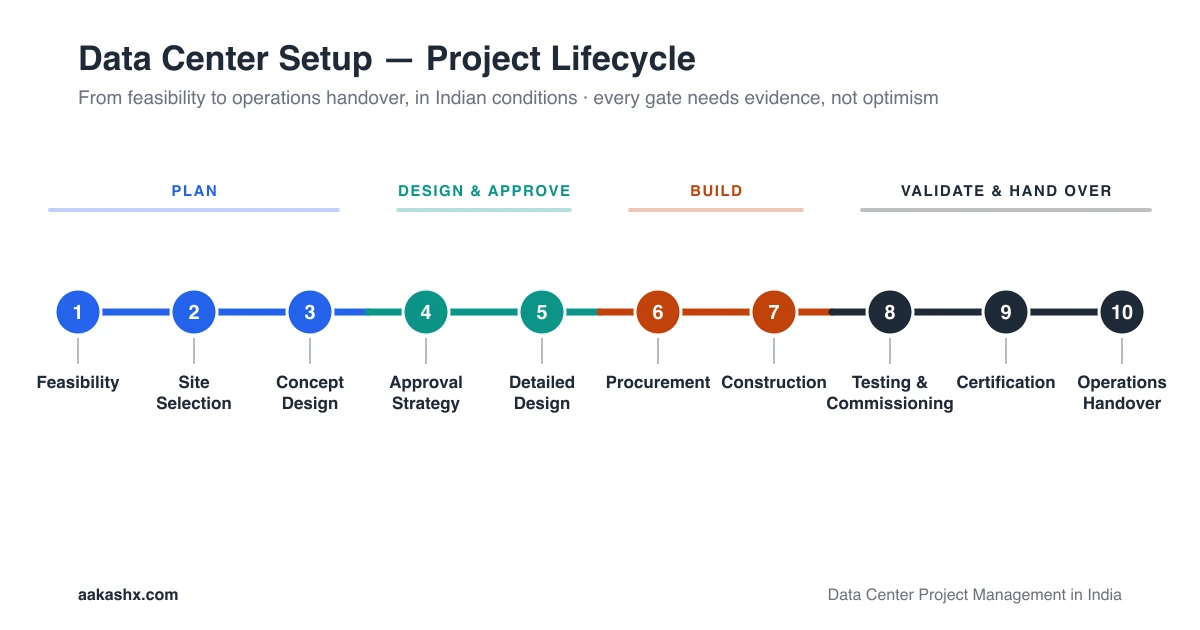
A data center setup in India should be managed through stage gates: feasibility, site selection, concept design, approvals, detailed design, procurement, construction, testing, certification, and operations handover. Each gate should have evidence before the next phase starts.
The project manager's job is not only to track timelines. The job is to control dependencies across power, land, cooling, water, telecom, civil, MEP, fire safety, security, vendors, commissioning, and operations.
Snippet-ready answer: A data center project is ready to move forward only when the next phase has evidence, not optimism: validated site assumptions, power path, cooling strategy, approval tracker, vendor responsibility map, commissioning plan, and handover checklist.
Why is a data center setup in India not just a construction project?
A normal commercial building can often tolerate phased fit-outs, late IT decisions, and operational adjustments after handover. A data center cannot be managed that way.
A data center is an availability-driven infrastructure asset. Its business value depends on power continuity, thermal stability, network reliability, access control, monitoring, maintainability, and incident response.
That means the project is really several projects running at once:
| Workstream | Why it matters |
|---|---|
| Land and site | Determines title risk, access, flood exposure, expansion capacity, and utility feasibility |
| Power | Drives critical path, redundancy, operating cost, and commissioning readiness |
| Cooling and water | Determines thermal resilience, operating economics, and sustainability exposure |
| Telecom/fiber | Determines latency, diversity, uptime, and customer suitability |
| Civil/structural | Must support load, safety, access, expansion, and MEP integration |
| MEP | Converts design intent into actual reliability |
| Fire/life safety | Can become a go-live blocker if handled late |
| Physical security | Controls access, zoning, customer confidence, and audit readiness |
| Vendors | Long-lead equipment and package boundaries can make or break timeline |
| Commissioning | Proves that systems work together, not just individually |
| Operations | Determines whether the facility can be safely run after handover |
What makes India-specific data center project planning different?
India-specific planning matters because policy intent, state-level incentives, local approvals, utility execution, climate conditions, and infrastructure readiness can vary by location.
MeitY's draft Data Centre Policy 2020 identified several enabling needs: single-window clearances, published approval lists, data center parks with land, power, high-capacity network backhaul, and pre-approved clearances. It also highlighted uninterrupted electricity, open access power procurement, renewable energy, and robust connectivity backhaul as policy focus areas.
That is the policy direction. The project reality still needs verification on the ground.
CEEW's 2026 study notes that India does not yet have a binding national policy framework for data center development, and that states have led sector policy development. The same study also reports stakeholder concerns around practical delays in land acquisition, building approvals, grid connectivity, and fire safety clearances despite single-window mechanisms. (CEEW)
This creates a simple project-management rule:
Treat every policy benefit as a hypothesis until it is converted into a named approval, a responsible authority, a defined document list, and a tracked timeline.
India-specific due diligence should include:
- land title and zoning,
- state data center policy applicability,
- DISCOM (power distribution company) load feasibility,
- substation and feeder readiness,
- open access or renewable procurement feasibility,
- water source and cooling implications,
- fire approval path,
- building plan approval path,
- fiber route diversity,
- flood, heat, seismic, and access risk.
CEEW's study also notes that stakeholders increasingly factor heat stress, flooding, and seismic risk into data center siting decisions. It reports that siting, power sourcing, and cooling decisions will shape long-term land, energy, and water impacts.
This is not legal advice. Validate with local counsel, owner's engineer, state industrial authority, DISCOM, fire consultant, and regulatory consultants before acting.
What is the full data center project lifecycle?
A data center project should be controlled through a lifecycle map. The map is not only a schedule. It is a governance tool.
Original asset — Data Center Setup Project Lifecycle Map:
Feasibility
  →
Site Selection
  →
Concept Design
  →
Approval Strategy
  →
Detailed Design
  →
Vendor Packaging and Procurement
  →
Construction and Installation
  →
Testing and Commissioning
  →
Certification / Validation
  →
Operations Handover
Lifecycle map for project managing a data center setup in India, from feasibility to operations handover. Reuse it as a project kickoff handout or a LinkedIn carousel.
Phase 1: Feasibility
Feasibility defines whether the project should exist at all.
Minimum outputs:
- business objective,
- capacity target,
- redundancy target,
- approximate power requirement,
- build vs colocation logic,
- location shortlist,
- budget envelope,
- regulatory assumptions,
- project governance model,
- high-level risk register.
Do not begin site negotiations seriously until the project sponsor knows what type of facility is being planned.
Phase 2: Site selection
Site selection should not be reduced to land cost. A cheap site with weak grid capacity, poor fiber diversity, high flood risk, or difficult approvals can become expensive later.
Minimum outputs:
- land/title diligence,
- zoning and permitted use check,
- road access,
- flood and drainage assessment,
- climate risk screen,
- water source assessment,
- grid proximity and capacity check,
- fiber path validation,
- expansion potential,
- approval path review.
This deserves a separate deep article in the Data Center Project Management in India series.
Phase 3: Concept design
Concept design converts intent into an initial technical model.
Minimum outputs:
- IT load estimate,
- rack density assumptions,
- redundancy philosophy,
- cooling concept,
- electrical single-line concept,
- space zoning,
- physical security zones,
- fire/life safety concept,
- monitoring direction across BMS (building management system) and DCIM (data center infrastructure management),
- commissioning approach.
At this stage, the project team should define the difference between what is required on day one and what must be reserved for future expansion.
Phase 4: Approval strategy
Approvals should be managed as a workstream, not as a clerical task.
Minimum outputs:
- approval inventory,
- responsible authority map,
- consultant ownership,
- document list,
- submission dates,
- dependency map,
- escalation path,
- evidence repository.
This is not legal advice. Approval requirements vary by state, municipality, land type, power arrangement, facility size, environmental context, and operating model. Validate with local counsel, owner's engineer, state industrial authority, DISCOM, fire consultant, and regulatory consultants before acting.
Phase 5: Detailed design
Detailed design is where late assumptions become expensive.
Minimum outputs:
- architectural design,
- structural design,
- electrical design,
- mechanical/cooling design,
- plumbing and water systems,
- fire detection and suppression design,
- security design,
- telecom design,
- BMS/DCIM integration plan,
- maintainability review,
- constructability review,
- commissioning scripts.
ANSI/TIA-942 is relevant here because the standard covers physical data center infrastructure including site location, architectural, electrical, mechanical, fire safety, telecom, security, monitoring, and redundancy requirements. (TIA Online)
Phase 6: Vendor packaging and procurement
Procurement is not only price negotiation. It is dependency control.
Minimum outputs:
- EPC vs multi-package decision,
- scope split,
- vendor responsibility matrix,
- long-lead equipment tracker,
- technical compliance sheet,
- delivery schedule,
- FAT/SAT requirements,
- warranty and AMC expectations,
- spares strategy,
- change-control procedure.
Long-lead equipment such as UPS systems, generators, switchgear, chillers, transformers, racks, fire systems, security systems, and monitoring platforms should be tracked as schedule-critical items.
Phase 7: Construction and installation
Construction governance must protect design intent.
Minimum outputs:
- baseline schedule,
- weekly workstream review,
- site issue log,
- design query log,
- change request log,
- safety reporting,
- quality inspection plan,
- vendor coordination tracker,
- snag register,
- as-built documentation process.
A dangerous pattern is allowing "minor" site changes without revalidating redundancy, maintainability, fire safety, cable routes, or commissioning scripts.
Phase 8: Testing and commissioning
Commissioning proves that systems work together.
Minimum outputs:
- pre-commissioning checklist,
- equipment-level tests,
- site acceptance tests,
- integrated systems testing,
- load bank testing,
- failure scenario tests,
- BMS/DCIM validation,
- fire system validation,
- security system validation,
- telecom readiness test,
- issue closure evidence.
Do not treat commissioning as a ceremony at the end. It should be planned during design.
Phase 9: Certification or validation
Certification planning should begin early if the project has a Tier or TIA-942 objective.
Uptime describes Tier III as "concurrently maintainable," where capacity components and distribution paths can be removed for planned maintenance without impacting operations. It describes Tier IV as "fault tolerant," where an individual equipment failure or distribution path interruption will not impact operations. (Uptime Institute)
The project implication is clear: Tier intent must shape design, procurement, construction, and commissioning. It cannot be added at the end.
Phase 10: Operations handover
A data center is not handed over when construction ends. It is handed over when operations can run it safely.
Minimum outputs:
- SOPs (standard operating procedures),
- MOPs (methods of procedure),
- EOPs (emergency operating procedures),
- shift staffing model,
- incident response process,
- escalation matrix,
- spares list,
- AMC contracts,
- preventive maintenance calendar,
- access control process,
- asset register,
- as-built drawings,
- commissioning evidence,
- training records,
- monitoring dashboards,
- customer onboarding process.
The handover should be evidence-based. A signed handover without operating documents is not readiness.
Which workstreams should the project manager control?
The project manager should run a multi-workstream PMO. Each workstream needs an owner, milestones, risks, decisions, dependencies, and evidence.
| Workstream | Owner candidates | Key evidence |
|---|---|---|
| Business case | Sponsor, finance, strategy | approved objective, capacity target, budget envelope |
| Site | real estate, legal, owner's engineer | title diligence, zoning, risk screen |
| Power | electrical consultant, DISCOM liaison | load feasibility, connection plan, redundancy design |
| Cooling/water | MEP consultant | cooling concept, water source, maintainability review |
| Telecom | network lead, carriers | fiber route diversity, carrier commitments |
| Approvals | regulatory consultant, local counsel | approval tracker, submission evidence |
| Civil/structural | architect, structural consultant | drawings, load validation, safety compliance |
| MEP | MEP consultant, EPC | design package, installation QA |
| Fire/life safety | fire consultant | fire design, NOC path, testing evidence |
| Security | physical security lead | access zoning, CCTV, visitor process |
| Procurement | commercial/procurement lead | vendor packages, long-lead tracker |
| Commissioning | commissioning agent | IST scripts, test evidence, issue closure |
| Operations | facility operations lead | SOP/MOP/EOP, staffing, AMC, training |
What usually fails during data center setup projects?
1. Power is assumed too early
Power availability should not be treated as a yes/no statement. The project needs clarity on sanctioned load, connection timeline, feeder/substation readiness, redundancy, power quality, backup architecture, fuel logistics, open access feasibility, and renewable procurement assumptions.
CEEW's 2026 study states that continuous, uninterrupted power is fundamental to data center operations and that servers, storage, cooling units, and network equipment must operate together to maintain operations. It also notes that server and cooling infrastructure together account for a large share of electricity consumption, though the proportion varies by facility type. (CEEW)
2. Approval dependencies are underestimated
Approvals are often discussed as a list. They should be managed as dependencies.
Building approval, fire clearance, power connection, DG/storage permissions, telecom right-of-way, water, drainage, local municipal requirements, environmental obligations, and state incentive applications may involve different authorities and timelines.
CEEW reports that stakeholders flagged slow and fragmented approvals as a material driver of project delays, particularly grid connectivity approvals, building plan sanctions, and fire NOCs.
3. Cooling is treated as an engineering choice only
Cooling affects power, water, footprint, redundancy, maintenance, sustainability exposure, and operating cost.
The project manager does not need to design the cooling system personally. But the PM must force tradeoff visibility: air cooling vs chilled water vs evaporative systems vs liquid cooling readiness, depending on load profile and site context.
CEEW highlights that siting, power sourcing, and cooling technologies will lock in land, energy, and water impacts for decades.
4. Fiber diversity is accepted on paper
A provider may show two logical paths, but the physical route may still share ducts, bridges, road crossings, or common risk points.
The PMO should demand physical route validation, not just carrier assurance.
5. Certification is treated as an end-stage activity
If the project has Tier or TIA-942 goals, certification evidence must be planned from design onward. Otherwise, value engineering, package changes, or construction deviations may compromise the intended outcome.
Uptime explicitly separates certification of design documents, constructed facility, and operational sustainability. That separation is a useful project-control model even when formal certification is not pursued. (Uptime Institute)
6. Operations handover starts too late
Operations should be involved before commissioning, not after it.
The operations team must review maintainability, monitoring, staffing, incident response, spares, vendor support, access control, SOPs, MOPs, EOPs, and customer onboarding.
How should the project governance model work?
A serious data center project needs governance at three levels.
Steering committee
Purpose: resolve strategic decisions.
Members:
- project sponsor,
- business owner,
- finance,
- real estate/facilities,
- technology/infrastructure,
- legal/compliance,
- procurement,
- operations head.
Typical decisions:
- site approval,
- budget changes,
- redundancy target,
- vendor model,
- major change requests,
- go-live readiness.
PMO / project control layer
Purpose: track execution and dependencies.
Responsibilities:
- integrated master schedule,
- risk register,
- issue log,
- decision log,
- approval tracker,
- vendor tracker,
- change-control board,
- reporting pack,
- commissioning readiness dashboard.
Workstream execution layer
Purpose: execute discipline-specific work.
Workstreams:
- land/site,
- power,
- cooling/water,
- telecom,
- civil,
- MEP,
- fire/life safety,
- physical security,
- procurement,
- construction,
- commissioning,
- operations.
The PMO should not become a meeting scheduler. It should be the place where assumptions are challenged and evidence is demanded.
What stage gates should be used before moving forward?
Use stage gates to prevent premature progress.
| Gate | Do not proceed until you have |
|---|---|
| Feasibility gate | business objective, capacity target, budget range, build/colo logic, sponsor approval |
| Site gate | title/zoning review, power feasibility, water review, flood/climate risk screen, fiber feasibility |
| Concept design gate | IT load, redundancy philosophy, cooling concept, electrical concept, space model |
| Approval gate | approval inventory, responsible authorities, document list, timeline, consultant ownership |
| Procurement gate | scope split, technical specifications, long-lead tracker, vendor evaluation criteria |
| Construction gate | issued-for-construction drawings, QA plan, safety plan, baseline schedule |
| Commissioning gate | test scripts, load bank plan, integrated systems test plan, issue closure process |
| Handover gate | SOP/MOP/EOP, staffing, monitoring, AMC, spares, as-builts, training, asset register |
How should testing, commissioning, and certification be handled?
Testing and commissioning should be planned backward from operating risk.
A sensible sequence:
- factory acceptance testing for critical equipment,
- delivery inspection,
- installation inspection,
- pre-commissioning checks,
- site acceptance testing,
- equipment-level tests,
- integrated systems testing,
- load bank testing,
- failure scenario simulation,
- monitoring and alarm validation,
- snag closure,
- operational readiness review.
Certification is separate from testing. Testing proves that systems work. Certification, where pursued, validates against a defined standard or certification framework.
TIA-942 is relevant for projects that want a broad infrastructure standard across site, architectural, electrical, mechanical, fire safety, telecom, security, monitoring, and redundancy. (TIA Online)
What should be ready before operations handover?
Operations handover should include people, process, documents, tools, vendors, and evidence.
Minimum handover pack:
| Area | Required handover evidence |
|---|---|
| Documentation | as-built drawings, O&M manuals, warranties, test certificates |
| Operations process | SOPs, MOPs, EOPs, escalation matrix |
| Staffing | shift plan, role descriptions, contact list |
| Monitoring | BMS/DCIM dashboards, alarm matrix, reporting process |
| Maintenance | preventive maintenance calendar, AMC contracts, spares list |
| Security | access control process, visitor process, CCTV coverage, audit logs |
| Incident readiness | incident playbooks, emergency drills, vendor escalation path |
| Commercial/customer readiness | customer onboarding process, SLA reporting process, capacity records |
| Compliance/audit | approval documents, commissioning evidence, training records |
Use the operational Excel-ready tracker
The article explains the decisions and failure modes. The downloadable Data Center Project Lifecycle and Stage-Gate Checklist — India turns them into assignable work packages with dependencies, accountable roles, blank start and end dates, completion evidence, status and stage-gate impact.
Open the interactive tracker and download the CSV →
Project manager's checklist for data center setup in India
Use this as the first version of the PMO checklist.
Feasibility
- Business objective defined
- Capacity target defined
- Build vs colocation decision documented
- Budget range approved
- Redundancy target defined
- Sponsor and governance structure approved
Site
- Land/title diligence initiated
- Zoning and permitted use checked
- Flood and drainage risk reviewed
- Climate risk reviewed
- Road access checked
- Expansion possibility reviewed
Power
- Load estimate prepared
- DISCOM feasibility discussed
- Grid/substation proximity checked
- Backup power concept defined
- UPS architecture direction defined
- Fuel logistics considered
- Open access or renewable assumptions validated where relevant
Cooling and water
- Cooling concept defined
- Water source reviewed
- Ambient temperature assumptions reviewed
- Maintainability checked
- Future rack density assumptions considered
Telecom
- Carrier availability checked
- Fiber diversity reviewed
- Physical route risk assessed
- Meet-me-room strategy defined where relevant
Approvals
- Approval inventory created
- Authority map created
- Consultant ownership assigned
- Fire approval path reviewed
- Building approval path reviewed
- Power approval path reviewed
- Submission evidence stored
Procurement
- Vendor packaging model decided
- Long-lead equipment tracker created
- Technical compliance matrix prepared
- FAT/SAT requirements defined
- AMC and spares expectations included
Construction
- Baseline schedule approved
- QA/QC plan approved
- Safety plan approved
- Site issue log active
- Change-control process active
- Snag register active
Commissioning
- Commissioning agent or owner assigned
- Test scripts approved
- Load bank plan approved
- Integrated systems testing planned
- Failure scenarios documented
- Snag closure tracked
Handover
- SOP/MOP/EOP prepared
- Operations team trained
- Asset register complete
- AMC contracts active
- Monitoring dashboards ready
- Incident response process tested
- As-built documentation received
Frequently Asked Questions About Data Center Setup in India
What is the first step in a data center setup in India?
The first step is feasibility, not site purchase or vendor selection. Feasibility should define the business objective, capacity target, redundancy requirement, budget range, location assumptions, power requirement, and governance model.
What is the biggest project risk in setting up a data center in India?
The biggest project risk is usually dependency mismanagement. Power, approvals, cooling, fiber, land, procurement, commissioning, and operations readiness are interconnected, and delay in one workstream can block go-live.
What approvals are needed for a data center in India?
Approvals can involve land use, building plans, fire safety, power connection, DG/storage, water, drainage, telecom/fiber right-of-way, local municipal requirements, and state incentive applications. Exact requirements vary by state, city, land type, and facility design, so they should be validated with local counsel and regulatory consultants.
When should power planning start?
Power planning should start during feasibility and site selection. A site should not be considered viable until load feasibility, grid connectivity, redundancy approach, backup architecture, and power approval path are reviewed.
Is Tier certification required for every data center?
No. Tier certification is not automatically required for every facility. But if the business case depends on a Tier objective, the target must influence design, procurement, construction, commissioning, and operations from the beginning.
What is the difference between construction completion and operations handover?
Construction completion means the physical work is substantially done. Operations handover means the facility can be safely run with trained staff, SOPs, MOPs, EOPs, monitoring, maintenance contracts, spares, incident processes, as-built documents, and commissioning evidence.
Should enterprises build their own data center or use colocation?
That depends on control requirements, capacity needs, compliance posture, latency needs, budget, operating capability, and time-to-market. Many enterprises should evaluate colocation before committing to a captive build because operating a reliable data center requires long-term facilities, power, cooling, security, and operations capability.
What should a project manager track weekly?
The weekly dashboard should track schedule, power path, approvals, design decisions, procurement, site progress, vendor dependencies, risk register, issue log, change requests, commissioning readiness, and operations handover readiness.
Key Takeaways
- A data center setup in India is a multi-workstream infrastructure program, not a normal construction project.
- The project manager must control dependencies across land, power, cooling, telecom, approvals, vendors, commissioning, and operations.
- India-specific risk sits in local execution: state policies, approvals, DISCOM processes, fire clearances, water, heat, flood risk, and fiber route validation.
- Stage gates should be evidence-based. Do not move forward only on verbal confidence.
- Commissioning and operations handover should be planned from design stage, not treated as end-stage paperwork.
- The first reusable asset for the project should be a lifecycle map supported by a risk register, approval tracker, vendor tracker, and handover checklist.
This article is the pillar of AakashX's Data Center Project Management in India series. Before starting feasibility, vendor discussions, or site shortlisting, use the lifecycle map and checklist above to identify which assumptions are still unproven — then follow the series into site selection, power planning, and approvals.
Track every task above with the Data Center Project Lifecycle and Stage-Gate Checklist — India, an interactive, Excel-ready CSV tracker with dependencies, accountable roles and completion evidence.
References
- MeitY Draft Data Centre Policy 2020 — policy focus on single-window clearances, data center parks, power, open access, renewable energy, and connectivity backhaul.
- CEEW — How Is Data Centre Infrastructure in India Shaping Power and Water Use? — India data center growth, land-energy-water issues, climate risk, approval delays, and implementation gaps.
- Uptime Institute — Tier Certification — Tier classifications, design document certification, constructed facility certification, and operational sustainability.
- TIA — ANSI/TIA-942 Standard — standard scope for data center physical infrastructure.
Part of the series
Data Center Project Management in India- 1.Project Managing a Data Center Setup in India: From Feasibility to Operations Handover← you are here
- 2.Data Center Site Selection in India: Land, Power, Water, Fiber, Climate, and Risk
- 3.Power Planning for Data Centers in India: Grid, Redundancy, DG Backup, Renewables, and Critical Path Risk
- 4.Cooling and Water Planning for Indian Data Centers: Design Choices, Water Risk, and Operating Tradeoffs
- 5.Data Center Approvals in India: A Project Manager's Checklist for Land, Power, Fire, Building, Environment, and Telecom
- 6.Data Center Project Governance: How to Run Workstreams, Vendors, Risks, Decisions, and Escalations
- 7.Data Center Procurement Strategy: How to Package Vendors, Track Long-Lead Equipment, and Avoid Commissioning Risk
- 8.Data Center Testing and Commissioning: IST, Load Banks, Failure Scenarios, and Handover Readiness
- 9.Data Center Certification Planning: Tier III, Tier IV, TIA-942, Design Reviews, and Commissioning Evidence
- 10.Data Center Operations Handover: SOPs, Staffing, Monitoring, Maintenance, Security, and Incident Readiness

Aakash Ahuja
Enterprise AI, Cybersecurity & Platform Engineering
Aakash writes about secure AI agents, microservices architecture, enterprise platforms, and production engineering. He has 20+ years of experience building and operating software systems across banking, cloud, cybersecurity, AI, and enterprise workflow automation. He is Director of Technology at itmtb Technologies and teaches AI, Big Data, and Reinforcement Learning at top institutes in India.