
Data Center Operations Handover: SOPs, Staffing, Monitoring, Maintenance, Security, and Incident Readiness
Data center operations handover should not be a document dump at the end of construction. A facility can be built, commissioned, and still be unsafe to operate if the operations team does not have procedures, staffing, monitoring access, maintenance contracts, spares, vendor escalation, security controls, incident response, and audit evidence.
The practical handover question is not "Has construction finished?" The real question is: "Can the operations team run the facility safely tomorrow morning, respond to incidents, maintain critical systems, prove compliance, and escalate failures without depending on project-team memory?"
This is the closing article in AakashX's Data Center Project Management in India series. It depends on everything before it — especially testing and commissioning, certification planning, and project governance — within the pillar guide.
Table of Contents
- What is the practical answer for data center operations handover?
- Why is handover different from construction completion?
- What should be handed over before operations accepts the facility?
- How should SOPs, MOPs, and EOPs be prepared?
- How should staffing, shift coverage, and training be validated?
- How should monitoring, BMS/DCIM, EPMS, and alarms be handed over?
- How should AMCs, spares, warranties, and vendor escalation be controlled?
- How should physical security, access control, and customer onboarding be prepared?
- How should incident response and drills be tested?
- What usually fails in data center operations handover?
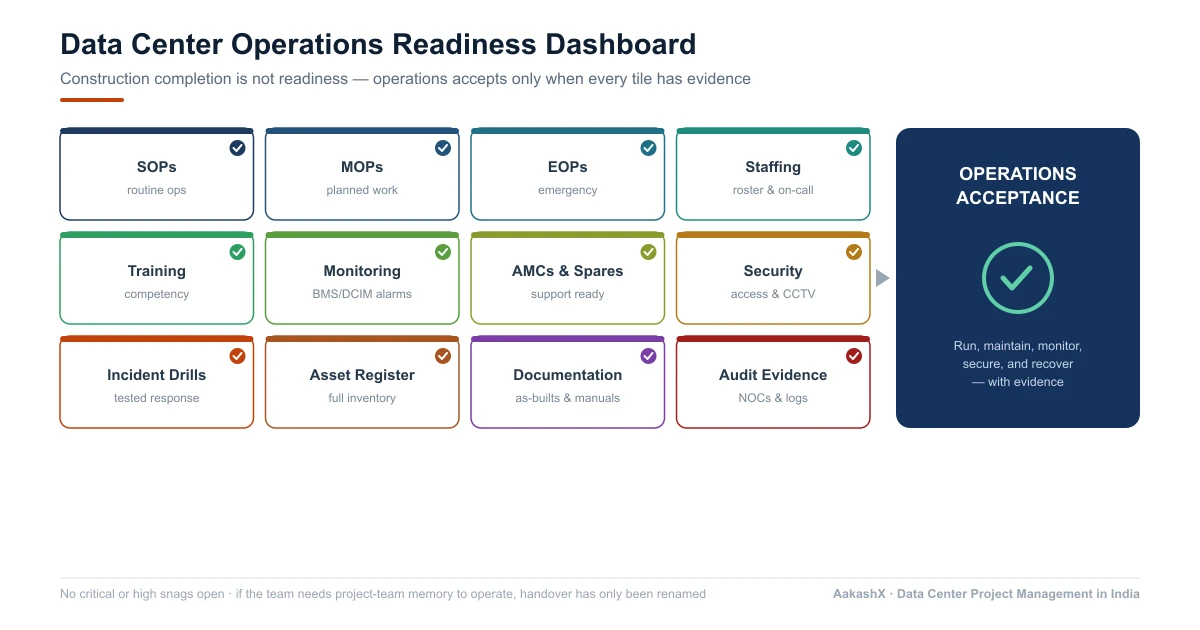
- Data Center Operations Readiness Dashboard
- FAQ
- Key Takeaways
What is the practical answer for data center operations handover?
Data center operations handover is the controlled transfer of responsibility from the project or build team to the operations team. It should include documents, drawings, asset registers, SOPs, MOPs, EOPs, monitoring dashboards, alarm rules, maintenance plans, AMCs, spares, warranties, shift staffing, access controls, vendor escalation, incident drills, and acceptance sign-off.
The operations team should not accept handover only because construction and commissioning are complete. Handover should be accepted only when operations can run, maintain, monitor, secure, and recover the facility with evidence.
Snippet-ready answer: Data center operations handover should cover SOPs, MOPs, EOPs, staffing, monitoring, BMS/DCIM, AMCs, spares, warranties, access control, physical security, incident response, drills, asset register, audit evidence, and signed operations acceptance.
Why is handover different from construction completion?
Construction completion means the facility has been built. Operations readiness means the facility can be run. Those are different states.
| State | Meaning | Risk if confused |
|---|---|---|
| Construction complete | civil, MEP, electrical, cooling, fire, telecom, and security works are installed | facility may still not be operable |
| Commissioning complete | systems have been tested and defects closed or accepted | operations may still lack procedures and staffing |
| Certification-ready | evidence may support external review or audit | operations still needs daily control discipline |
| Handover accepted | operations has accepted responsibility with evidence | owner can begin controlled operation |
What should be handed over before operations accepts the facility?
Operations handover should be evidence-based. At minimum, the handover pack should include four document sets.
1. Technical documents
Approved drawings, as-built drawings, single-line diagrams, mechanical schematics, fire-system drawings, network diagrams, security-system layouts, the BMS/DCIM point list, the EPMS point list, cable schedules, equipment datasheets, testing and commissioning records, load-bank test records, failure-scenario test records, and snag closure records.
2. Operations documents
SOPs, MOPs, EOPs, the shift handover format, the incident response plan, the escalation matrix, the preventive maintenance plan, the maintenance calendar, the access-control procedure, the visitor-management procedure, the change-control procedure, the permit-to-work procedure, the customer onboarding process where relevant, and the audit evidence checklist.
3. Commercial and vendor documents
Warranty certificates, AMC contracts, O&M contracts, the vendor escalation matrix, the spare parts list, the critical consumables list, OEM manuals, license records, software credentials through a secure process, and support SLAs where contractually defined.
4. Operations readiness evidence
Training records, drill records, monitoring dashboard access, alarm validation evidence, the asset register, the open-risk register, the accepted open-snag list, authority approvals and NOCs where applicable, certification evidence where applicable, and the final handover acceptance note.
If a document is required to operate, maintain, audit, troubleshoot, or recover the facility, it belongs in the handover pack.
How should SOPs, MOPs, and EOPs be prepared?
SOPs, MOPs, and EOPs are not interchangeable.
| Document | Meaning | Example |
|---|---|---|
| SOP | Standard Operating Procedure for routine operation | shift checks, access process, monitoring review |
| MOP | Method of Procedure for planned work | UPS maintenance, chiller isolation, generator test |
| EOP | Emergency Operating Procedure for abnormal or emergency events | utility failure, cooling failure, fire alarm, water leak |
SOPs: routine operations
SOPs should define how daily operations run: shift handover, daily equipment checks, alarm review, visitor entry, vendor entry, server hall access, customer escort process, BMS/DCIM dashboard review, security patrol, incident logging, permit-to-work issuance, and housekeeping standards.
MOPs: planned maintenance
MOPs should define step-by-step execution of planned work. A good MOP should include the purpose, scope, affected systems, prerequisites, tools and spares, personnel required, safety precautions, approval required, rollback plan, communication plan, step-by-step method, expected readings, hold points, post-work checks, and sign-off.
EOPs: emergency response
EOPs should define what to do when abnormal conditions occur: utility power failure, DG failure, UPS alarm, cooling failure, high-temperature alarm, fire alarm, water leak, security breach, network outage, BMS/DCIM failure, fuel shortage, or a severe weather event.
EOPs should be short enough to use under pressure. A 40-page emergency procedure is usually not operationally useful during an actual incident.
How should staffing, shift coverage, and training be validated?
Operations readiness depends on people, not only documents.
The handover gate should validate that the operations manager, shift leads, facilities technicians, security team, BMS/DCIM users, and network/security escalation contacts are appointed; that vendor escalation contacts are available; that the on-call rota, night and weekend coverage, and emergency escalation path are defined; and that training is completed and competency is checked.
Staffing readiness checklist
| Area | Handover question |
|---|---|
| Shift coverage | Is the site covered during operating hours or 24x7 as required? |
| Skills | Can staff operate power, cooling, fire, security, and monitoring systems? |
| Escalation | Does every shift know whom to call and when? |
| Vendor support | Are OEM and AMC contacts available? |
| Drills | Has the team practiced failure scenarios? |
| Access | Do staff have correct access rights? |
| Documentation | Can staff find and use SOP/MOP/EOP documents? |
How should monitoring, BMS/DCIM, EPMS, and alarms be handed over?
Monitoring handover is one of the highest-risk areas because teams often assume dashboards mean readiness.
The handover should validate BMS access, DCIM access where used, EPMS access where used, user roles, alarm thresholds, alarm routing, escalation rules, event timestamps, sensor accuracy, dashboard views, trend logs, reports, the backup and restore process, license validity, and integration with UPS, DG, cooling, fire, fuel, security, and network systems.
Alarm readiness checklist
Every critical alarm should have a source system, alarm name, severity, threshold, dashboard location, notification route, response owner, escalation time, linked SOP or EOP, and test evidence.
A dashboard without tested alarms is not a monitoring system. It is a display.
BMS/DCIM handover pack
The BMS/DCIM handover pack should include the point list, as-built integration architecture, alarm list, escalation matrix, user-role matrix, report list, dashboard screenshots, integration credentials under secure handover, license details, the backup and restore procedure, the vendor support contact, test records, and open defects.
Operations should not accept monitoring handover until the team has tested alarms and response procedures.
How should AMCs, spares, warranties, and vendor escalation be controlled?
Warranty is not operations support.
A warranty may cover defects under defined conditions. It may not cover preventive maintenance, emergency attendance, response time, spare availability, remote support, or uptime obligations.
Warranty vs AMC vs O&M
| Term | Meaning | Handover risk |
|---|---|---|
| Warranty | defect coverage under agreed terms | may not include proactive maintenance |
| AMC | annual maintenance contract for preventive/reactive support | must define response and scope |
| O&M contract | operating and maintaining the facility | broader responsibility |
| SLA | agreed service-level commitment | must be contractually clear |
Vendor support tracker
| System | Warranty end | AMC status | Spares | Response path | Escalation |
|---|---|---|---|---|---|
| UPS | date | pending/active | available/not available | vendor contact | L1/L2/L3 |
| Batteries | date | pending/active | available/not available | vendor contact | L1/L2/L3 |
| DG | date | pending/active | available/not available | vendor contact | L1/L2/L3 |
| Chillers | date | pending/active | available/not available | vendor contact | L1/L2/L3 |
| Fire system | date | pending/active | available/not available | vendor contact | L1/L2/L3 |
| BMS/DCIM | date | pending/active | license/support | vendor contact | L1/L2/L3 |
| Security systems | date | pending/active | available/not available | vendor contact | L1/L2/L3 |
Critical spares
The operations team should define critical spares for the UPS, batteries, DG systems, filters, pumps, sensors, fire-system components, access-control devices, network equipment, BMS/DCIM components, consumables, and tools and PPE.
The question is not "Are spares listed?" The question is "Can the team recover from likely failures without waiting for procurement?"
How should physical security, access control, and customer onboarding be prepared?
Physical security is part of operations readiness.
Before handover, validate the site perimeter, guard procedures, CCTV coverage, CCTV retention settings, access-control roles, server hall access rules, visitor management, the vendor entry procedure, loading bay access, emergency access override, mantrap or turnstile behavior where applicable, key management, the rack access procedure, the customer escort procedure, incident logging, audit log retention, and the access review process.
Customer onboarding
For colocation, managed infrastructure, or internal multi-business-unit facilities, onboarding must be defined before go-live. It may include rack allocation, access approval, cable routing, the cross-connect process, the remote-hands process, the change request process, the maintenance notification process, the incident notification process, billing or usage evidence where relevant, an acceptance form, and an escalation matrix.
Even for captive enterprise data centers, internal customer onboarding matters. Application teams, network teams, security teams, and business units need clear entry points into operations.
How should incident response and drills be tested?
Incident response should be practiced before the project is declared closed.
At minimum, run drills for utility power failure, DG start failure, UPS alarm, cooling failure, high-temperature alarm, fire alarm, water leak, network outage, access-control failure, a security incident, BMS/DCIM alarm failure, and a severe weather or flood access issue.
Incident drill checklist
Each drill should capture the scenario, trigger, first responder, detection path, alarm behavior, escalation path, communication log, time to acknowledge, time to stabilize, vendor involvement, customer or internal notification, lessons learned, procedure update, and closure owner.
Drills should update SOPs, MOPs, and EOPs. If drills do not change procedures, the team may only be performing theatre.
What usually fails in data center operations handover?
1. Handover becomes a document dump
Documents are necessary, but they do not prove operational readiness. The team must know how to use them.
2. Operations is not involved during commissioning
If operations does not witness commissioning, it inherits systems it has not seen under stress.
3. SOPs, MOPs, and EOPs are generic
Generic procedures fail under pressure. Procedures must match the actual facility, systems, alarms, vendors, and escalation paths.
4. Monitoring is accepted without alarm testing
Dashboards can look complete while alarm thresholds, routing, severity, and escalation are wrong.
5. AMCs and spares are unfinished
Operations cannot rely on warranty alone. Maintenance support, spares, escalation, and preventive maintenance must be ready.
6. Security handover is shallow
Badges, access groups, CCTV retention, visitor process, vendor access, rack access, and audit logs need controlled handover.
7. Open snags are not risk-classified
Operations should not inherit unknown risk. Every open item should be classified, owned, dated, and accepted or rejected.
8. No incident drills are performed
A team that has not practiced failure response is not ready for real incidents.
Data Center Operations Readiness Dashboard
Use this as the final handover gate.
| Readiness area | Evidence required | Owner | Status | Handover impact |
|---|---|---|---|---|
| SOPs | approved routine operating procedures | operations | pending | high |
| MOPs | approved maintenance procedures | operations/vendors | pending | high |
| EOPs | emergency procedures | operations | pending | high |
| Staffing | roster, roles, on-call plan | operations | pending | high |
| Training | attendance and competency evidence | operations/vendors | pending | high |
| Monitoring | BMS/DCIM/EPMS access and alarm tests | BMS/DCIM lead | pending | high |
| Asset register | complete asset list and IDs | PMO/operations | pending | high |
| AMCs | active or approved contracts | procurement/operations | pending | high |
| Spares | critical spares list and availability | operations | pending | high |
| Security | access control, CCTV, visitor process | security lead | pending | high |
| Incident response | drill records and escalation matrix | operations | pending | high |
| Documentation | as-builts, manuals, test records | PMO | pending | high |
| Snags | open/closed risk-classified list | PMO | pending | high |
| Audit evidence | NOCs, certifications, logs, approvals | compliance/PMO | pending | medium/high |
| Customer onboarding | process and forms where applicable | operations/customer team | pending | medium/high |
Final handover acceptance rule
Operations should accept handover only when:
- critical systems are commissioned,
- critical and high snags are closed or formally risk-accepted,
- SOPs/MOPs/EOPs are approved,
- staff are trained and scheduled,
- monitoring and alarms are tested,
- AMCs and spares are ready,
- the vendor escalation matrix is active,
- incident drills are completed,
- the asset register is complete,
- security and access controls are operational,
- the documentation pack is complete,
- open risks are signed off by the right authority.
Use the operational Excel-ready tracker
The article explains the decisions and failure modes. The downloadable Data Center Operations Handover Checklist turns them into assignable work packages with dependencies, accountable roles, blank start and end dates, completion evidence, status and stage-gate impact.
Open the interactive tracker and download the CSV →
Frequently Asked Questions About Data Center Operations Handover
What is data center operations handover?
Data center operations handover is the formal transfer of responsibility from the project or construction team to the operations team. It includes documents, procedures, staffing, monitoring, maintenance support, security controls, incident readiness, and acceptance evidence.
What should be included in a data center handover checklist?
A data center handover checklist should include as-built drawings, testing records, SOPs, MOPs, EOPs, monitoring access, alarm validation, asset register, AMCs, spares, warranties, vendor contacts, training records, security procedures, incident drills, and open-snag status.
What is the difference between SOP, MOP, and EOP?
SOPs cover routine operations. MOPs cover planned maintenance activities. EOPs cover emergency response to abnormal or high-risk events.
When should operations be involved in a data center project?
Operations should be involved before handover, ideally from design review and commissioning planning onward. They should witness tests, review maintainability, validate alarms, prepare procedures, and practice incident response.
Is commissioning enough for operations handover?
No. Commissioning proves systems perform against test requirements. Operations handover also requires procedures, staffing, monitoring access, maintenance contracts, spares, security controls, incident response, and signed acceptance.
Why are AMCs important before handover?
AMCs define preventive and reactive maintenance support after handover. Without active or approved AMCs, operations may depend only on warranty terms, which may not provide the required response or maintenance coverage.
What is the biggest operations handover mistake?
The biggest mistake is treating handover as document submission. Handover should prove that the operations team can run, monitor, maintain, secure, and recover the facility.
Can handover happen with open snags?
Only if open snags are non-critical, risk-classified, owned, dated, and formally accepted. Critical safety, uptime, security, monitoring, or compliance gaps should block handover.
Key Takeaways
- Data center operations handover is not a document dump; it is an operations-readiness gate.
- SOPs, MOPs, and EOPs must match the actual facility, systems, vendors, alarms, and escalation paths.
- Operations should witness commissioning and practice incident response before handover.
- Monitoring handover must include alarm testing, dashboard access, escalation rules, and secure credential transfer.
- Warranty is not the same as AMC or O&M support.
- Physical security, customer onboarding, asset register, and audit evidence are part of handover.
- Operations should accept the facility only when it can run, maintain, monitor, secure, and recover it with evidence.
Track every task above with the Data Center Operations Handover Checklist, an interactive, Excel-ready CSV tracker with dependencies, accountable roles and completion evidence.
References
- Uptime Institute — Tier Certification — Tier Standards consider both the built environment and the operations team's approach and performance.
- Uptime Institute — Tier Certification: Operational Sustainability — assessment of operational sustainability and potential sources of unplanned downtime.
- Uptime Institute — Management & Operations Guideline — operating behaviors, independent of Tier and installed infrastructure, that affect performance.
- Uptime Institute Journal — The Making of a Good Method of Procedure — how MOPs define repeatable action sequences and reduce human error.
- ANSI/TIA-942 Standard (TIA) — physical infrastructure scope across site, architecture, electrical, mechanical, fire safety, telecom, and security.
Part of the series
Data Center Project Management in India- 1.Project Managing a Data Center Setup in India: From Feasibility to Operations Handover
- 2.Data Center Site Selection in India: Land, Power, Water, Fiber, Climate, and Risk
- 3.Power Planning for Data Centers in India: Grid, Redundancy, DG Backup, Renewables, and Critical Path Risk
- 4.Cooling and Water Planning for Indian Data Centers: Design Choices, Water Risk, and Operating Tradeoffs
- 5.Data Center Approvals in India: A Project Manager's Checklist for Land, Power, Fire, Building, Environment, and Telecom
- 6.Data Center Project Governance: How to Run Workstreams, Vendors, Risks, Decisions, and Escalations
- 7.Data Center Procurement Strategy: How to Package Vendors, Track Long-Lead Equipment, and Avoid Commissioning Risk
- 8.Data Center Testing and Commissioning: IST, Load Banks, Failure Scenarios, and Handover Readiness
- 9.Data Center Certification Planning: Tier III, Tier IV, TIA-942, Design Reviews, and Commissioning Evidence
- 10.Data Center Operations Handover: SOPs, Staffing, Monitoring, Maintenance, Security, and Incident Readiness← you are here

Aakash Ahuja
Enterprise AI, Cybersecurity & Platform Engineering
Aakash writes about secure AI agents, microservices architecture, enterprise platforms, and production engineering. He has 20+ years of experience building and operating software systems across banking, cloud, cybersecurity, AI, and enterprise workflow automation. He is Director of Technology at itmtb Technologies and teaches AI, Big Data, and Reinforcement Learning at top institutes in India.