
Data Center Procurement Strategy: How to Package Vendors, Track Long-Lead Equipment, and Avoid Commissioning Risk
Data center procurement strategy fails when procurement is treated as buying equipment instead of controlling system readiness. A purchase order for UPS, DG sets, switchgear, chillers, racks, BMS/DCIM, fire systems, or security systems does not prove the facility will be installable, testable, maintainable, or handover-ready.
The practical procurement question is not "Which vendor is cheapest?" The real question is: "Which procurement structure gives the project the right technical compliance, interface ownership, lead-time control, commissioning evidence, warranty support, AMC readiness, and operations handover?"
This is the vendor and procurement article in AakashX's Data Center Project Management in India series. It sits between project governance and testing and commissioning, within the pillar guide.
Table of Contents
- What is the practical answer for data center procurement strategy?
- Why is data center procurement different from normal construction procurement?
- What should be procured as packages, not individual purchases?
- Should the project use EPC, multi-package, or hybrid procurement?
- Which long-lead equipment should be tracked from day one?
- How should vendors be evaluated beyond lowest price?
- How should technical submittals, substitutions, and change control be managed?
- How should FAT, SAT, commissioning, warranty, and AMC obligations be written into procurement?
- What usually fails in data center procurement?
- Data Center Procurement Strategy Matrix and Long-Lead Tracker
- FAQ
- Key Takeaways
What is the practical answer for data center procurement strategy?
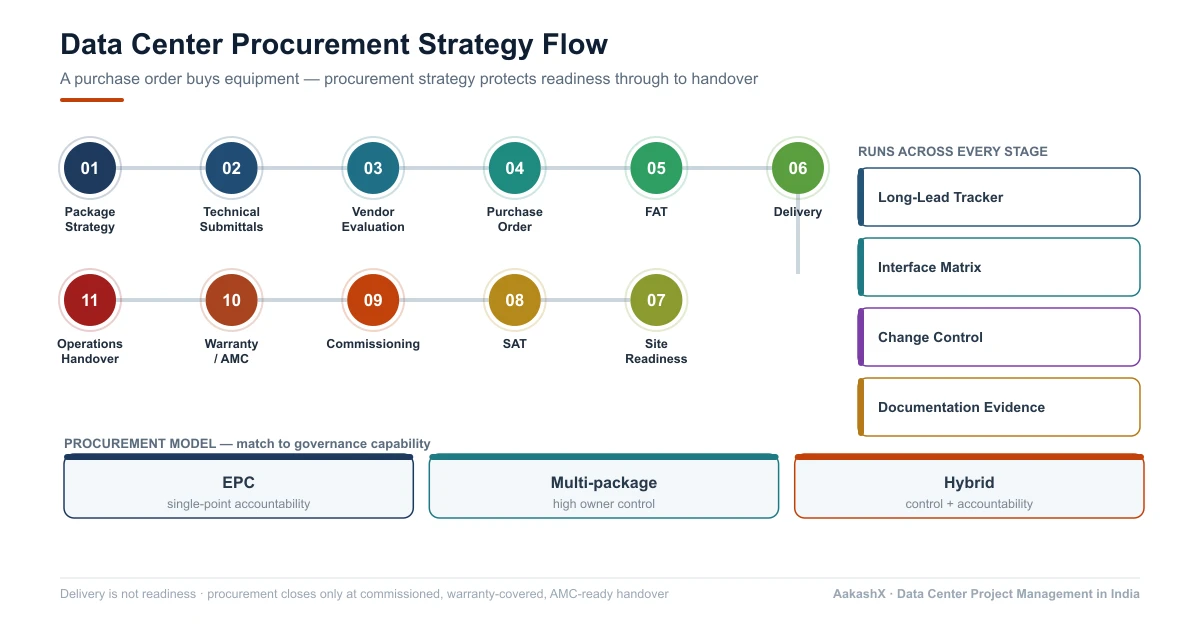
Data center procurement strategy is the project-control model for deciding how equipment, contractors, OEMs, system integrators, testing agencies, and operations-support vendors will be packaged, evaluated, purchased, delivered, tested, commissioned, and handed over.
A strong procurement strategy should define package boundaries, vendor responsibilities, long-lead items, technical submittal workflow, FAT/SAT requirements, logistics, site-readiness dependencies, warranty terms, AMC obligations, spares, commissioning support, and handover documents before purchase orders are released.
Snippet-ready answer: Data center procurement strategy should cover package strategy, EPC vs multi-package decisions, long-lead equipment, vendor evaluation, technical submittals, substitutions, FAT, SAT, logistics, commissioning support, warranty, AMC, spares, and operations handover evidence.
Why is data center procurement different from normal construction procurement?
Data center procurement is different because the purchased systems must operate together under continuous-load, failure, maintenance, safety, and monitoring conditions.
A normal procurement process may optimize for price, delivery, and vendor compliance. A data center procurement process must also optimize for resilience, maintainability, integration, testability, monitoring, service support, and lifecycle evidence.
A low-cost vendor decision can create high-cost risk later.
| Procurement decision | Possible project impact |
|---|---|
| UPS vendor chosen only on price | integration, warranty, spares, service response, commissioning risk |
| Generator package excludes fuel-system interface | backup runtime and fire-approval risk |
| Chiller package excludes BMS integration | monitoring and control gap |
| Fire package released before final cable routes | rework and authority observation risk |
| Rack procurement ignores cooling containment | hot spots and airflow problems |
| BMS/DCIM scope is vague | alarm gaps and weak operations handover |
| Carrier contract ignores physical route diversity | connectivity resilience risk |
| AMC discussed after handover | operations support gap |
What should be procured as packages, not individual purchases?
The safest data center procurement approach is package-based, not item-based. Instead of buying isolated products, the PMO should define procurement packages around operating systems and responsibilities.
Typical procurement packages
| Package | What it may include | Why package boundary matters |
|---|---|---|
| Electrical infrastructure | HT/LT panels, switchgear, transformers, busduct, cabling, earthing | affects energization, safety, testing, and maintainability |
| UPS and batteries | UPS modules, batteries, bypass, monitoring, battery racks | affects critical load continuity |
| DG and fuel system | generators, synchronization, fuel tanks, piping, exhaust, acoustic system | affects backup readiness and compliance |
| Cooling plant | chillers, pumps, cooling towers/dry coolers, pipework, controls | affects heat rejection and power load |
| White-space systems | racks, containment, cable trays, PDUs, structured cabling | affects airflow, installability, and operations |
| BMS/DCIM/EPMS | monitoring, metering, alarms, dashboards, reports | affects visibility and incident response |
| Fire and life safety | detection, alarm, suppression, hydrants, interfaces | affects safety, authority approvals, and handover |
| Physical security | CCTV, access control, visitor management, perimeter systems | affects auditability and site control |
| Network/carrier | fiber, meet-me-room, cross-connects, internet/MPLS/dark fiber | affects connectivity and resilience |
| Commissioning | scripts, test witnessing, IST, load-bank planning | affects readiness evidence |
| O&M / AMC | preventive maintenance, escalation, spares, operating support | affects post-handover reliability |
Should the project use EPC, multi-package, or hybrid procurement?
The procurement model should match the owner's capability and the project's complexity.
EPC procurement
In an EPC model, one contractor takes broader responsibility for engineering, procurement, and construction.
It is best when the owner wants single-point accountability, internal PMO capability is limited, schedule control needs central ownership, package coordination should sit with one contractor, and the owner can still maintain technical assurance through an owner's engineer.
Risks include reduced direct owner visibility, vendor substitution risk, scope-exclusion risk, dependence on EPC reporting quality, and weaker owner leverage over specialist OEMs unless contractually controlled.
Multi-package procurement
In a multi-package model, the owner directly procures multiple packages and manages interfaces.
It is best when the owner has strong PMO and technical capability, package-level control matters, specialist vendors need direct evaluation, the project requires flexibility, and transparency is more important than single-point contracting.
Risks include a higher interface burden, blame-shifting between vendors, more change-control complexity, and greater commissioning integration risk.
Hybrid procurement
A hybrid model combines both. For example, civil and MEP may sit under an EPC contractor, while the owner directly procures critical OEMs such as UPS, DG, chillers, BMS/DCIM, or network providers.
It is best when the owner wants EPC execution but direct control over critical systems, some packages have strategic value, warranty and AMC relationships matter, certification evidence requires direct vendor engagement, and long-lead items need early owner action.
EPC vs multi-package vs hybrid
| Model | Strength | Risk | Best fit |
|---|---|---|---|
| EPC | single-point accountability | lower package visibility | owners needing an execution wrapper |
| Multi-package | high owner control | high interface burden | owners with strong PMO |
| Hybrid | balances control and accountability | requires careful boundary control | complex DC projects with critical OEM choices |
Which long-lead equipment should be tracked from day one?
Long-lead procurement should start during design development, not after drawings are fully mature.
Common long-lead packages include transformers, HT/LT switchgear, busduct, UPS systems, batteries, diesel generators, synchronization panels, chillers, CRAH/CRAC units, cooling towers or dry coolers, pumps, fire detection and suppression systems, BMS/DCIM/EPMS systems, racks and containment, structured cabling, security systems, and network carrier last-mile infrastructure.
The long-lead tracker should not only track PO and delivery. It should track every step from technical approval to commissioning.
Long-lead tracker fields
| Field | Why it matters |
|---|---|
| Package name | identifies procurement item |
| Design dependency | shows whether drawings/specs are mature |
| Technical submittal status | prevents premature purchase |
| Approved make/model | controls substitution risk |
| PO date | anchors procurement baseline |
| Manufacturing lead time | exposes schedule risk |
| FAT date | creates pre-dispatch evidence |
| Dispatch date | controls logistics |
| Delivery constraints | identifies unloading/storage needs |
| Site readiness dependency | prevents material arriving before site can accept it |
| Installation owner | clarifies responsibility |
| SAT requirement | links delivery to acceptance |
| Commissioning dependency | links procurement to go-live |
| Warranty start date | prevents warranty leakage |
| AMC requirement | connects procurement to operations handover |
How should vendors be evaluated beyond lowest price?
Lowest price procurement is dangerous in data center projects when it ignores lifecycle and readiness risk. Vendor evaluation should include both commercial and operational criteria.
Vendor evaluation matrix
| Evaluation area | What to check |
|---|---|
| Technical compliance | matches design, redundancy, capacity, and standard requirements |
| Reference relevance | relevant data center or mission-critical experience |
| Lead time | realistic manufacturing and delivery timeline |
| Service network | local service capability and escalation path |
| Spares availability | critical spares and consumables support |
| Integration capability | ability to interface with BMS/DCIM, controls, electrical/cooling systems |
| FAT/SAT support | test procedure, witness support, documentation quality |
| Warranty terms | coverage, exclusions, start date, claim process |
| AMC terms | preventive maintenance, emergency response, parts, escalation |
| Documentation | manuals, datasheets, as-builts, test reports, training |
| Financial stability | ability to support the project lifecycle |
| Sustainability/compliance | energy efficiency, compliance documents, responsible procurement where relevant |
L1 vs total cost of ownership
L1 means the lowest quoted price. Total cost of ownership considers price plus lifecycle effects.
| Evaluation model | What it optimizes | Risk |
|---|---|---|
| L1 pricing | upfront purchase cost | weak service, poor integration, higher lifecycle risk |
| TCO evaluation | upfront cost + maintenance + efficiency + spares + support | requires stronger evaluation discipline |
How should technical submittals, substitutions, and change control be managed?
Technical submittals should be approved before procurement commitment.
A technical submittal should include the datasheet, model details, a compliance statement, deviations, shop drawings, installation requirements, space and clearance requirements, power and cooling requirements, controls and interface requirements, BMS/DCIM points, the maintenance access requirement, the FAT/SAT plan, the documentation list, and warranty and AMC assumptions.
Vendor substitution control
Vendor substitutions should never be approved casually. Before accepting a substitution, review design compliance, capacity, efficiency, footprint, maintainability, spare availability, service support, integration impact, BMS/DCIM impact, certification impact, commissioning impact, warranty impact, delivery impact, and cost impact.
Change-control rule
No vendor substitution or material deviation should be approved without written technical, commercial, commissioning, operations, and certification-impact review. A cheaper substitute can become expensive if it creates testing, integration, spares, or handover problems.
How should FAT, SAT, commissioning, warranty, and AMC obligations be written into procurement?
Procurement documents should include the evidence required for commissioning and handover.
FAT obligations
Where relevant, procurement should define the FAT requirement, FAT procedure, witness requirement, acceptance criteria, deviation handling, dispatch clearance, and test report format.
SAT obligations
Procurement should define delivery inspection, installation inspection, the site test procedure, required vendor attendance, acceptance criteria, defect handling, the retest process, and sign-off authority.
Commissioning obligations
Vendor scope should state attendance during commissioning, integrated systems testing support, failure scenario support, BMS/DCIM point validation, alarm validation, issue closure support, documentation required, training required, and final acceptance conditions. These obligations are what make testing and commissioning enforceable rather than goodwill.
Warranty and AMC obligations
Procurement should define the warranty start condition, warranty duration, coverage, exclusions, response path, preventive maintenance requirement, AMC terms, emergency support, spare availability, the escalation matrix, and post-handover support.
Do not leave AMC and spares to the end. If post-handover support is not defined during procurement, operations inherits risk.
What usually fails in data center procurement?
1. Procurement starts before package boundaries are clear
The project buys equipment but leaves integration, installation, controls, testing, and handover responsibilities unclear.
2. L1 price dominates technical risk
Lowest cost can become expensive when service support, spares, commissioning, warranty, and integration are weak.
3. Long-lead trackers stop at delivery
Delivery is not readiness. The tracker must continue through site readiness, SAT, commissioning, warranty, and AMC.
4. Technical submittals are treated as paperwork
Submittals are design-control tools. They expose deviations before purchase.
5. Vendor substitutions bypass governance
A substitution can affect design, approvals, certification, commissioning, spares, and operations.
6. FAT/SAT requirements are not written into POs
If testing obligations are not contractual, vendor support becomes harder to enforce.
7. BMS/DCIM integration is under-scoped
Monitoring requires point lists, protocols, dashboards, alarms, trend logs, reports, user roles, and handover training.
8. Warranty starts before operational acceptance
If warranty starts at dispatch or delivery instead of operational acceptance, useful warranty time can be lost before the facility is live.
9. AMCs and spares are discussed after commissioning
This leaves the operations team exposed during the first months of operation.
Data Center Procurement Strategy Matrix and Long-Lead Tracker
Use this matrix before releasing major procurement packages.
A. Procurement strategy matrix
| Decision area | PMO question | Evidence required |
|---|---|---|
| Procurement model | EPC, multi-package, or hybrid? | approved procurement strategy |
| Package boundary | who supplies, installs, integrates, tests, and hands over? | scope boundary matrix |
| Technical approval | is the submittal approved? | approved datasheets/drawings |
| Lead time | can delivery meet schedule? | manufacturing and dispatch plan |
| Site readiness | can site accept delivery and installation? | site-readiness checklist |
| FAT/SAT | are tests defined and contractual? | FAT/SAT procedure and PO clause |
| Integration | who owns interfaces? | interface responsibility matrix |
| Commissioning | who attends and closes defects? | commissioning obligation matrix |
| Warranty | when does it start and what is covered? | warranty certificate/terms |
| AMC/spares | is post-handover support ready? | AMC and spares tracker |
| Documentation | what must be handed over? | document deliverables list |
B. Long-lead procurement tracker
| Package | Technical approval | PO | FAT | Dispatch | Site readiness | SAT | Commissioning | Warranty | AMC |
|---|---|---|---|---|---|---|---|---|---|
| Transformer | pending | pending | required | pending | pending | required | required | pending | pending |
| Switchgear | pending | pending | required | pending | pending | required | required | pending | pending |
| UPS | pending | pending | required | pending | pending | required | required | pending | pending |
| Batteries | pending | pending | maybe | pending | pending | required | required | pending | pending |
| DG sets | pending | pending | required | pending | pending | required | required | pending | pending |
| Chillers | pending | pending | required | pending | pending | required | required | pending | pending |
| CRAH/CRAC | pending | pending | required | pending | pending | required | required | pending | pending |
| Fire systems | pending | pending | maybe | pending | pending | required | required | pending | pending |
| BMS/DCIM/EPMS | pending | pending | maybe | pending | pending | required | required | pending | pending |
| Racks/containment | pending | pending | maybe | pending | pending | required | required | pending | pending |
| Security systems | pending | pending | maybe | pending | pending | required | required | pending | pending |
| Network/carrier | design pending | contract pending | not applicable | rollout pending | entry pending | test required | required | SLA pending | support pending |
C. Procurement gate checklist
Before issuing a purchase order, confirm that:
- the package scope is defined,
- the technical submittal is approved,
- deviations are listed,
- the interface owner is identified,
- FAT/SAT requirements are included,
- commissioning support is included,
- documentation deliverables are listed,
- warranty terms are clear,
- AMC and spares are planned,
- delivery and storage requirements are known,
- the site-readiness dependency is tracked,
- the substitution process is defined,
- handover obligations are included.
Frequently Asked Questions About Data Center Procurement Strategy
What is data center procurement strategy?
Data center procurement strategy is the approach used to package, evaluate, purchase, deliver, test, commission, and hand over all major equipment and vendor scopes in a data center project. It covers vendor packages, long-lead items, technical submittals, FAT, SAT, commissioning support, warranties, AMCs, spares, and documentation.
How is procurement different from purchasing?
Purchasing is the act of buying. Procurement strategy defines what to buy, how to package it, which vendor should own which responsibility, how risks will be controlled, and what evidence is required before handover.
What are long-lead items in a data center project?
Long-lead items are equipment or systems that take significant time to approve, manufacture, ship, install, test, and commission. Examples include transformers, switchgear, UPS, batteries, DG sets, chillers, cooling units, fire systems, BMS/DCIM, racks, and network infrastructure.
Should data center procurement use EPC or multi-package contracting?
It depends on owner capability and project complexity. EPC gives stronger single-point accountability, while multi-package procurement gives more control but increases interface-management burden. Hybrid procurement may work where the owner wants EPC execution but direct control over critical OEMs.
Why is lowest-price procurement risky in data centers?
Lowest-price procurement can ignore lifecycle cost, service support, integration quality, spares, commissioning evidence, warranty, AMC, and operations readiness. Data center procurement should consider total cost of ownership and system-readiness risk.
What should be included in a data center purchase order?
A data center purchase order should include technical specifications, approved submittals, deviations, FAT/SAT requirements, delivery terms, documentation deliverables, commissioning support, warranty terms, AMC expectations, spares, training, and handover obligations.
What is the role of FAT and SAT in procurement?
FAT verifies equipment before dispatch where applicable. SAT verifies equipment after delivery and installation at site. Both should be defined in procurement documents so vendors are contractually responsible for test support and evidence.
What is the biggest procurement mistake in data center projects?
The biggest mistake is treating procurement as price comparison and purchase order release. In data centers, procurement must also control technical compliance, vendor interfaces, lead time, testing, commissioning, warranty, AMC, spares, and handover evidence.
Key Takeaways
- Data center procurement strategy is about readiness control, not only buying.
- Procurement packages should be structured around systems and interfaces, not isolated products.
- EPC, multi-package, and hybrid procurement models each have different governance burdens.
- Long-lead equipment should be tracked from technical approval through commissioning and AMC readiness.
- Vendors should be evaluated on technical compliance, service support, integration, spares, FAT/SAT, warranty, and lifecycle cost.
- Vendor substitutions should go through technical, commercial, commissioning, operations, and certification-impact review.
- Procurement is not closed until equipment is installed, tested, commissioned, documented, warranty-covered, AMC-ready, and handed over.
This article is part of AakashX's Data Center Project Management in India field manual. Start with the master guide, Project Managing a Data Center Setup in India, revisit Data Center Project Governance, continue with Data Center Testing and Commissioning, and plan ahead to Data Center Operations Handover. Before releasing major purchase orders, build the procurement strategy matrix and long-lead tracker above. If procurement does not include commissioning, warranty, AMC, spares, and handover obligations, the project is not buying readiness — it is only buying equipment.
References
- ANSI/TIA-942 Standard (TIA) — physical infrastructure scope across site, architecture, electrical, mechanical, fire safety, telecom, and security.
- Uptime Institute — Tier Certification: Operational Sustainability — design-document, constructed-facility, and operational-sustainability certification phases.
- Uptime Institute — Tier Certification — Tier Standards consider both the built environment and the operations team's approach.
- ISO 20400:2017 — Sustainable procurement guidance — integrating sustainability into procurement decisions.
- Systemiq — Scaling India's Data Centre Ecosystem — planning, grid integration, sustainability, and coordination themes for Indian data centers.
Part of the series
Data Center Project Management in India- 1.Project Managing a Data Center Setup in India: From Feasibility to Operations Handover
- 2.Data Center Site Selection in India: Land, Power, Water, Fiber, Climate, and Risk
- 3.Power Planning for Data Centers in India: Grid, Redundancy, DG Backup, Renewables, and Critical Path Risk
- 4.Cooling and Water Planning for Indian Data Centers: Design Choices, Water Risk, and Operating Tradeoffs
- 5.Data Center Approvals in India: A Project Manager's Checklist for Land, Power, Fire, Building, Environment, and Telecom
- 6.Data Center Project Governance: How to Run Workstreams, Vendors, Risks, Decisions, and Escalations
- 7.Data Center Procurement Strategy: How to Package Vendors, Track Long-Lead Equipment, and Avoid Commissioning Risk← you are here
- 8.Data Center Testing and Commissioning: IST, Load Banks, Failure Scenarios, and Handover Readiness
- 9.Data Center Certification Planning: Tier III, Tier IV, TIA-942, Design Reviews, and Commissioning Evidence
- 10.Data Center Operations Handover: SOPs, Staffing, Monitoring, Maintenance, Security, and Incident Readiness

Aakash Ahuja
Enterprise AI, Cybersecurity & Platform Engineering
Aakash writes about secure AI agents, microservices architecture, enterprise platforms, and production engineering. He has 20+ years of experience building and operating software systems across banking, cloud, cybersecurity, AI, and enterprise workflow automation. He is Director of Technology at itmtb Technologies and teaches AI, Big Data, and Reinforcement Learning at top institutes in India.