
Data Center Project Governance: How to Run Workstreams, Vendors, Risks, Decisions, and Escalations
Data center project governance fails when the project is treated as a reporting exercise instead of a decision-control system. A weekly progress deck cannot protect the project if power, cooling, telecom, civil, MEP, approvals, vendors, commissioning, and operations are making disconnected decisions.
Data center project governance is the operating model that defines who decides, who owns, who reviews, who escalates, who approves changes, and what evidence is required before the project moves to the next gate. For Indian data center projects, this governance layer is especially important because land, power, building approvals, fire NOC, grid connectivity, water, vendors, and local authorities can all affect the critical path.
This is the sixth article in AakashX's Data Center Project Management in India series. It sits on top of the workstreams covered earlier — site selection, power planning, cooling and water, and approvals — from the pillar guide.
Table of Contents
- What is the practical answer for data center project governance?
- Why does a data center project need stronger governance than a normal construction project?
- What governance structure should be used?
- Who should sit in the steering committee?
- What should the PMO control every week?
- How should RACI work across owners, consultants, EPC, vendors, and operations?
- What is the difference between risks, issues, decisions, and changes?
- How should change control work in a data center project?
- What governance cadence should the project use?
- What usually fails in data center project governance?
- Data Center Project Governance RACI and Dashboard
- FAQ
- Key Takeaways
What is the practical answer for data center project governance?
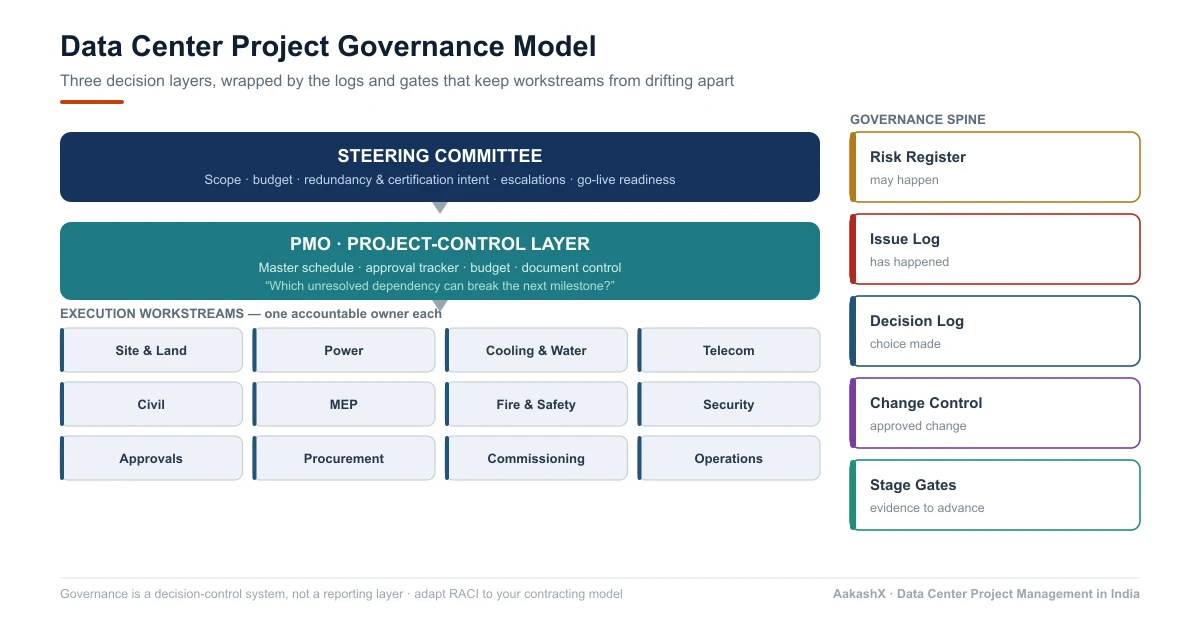
Data center project governance should be built around five controls: workstream ownership, decision rights, risk and issue management, change control, and stage-gate evidence. The PMO should not only collect updates; it should force unresolved dependencies into decisions.
The project should have a steering committee for strategic decisions, a PMO for day-to-day project control, named workstream owners for execution, an owner's engineer or technical assurance layer for design and quality review, and an operations representative from early design onward.
Snippet-ready answer: Data center project governance is the system of steering committee decisions, PMO controls, RACI ownership, risk register, issue log, decision log, change-control process, and stage gates used to coordinate civil, MEP, power, cooling, telecom, approvals, vendors, commissioning, and operations.
Why does a data center project need stronger governance than a normal construction project?
A normal commercial building can often absorb late changes, phased fit-outs, and operational adjustments after handover. A data center has less tolerance for disconnected decisions because its business value depends on reliability, power continuity, cooling stability, telecom diversity, fire safety, physical security, maintainability, and operational readiness.
A design change in one workstream can create risk in another.
| Change | Possible downstream impact |
|---|---|
| Rack density increases | cooling load, UPS sizing, DG sizing, floor layout, cable management |
| Electrical room layout changes | fire strategy, access control, maintainability, commissioning scripts |
| Generator yard moves | fuel storage, acoustic treatment, exhaust, fire approval, cable routing |
| Fiber entry path changes | security zoning, telecom RoW, meet-me-room layout, physical diversity |
| Cooling technology changes | water demand, electrical load, maintenance skills, approval path |
| Fire authority observation | civil layout, MEP design, suppression system, commissioning schedule |
| Vendor substitution | design compliance, warranty, spares, commissioning evidence |
This builds directly on the earlier workstreams in this series: the power critical path, cooling and water tradeoffs, and the approvals dependency map all converge in governance.
What governance structure should be used?
A data center project should use a three-layer governance structure.
1. Steering committee
The steering committee owns major decisions, budget direction, strategic tradeoffs, and escalations that cannot be resolved by the PMO.
It should decide site approval, major budget changes, target redundancy level, certification intent, vendor contracting model, major design tradeoffs, unresolved authority or utility escalations, go-live readiness, and scope changes with cost or schedule impact.
2. PMO and project-control layer
The PMO owns the integrated project control system.
It should control the integrated master schedule, risk register, issue log, decision log, change-control log, approval tracker, vendor dependency tracker, procurement tracker, budget and committed cost, document control, stage-gate evidence, commissioning readiness, and operations handover readiness.
The PMO's job is not to ask, "Are we on track?" Its job is to ask, "Which unresolved dependency can break the next milestone?"
3. Workstream execution layer
The workstream layer owns execution. Typical workstreams include land and site, power, cooling and water, telecom and fiber, civil and structural, MEP, fire and life safety, physical security, approvals, procurement, construction, BMS/DCIM, commissioning, and operations handover.
Each workstream should have one accountable owner. Shared ownership usually means no ownership.
Who should sit in the steering committee?
The steering committee should include people who can make decisions, not only people who want updates.
| Role | Why needed |
|---|---|
| Project sponsor | owns business objective and final tradeoffs |
| Finance / commercial owner | owns budget, commitments, contingency, cash flow |
| Real estate / facilities head | owns land, site, civil, local coordination |
| Technology / infrastructure head | owns IT load, rack density, network, reliability expectations |
| Operations head | owns maintainability, staffing, incident readiness, handover |
| Legal / compliance | owns contracts, approvals, land, regulatory exposure |
| Procurement head | owns vendor packages, commercial terms, long-lead items |
| PMO lead | owns integrated governance and reporting |
| Owner's engineer / technical advisor | provides independent technical assurance |
Steering committee decision areas
| Decision area | Example decision |
|---|---|
| Scope | captive DC vs phased build vs colocation fallback |
| Budget | contingency release, cost overrun approval |
| Design | redundancy target, certification intent, major design changes |
| Site | site approval, land risk acceptance |
| Power | sanctioned load risk, substation dependency, backup strategy |
| Approvals | escalation to authority or policy body |
| Vendors | contracting model, major vendor selection, substitution approval |
| Go-live | readiness acceptance or controlled delay |
What should the PMO control every week?
The PMO should maintain one version of project truth. A serious weekly PMO dashboard should include:
- milestone status,
- critical path,
- site readiness,
- approval tracker,
- power readiness,
- cooling and water readiness,
- telecom readiness,
- procurement tracker,
- long-lead equipment status,
- civil and MEP progress,
- design queries,
- change requests,
- risk register,
- issue log,
- decision log,
- budget status,
- commissioning readiness,
- operations handover readiness.
What the weekly review should avoid
Avoid meetings where every team says "work is in progress." Instead, every weekly review should force five questions:
- What changed since last week?
- What decision is blocked?
- What risk has increased?
- What milestone is now exposed?
- What evidence proves closure?
How should RACI work across owners, consultants, EPC, vendors, and operations?
RACI is useful only if it changes behavior.
RACI means Responsible (does the work), Accountable (owns the outcome), Consulted (gives input before the decision), and Informed (receives status after the decision). A data center RACI should be built around decisions and deliverables, not job titles.
Example RACI logic
| Deliverable / decision | Sponsor | PMO | Owner's engineer | EPC | MEP consultant | Ops | Vendor |
|---|---|---|---|---|---|---|---|
| Site approval | A | R | C | I | C | C | I |
| Load basis | A | R | C | I | R | C | I |
| Power application | I | R | C | C | A/R | I | I |
| Cooling concept | I | R | C | C | A/R | C | C |
| Fire strategy | I | R | C | C | R | C | C |
| Vendor package | A | R | C | C | C | C | C |
| Change request approval | A | R | C | C | C | C | C |
| Commissioning scripts | I | R | C | C | C | C | R |
| Handover acceptance | A | R | C | C | C | A/R | C |
RACI mistake to avoid
Do not assign accountability to a committee. Committees can review and approve, but a named person must be accountable for each major outcome.
What is the difference between risks, issues, decisions, and changes?
Weak governance mixes risks, issues, decisions, and changes into meeting notes. Strong governance separates them.
| Item | Meaning | Example | Tool |
|---|---|---|---|
| Risk | something that may happen | substation capacity may not be available on time | risk register |
| Issue | something that has happened | fire authority has raised design observations | issue log |
| Decision | a choice that is required | whether to redesign the DG yard or escalate approval | decision log |
| Change | an approved modification to scope, design, cost, or time | moving the generator location after fire review | change-control log |
Why the distinction matters
If a risk becomes an issue, it needs action. If an issue requires a tradeoff, it needs a decision. If a decision changes scope, cost, design, or schedule, it needs change control.
This is where many projects lose control. They discuss everything, but formally control nothing.
How should change control work in a data center project?
Change control should begin before construction. A data center project should not allow informal site instructions to change critical systems without impact review.
Every change request should answer:
- What is changing?
- Why is it changing?
- Which drawing, specification, package, or authority condition is affected?
- What is the cost impact?
- What is the schedule impact?
- What is the approval impact?
- What is the commissioning impact?
- What is the operations impact?
- Does it affect redundancy, maintainability, safety, security, or certification intent?
- Who approves it?
Change categories
| Change type | Example | Required review |
|---|---|---|
| Scope change | adding capacity or phase | sponsor, finance, PMO |
| Design change | changing cooling or electrical topology | owner's engineer, MEP, PMO |
| Site change | moving DG yard or transformer area | civil, MEP, fire, approvals |
| Vendor change | substituting UPS, chiller, fire system, BMS | technical, commercial, commissioning |
| Approval-driven change | redesign after fire, building, or power review | authority consultant, owner's engineer |
| Operations change | changing access, security, or maintenance model | operations, security, PMO |
Change-control gate
No change affecting critical infrastructure should be implemented until the PMO has logged it, impact-assessed it, assigned reviewers, and secured the required approval. Verbal approval is not project control.
What governance cadence should the project use?
A data center project needs different meeting rhythms for different decisions.
| Cadence | Meeting | Purpose |
|---|---|---|
| Daily / alternate day during active construction | site coordination | resolve field conflicts and safety issues |
| Weekly | PMO workstream review | track dependencies, risks, issues, decisions, changes |
| Weekly / fortnightly | design and technical review | close design queries and interface conflicts |
| Weekly | approvals review | track submissions, authority observations, escalations |
| Weekly | procurement review | track long-lead items and vendor dependencies |
| Fortnightly / monthly | steering committee | decide escalations, budget, scope, risk acceptance |
| Pre-gate | stage-gate review | validate evidence before moving forward |
| Pre-commissioning onward | commissioning readiness review | verify test plans, witnesses, snags, closure |
| Pre-handover | operations readiness review | validate SOPs, staffing, spares, AMCs, monitoring |
What usually fails in data center project governance?
1. Governance becomes reporting
A dashboard that reports delay after it happens is not governance. Governance should expose decisions and dependencies before they become delay.
2. PMO tracks civil progress more than interface risk
Civil progress can look good while power, fire, telecom, cooling, or commissioning readiness is slipping.
3. Workstreams optimize locally
The power team, cooling team, civil team, fire consultant, and vendors may each make reasonable decisions that conflict at the system level.
4. Decisions stay in meeting minutes
Important decisions should be in a decision log with owner, date, options considered, decision taken, impact, and evidence.
5. Change control starts too late
Late change control means design drift, procurement mismatch, rework, approval delay, and commissioning surprises.
6. Operations joins only at handover
Operations should review maintainability, access, monitoring, spares, staffing, incident response, and MOP/EOP/SOP requirements during design and commissioning.
7. Vendor dependencies are not mapped
UPS, generators, switchgear, chillers, BMS/DCIM, fire systems, security systems, and telecom providers all interact. If package boundaries are unclear, gaps appear late.
8. Approval risks are treated as external problems
Approval risks are project risks. They need owners, escalation paths, document control, and milestone impact tracking, as covered in data center approvals in India.
Data Center Project Governance RACI and Dashboard
Use this as the original PMO asset for the article.
A. Governance RACI
| Activity | Sponsor | Steering Committee | PMO | Owner's Engineer | EPC | Consultants | Vendors | Operations |
|---|---|---|---|---|---|---|---|---|
| Business objective | A | C | R | I | I | I | I | C |
| Site gate | A | C | R | C | C | C | I | C |
| Design gate | A | C | R | C | C | R | C | C |
| Approval tracker | I | C | A/R | C | C | R | I | I |
| Risk register | I | C | A/R | C | C | C | C | C |
| Issue log | I | C | A/R | C | R | C | C | C |
| Decision log | A | C | R | C | C | C | C | C |
| Change control | A | C | R | C | C | C | C | C |
| Procurement tracker | I | C | A/R | C | C | C | R | I |
| Commissioning readiness | A | C | R | C | C | C | R | C |
| Operations handover | A | C | R | C | C | C | C | A/R |
B. Weekly PMO dashboard
| Dashboard area | Status | Owner | Evidence | Risk |
|---|---|---|---|---|
| Milestones | green / amber / red | PMO | master schedule | delay risk |
| Approvals | green / amber / red | approvals owner | tracker + submissions | authority delay |
| Power | green / amber / red | electrical lead | DISCOM / design evidence | energization risk |
| Cooling/water | green / amber / red | MEP lead | design + water evidence | capacity/water risk |
| Telecom | green / amber / red | network lead | route + carrier evidence | network readiness |
| Procurement | green / amber / red | procurement | PO + delivery tracker | long-lead delay |
| Construction | green / amber / red | EPC | site progress evidence | rework / safety |
| Design queries | green / amber / red | design lead | query log | interface risk |
| Change requests | green / amber / red | PMO | change log | scope/cost drift |
| Commissioning | green / amber / red | commissioning lead | test plan | go-live risk |
| Handover | green / amber / red | operations | SOP/MOP/EOP tracker | operations risk |
C. Stage-gate evidence checklist
| Gate | Evidence required |
|---|---|
| Feasibility gate | business case, capacity target, budget range, governance model |
| Site gate | site scorecard, land note, power feasibility, water note, fiber validation |
| Design gate | concept design, load basis, redundancy target, approval review |
| Procurement gate | package strategy, technical specs, vendor evaluation, long-lead tracker |
| Construction gate | IFC drawings, QA plan, safety plan, issue and change-control process |
| Commissioning gate | test scripts, load bank plan, witness plan, failure scenarios |
| Handover gate | SOP/MOP/EOP, as-builts, AMCs, spares, training, monitoring dashboard |
Frequently Asked Questions About Data Center Project Governance
What is data center project governance?
Data center project governance is the operating model used to control decisions, ownership, risks, issues, changes, approvals, vendors, and stage gates during a data center project. It ensures that civil, MEP, power, cooling, telecom, fire, security, commissioning, and operations workstreams do not drift apart.
Who should own governance in a data center project?
The PMO should own day-to-day governance, but the project sponsor and steering committee should own major decisions and escalations. Each workstream should have a named accountable owner.
What should a data center PMO track weekly?
A data center PMO should track milestones, critical path, approvals, power readiness, cooling and water readiness, telecom readiness, procurement, long-lead equipment, risks, issues, decisions, changes, commissioning readiness, budget, and handover readiness.
What is the difference between a risk register and an issue log?
A risk register tracks things that may happen and could affect the project. An issue log tracks things that have already happened and need action.
Why is change control important in data center projects?
Change control is important because small design, layout, vendor, or site changes can affect power, cooling, fire approval, security, commissioning, cost, schedule, and operations. Informal changes can create hidden reliability and handover risks.
Should operations be involved before handover?
Yes. Operations should be involved during design, procurement, commissioning, and handover planning. They need to review maintainability, monitoring, staffing, spares, vendor support, SOPs, MOPs, EOPs, and incident response.
What is the role of the owner's engineer?
The owner's engineer or independent technical advisor helps review design, quality, interfaces, technical risks, vendor submissions, commissioning evidence, and compliance with owner requirements. This role protects the sponsor from relying only on contractor self-reporting.
What is the biggest governance mistake in data center projects?
The biggest governance mistake is treating governance as reporting. Real governance controls decisions, dependencies, changes, risks, issues, approvals, and evidence before they affect the critical path.
Key Takeaways
- Data center project governance is a decision-control system, not a reporting layer.
- The PMO should control risks, issues, decisions, changes, approvals, vendors, commissioning readiness, and handover evidence.
- Steering committees should handle strategic decisions, scope changes, budget shifts, unresolved escalations, and stage-gate approvals.
- RACI should be built around deliverables and decisions, not job titles.
- Risk, issue, decision, and change logs should be separate tools.
- Operations should be involved before handover, not after construction completion.
- Every stage gate should require evidence before the project moves forward.
References
- ISO 21502:2020 — Project, programme and portfolio management: guidance on project management — high-level project-management practice, governance, and control.
- Project Management Institute (PMI) — project governance, roles, risk management, change control, and stakeholder communication.
- CEEW — How Is Data Centre Infrastructure in India Shaping Power and Water Use? — practical approval delays around land, building approvals, grid connectivity, and fire safety clearances.
- Uptime Institute — Tier Certification — design, constructed-facility, and operational sustainability staging that supports stage-gate governance.
Part of the series
Data Center Project Management in India- 1.Project Managing a Data Center Setup in India: From Feasibility to Operations Handover
- 2.Data Center Site Selection in India: Land, Power, Water, Fiber, Climate, and Risk
- 3.Power Planning for Data Centers in India: Grid, Redundancy, DG Backup, Renewables, and Critical Path Risk
- 4.Cooling and Water Planning for Indian Data Centers: Design Choices, Water Risk, and Operating Tradeoffs
- 5.Data Center Approvals in India: A Project Manager's Checklist for Land, Power, Fire, Building, Environment, and Telecom
- 6.Data Center Project Governance: How to Run Workstreams, Vendors, Risks, Decisions, and Escalations← you are here
- 7.Data Center Procurement Strategy: How to Package Vendors, Track Long-Lead Equipment, and Avoid Commissioning Risk
- 8.Data Center Testing and Commissioning: IST, Load Banks, Failure Scenarios, and Handover Readiness
- 9.Data Center Certification Planning: Tier III, Tier IV, TIA-942, Design Reviews, and Commissioning Evidence
- 10.Data Center Operations Handover: SOPs, Staffing, Monitoring, Maintenance, Security, and Incident Readiness

Aakash Ahuja
Enterprise AI, Cybersecurity & Platform Engineering
Aakash writes about secure AI agents, microservices architecture, enterprise platforms, and production engineering. He has 20+ years of experience building and operating software systems across banking, cloud, cybersecurity, AI, and enterprise workflow automation. He is Director of Technology at itmtb Technologies and teaches AI, Big Data, and Reinforcement Learning at top institutes in India.