
Power Planning for Data Centers in India: Grid, Redundancy, DG Backup, Renewables, and Critical Path Risk
Power planning for data centers in India is not an electrical-design subtask that can be pushed to the MEP team after site selection. It is one of the main critical-path workstreams because it affects site feasibility, sanctioned load, substation dependency, backup strategy, cooling design, approvals, commissioning, operating cost, and uptime risk.
A data center project should not move from feasibility to site commitment until the team has tested the power path: estimated load, grid feasibility, the DISCOM (power distribution company) process, HT connection, redundancy target, UPS and DG strategy, fuel logistics, power quality, open access or renewable options, and commissioning evidence.
This is the third article in AakashX's Data Center Project Management in India series, expanding the power workstream from the pillar guide and the site selection gate.
Table of Contents
- What is the practical answer for power planning in Indian data centers?
- Why does power planning become the critical path?
- What should be estimated before asking for sanctioned load?
- How should grid connectivity and substation planning be handled?
- What is the difference between grid power, UPS, and DG backup?
- How should redundancy targets influence power design?
- How should open access and renewable power be evaluated?
- What approvals and compliance dependencies affect the power workstream?
- What usually fails in data center power planning?
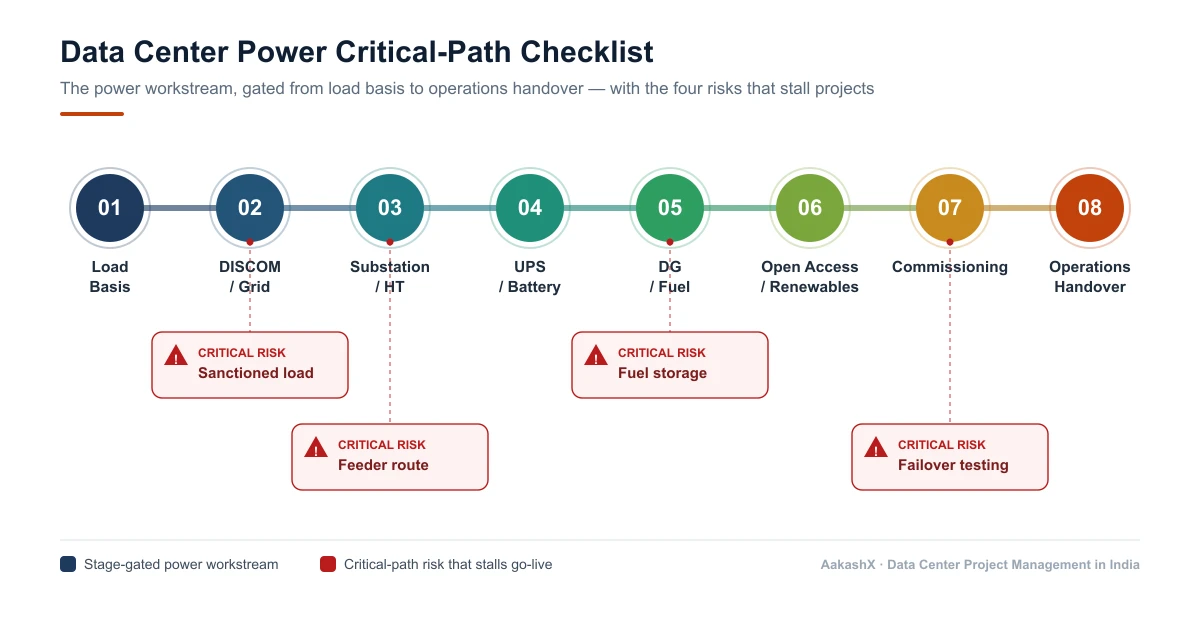
- Data Center Power Critical-Path Checklist
- FAQ
- Key Takeaways
What is the practical answer for power planning in Indian data centers?
Power planning for a data center in India means converting the business capacity target into an executable power path. That path must cover utility supply, sanctioned load, substation and feeder readiness, internal electrical distribution, UPS, batteries, DG backup, fuel, monitoring, redundancy, power quality, open access or renewable procurement, approvals, and commissioning.
The project manager should treat power as a stage-gate workstream. The team should not approve a site, freeze design, issue major procurement packages, or announce go-live until the power assumptions have evidence.
Snippet-ready answer: Power planning for data centers in India should start before site finalization and should cover estimated IT load, facility load, sanctioned load, DISCOM feasibility, substation access, redundancy target, UPS, DG backup, fuel logistics, renewable/open-access options, and commissioning tests.
Why does power planning become the critical path?
Power becomes the critical path because nearly every other data center workstream depends on it.
| Workstream | Power dependency |
|---|---|
| Site selection | depends on grid availability, substation proximity, feeder path, and future load growth |
| Cooling | cooling strategy changes total facility load and backup sizing |
| Civil design | electrical rooms, transformer yards, DG yards, fuel systems, and cable routes need space |
| Approvals | power connection, DG installation, fuel storage, fire, pollution, and open access may involve different authorities |
| Procurement | transformers, switchgear, UPS, batteries, generators, busduct, panels, and fuel systems can be long-lead items |
| Commissioning | load bank testing, failover tests, and integrated systems testing depend on power readiness |
| Operations | energy cost, maintainability, backup runtime, and incident response depend on power architecture |
The field implication is simple:
A data center site is not "selected" until the power path is believable.
This is why power planning should connect directly back to data center site selection in India and the master plan for project managing a data center setup in India.
What should be estimated before asking for sanctioned load?
Before the project team approaches the DISCOM or begins formal power planning, it should convert business intent into a preliminary load model.
Define IT load first
IT load is the power consumed by servers, storage, network equipment, and other IT hardware. It is the starting point for the data center's power plan.
Inputs:
- number of racks,
- average rack density,
- peak rack density,
- expected day-one IT load,
- expected year-three and year-five load,
- phased expansion plan,
- redundancy requirement,
- customer or internal workload profile.
Convert IT load into facility load
Facility load includes IT load plus cooling, electrical losses, lighting, security, BMS/DCIM, pumps, fans, and other support systems.
The exact conversion depends on design, climate, cooling method, and efficiency assumptions. This article does not invent a PUE (power usage effectiveness) number. The project team should ask the MEP consultant to model multiple scenarios instead of using a generic thumb rule.
Minimum scenarios:
| Scenario | Purpose |
|---|---|
| Day-one load | initial connection and commissioning |
| Phase-two load | expansion planning |
| Full-build load | land, substation, transformer, and feeder planning |
| Peak summer load | cooling and backup stress case |
| Maintenance mode | redundancy and concurrent maintainability check |
| Failure mode | DG/UPS/failover testing basis |
Create a load basis document
Before moving forward, prepare a load basis document with IT load assumptions, facility load assumptions, redundancy target, cooling concept, phased growth, voltage level expectation, backup runtime expectation, open access/renewable intent, power quality requirement, and commissioning test expectation.
This document prevents vague conversations like "we need around X MW." The project team should know whether X means IT load, critical load, connected load, sanctioned load, or full facility load.
How should grid connectivity and substation planning be handled?
Grid planning should start during site selection, not after design freeze.
The team should validate the nearest substation, available capacity, voltage level, feeder path, right-of-way dependencies, connection timeline, redundancy options, outage history where available, expansion feasibility, cost and deposit implications, metering and protection requirements, and the state-specific DISCOM process.
DISCOM discussion is not enough
A preliminary DISCOM discussion is useful, but it is not equivalent to a power commitment.
The project manager should separate:
| Stage | Meaning |
|---|---|
| Informal feasibility | early discussion; useful but not binding |
| Application submission | formal request with documents |
| Technical feasibility | DISCOM reviews load and connection possibility |
| Sanctioned load | approved load subject to terms and process |
| Connection execution | line, feeder, bay, substation, metering, protection, inspection |
| Energization | supply made available and tested |
Substation dependency should be visible in the project plan
A data center project can be delayed if the required substation capacity, bay, feeder, or right-of-way is not ready.
Track whether the existing substation has capacity, whether augmentation is needed, whether a dedicated feeder is needed, whether redundant feeders are feasible, whether cable or overhead routing is possible, whether land is needed for electrical infrastructure, whether the site has room for transformers and switching infrastructure, and whether future expansion load has been reserved.
Snippet-ready sentence: For a data center project, "power available nearby" is not enough; the PMO needs evidence for sanctioned load, voltage level, substation capacity, feeder path, right-of-way, metering, protection, and energization sequence.
What is the difference between grid power, UPS, and DG backup?
A data center power plan should distinguish three layers clearly.
| Layer | What it does | What it does not do |
|---|---|---|
| Grid power | primary supply from utility/DISCOM or a power procurement route | does not guarantee uninterrupted supply by itself |
| UPS and batteries | bridge short interruptions and protect critical IT load during transition | not usually designed for long-duration full-site backup |
| DG backup | supports longer outage scenarios when grid supply is unavailable | introduces fuel, emissions, noise, maintenance, and compliance dependencies |
Grid power
Grid power is the normal operating source. It drives cost, reliability, and sustainability planning. For India, the project must evaluate DISCOM supply, HT connection, power quality, tariff category, contract demand, open access feasibility, renewable procurement, and local grid reliability.
UPS and batteries
UPS (uninterruptible power supply) systems protect critical IT load from interruptions, voltage events, and transfer gaps.
The project manager does not need to design the UPS topology personally, but must ensure the design team has answered which loads are UPS-backed, the expected autonomy, battery chemistry, room requirements, fire/life-safety implications, maintenance bypass, replacement strategy, monitoring, end-of-life plan, and commissioning tests.
DG backup
DG (diesel generator) backup remains common because uptime requirements cannot rely only on grid power. India's data center ecosystem analysis continues to treat diesel generator sets as an indispensable reliability asset for meeting uptime requirements.
DG planning must include the number and rating of generators, the N/N+1/2N target, fuel storage, fuel supply contracts, emissions compliance, acoustic treatment, exhaust routing, fire safety, load testing, maintenance access, black-start procedures, and synchronization and controls.
The Central Pollution Control Board maintains a genset notifications page with emission and noise standards, office memoranda, and certified RECD information, including separate categories for diesel genset engines up to 800 kW and above 800 kW. Treat generator compliance as a regulatory workstream, not a procurement afterthought.
How should redundancy targets influence power design?
Power design should follow the required availability target. Do not choose N+1 or 2N because the term sounds strong; choose it because the business case, customer expectation, SLA, certification intent, and budget justify it.
N vs N+1 vs 2N
| Redundancy model | Meaning | Project implication |
|---|---|---|
| N | minimum required capacity | lower resilience; maintenance can become disruptive |
| N+1 | required capacity plus one extra component/path where designed | better maintainability; still needs careful topology |
| 2N | two independent systems each capable of supporting the load | higher resilience; higher cost, space, and complexity |
The Uptime Institute describes Tier III as concurrently maintainable, where capacity components and distribution paths can be removed for planned maintenance without impacting operations, and Tier IV as fault tolerant, where an individual equipment failure or distribution path interruption will not impact operations.
The project implication:
If the project has a Tier intent or high-availability promise, redundancy must be designed into the electrical topology, equipment procurement, physical routing, commissioning scripts, maintenance plans, and operations procedures from the beginning.
Redundancy is not only equipment count
A project can buy redundant equipment and still have poor resilience if it has common failure points.
Check independent distribution paths, physical separation, switchgear arrangement, transformer redundancy, UPS topology, generator topology, fuel system redundancy, control system dependencies, maintenance bypass, cable route separation, and monitoring and alarm visibility.
Redundancy must be proven through design review and commissioning, not assumed from a vendor bill of material.
How should open access and renewable power be evaluated?
Open access and renewable power should be evaluated early, but not treated as a magic shortcut.
MeitY's Draft Data Centre Policy 2020 discusses enabling open access so data centre providers can procure power directly from generation companies, including renewable power generation units, and encourages renewable energy use for data centres.
The Ministry of Power's Green Energy Open Access framework allows green open access to consumers, lowered the open-access transaction limit to 100 kW for green energy, mandates time-bound processing through a national portal, and provides for deemed approval if green open access is not granted within the stated period.
For a data center project, however, the PMO still needs to validate eligibility, state-specific implementation, the DISCOM process, contract demand impact, open access charges, wheeling and transmission charges, banking rules, standby charges, scheduling and deviation settlement, renewable energy certificate treatment, curtailment risk, metering, and regulatory change risk.
Open access vs DISCOM supply
| Option | What it means | Project-management concern |
|---|---|---|
| DISCOM supply | supply through the local distribution utility | simpler operating model; tariff and reliability must be evaluated |
| Green open access | procurement of renewable/green power through open access route | needs regulatory, metering, scheduling, commercial, and state-level validation |
| Captive/group captive | ownership-linked procurement structure | legal, financial, operational, and compliance complexity |
| On-site renewable | local solar or hybrid where feasible | land, intermittency, storage, and backup limitations |
What approvals and compliance dependencies affect the power workstream?
The power workstream may involve more than a utility application. Depending on site, scale, design, and state, the project may need to coordinate the sanctioned load application, HT connection approval, transformer and switchgear inspection, electrical inspector approval, substation or feeder work, right-of-way for cable/line, DG installation approval, fuel storage permission, fire approval, pollution/noise compliance, battery room and fire-safety review, open access application, metering approval, synchronization approval, and commissioning test documentation.
This is not legal advice. Exact requirements vary by state, DISCOM, electrical inspectorate, local body, facility size, fuel system, generator size, and procurement model. Validate with the DISCOM, state electrical inspector, licensed electrical contractor, owner's engineer, fire consultant, pollution-control consultant, and regulatory counsel.
Approval tracker for power
| Approval/dependency | Owner | Evidence required | Status |
|---|---|---|---|
| Load application | electrical consultant / owner | application copy, receipt, correspondence | pending/in progress/approved |
| Technical feasibility | DISCOM liaison | feasibility note or written response | pending/in progress/approved |
| HT connection | electrical consultant | connection terms, design requirements | pending/in progress/approved |
| Substation/feeder | DISCOM/STU/owner | scope, timeline, right-of-way note | pending/in progress/approved |
| DG compliance | vendor / consultant | emissions/noise compliance documents | pending/in progress/approved |
| Fuel storage | safety/fire consultant | permission documents | pending/in progress/approved |
| Open access | energy consultant | portal submission, approvals, agreements | pending/in progress/approved |
| Commissioning | commissioning agent | test scripts, test records, closure report | pending/in progress/approved |
What usually fails in data center power planning?
1. Teams confuse IT load, connected load, and sanctioned load
This creates poor communication with consultants, DISCOMs, vendors, and sponsors. Use a load basis document to define each number.
2. Site selection happens before power feasibility
A site can look strong on land and location but fail on substation capacity, feeder route, expansion load, or connection timeline.
3. Open access is discussed too late
Renewable or open-access procurement can affect metering, contracts, commercial modeling, regulatory approvals, and operations. It should be evaluated during feasibility, not after commissioning.
4. DG backup is treated as equipment procurement
DG backup also means emissions, noise, acoustic treatment, exhaust, fuel storage, fuel supply, fire safety, maintenance, load testing, and black-start procedures.
5. Redundancy is bought, not designed
Buying extra UPS modules or generators does not automatically create resilience. Common paths, controls, rooms, fuel systems, and maintenance procedures can still create single points of failure.
6. Cooling load is not coordinated with power planning
Cooling choices affect facility load, transformer sizing, DG backup, UPS strategy, electrical room sizing, and commissioning tests. Power and cooling should be planned together.
7. Commissioning is planned after installation
Power commissioning should be designed into the project schedule. Load bank testing, failover testing, control logic, alarm validation, and integrated systems testing need time, scripts, witnesses, and issue closure.
Data Center Power Critical-Path Checklist
Use this checklist before site approval, design freeze, procurement release, and go-live.
A. Load basis
- Business capacity target defined
- Day-one IT load estimated
- Phase-two IT load estimated
- Full-build IT load estimated
- Facility load assumptions created
- Cooling concept reflected in load model
- Peak summer scenario modeled
- Maintenance/failure mode scenario modeled
- Load basis document approved
B. Grid and DISCOM
- Nearest substation identified
- Available capacity checked
- Voltage level identified
- Feeder route reviewed
- Right-of-way risks listed
- Sanctioned load process mapped
- HT connection process mapped
- Expansion load discussed
- DISCOM correspondence stored
C. Internal power architecture
- Transformer strategy reviewed
- Switchgear strategy reviewed
- UPS topology reviewed
- Battery strategy reviewed
- Critical/non-critical load separation defined
- Cable routing and separation reviewed
- Electrical room space allocated
- Maintainability reviewed
D. Backup power
- DG sizing basis reviewed
- Redundancy target defined
- Fuel storage requirement estimated
- Fuel delivery route checked
- Acoustic and exhaust requirements reviewed
- Emissions/noise compliance checked
- Load testing plan included
- Maintenance access reviewed
E. Renewable / open access
- Green power objective defined
- DISCOM supply vs open access evaluated
- State-specific open access rules checked
- Charges and commercial model reviewed
- Metering requirements reviewed
- Renewable certificates/accounting reviewed
- Regulatory risk noted
F. Approvals and compliance
- Electrical inspectorate path mapped
- Fire implications reviewed
- Pollution/noise requirements reviewed
- Fuel storage permissions reviewed
- Battery room safety reviewed
- Open access approval path mapped
- Approval tracker active
G. Commissioning and handover
- FAT/SAT requirements written into procurement
- Pre-commissioning checklist prepared
- Load bank test plan prepared
- Failover scenarios documented
- UPS-to-DG transition test planned
- Alarm and BMS/DCIM validation planned
- Issue closure process defined
- Operations team included in witnessing
- Power handover pack defined
Frequently Asked Questions About Power Planning for Data Centers in India
When should power planning start in a data center project?
Power planning should start during feasibility and site selection. Waiting until detailed design is risky because power availability, sanctioned load, substation access, feeder path, backup systems, and cooling load can all affect site viability.
What is sanctioned load in a data center project?
Sanctioned load is the load approved by the power distribution utility or relevant authority for the consumer connection, subject to local process and conditions. For a data center, sanctioned load must be aligned with day-one needs, expansion needs, cooling load, redundancy target, and commissioning requirements.
Is grid power enough for a data center?
No. Grid power is the primary supply, but data centers usually need UPS systems, batteries, backup generation, monitoring, protection, and operating procedures to manage interruptions and power-quality events.
What is the difference between UPS and DG backup?
UPS systems protect critical IT load during short interruptions and transitions. DG backup supports longer outage scenarios but adds fuel, emissions, noise, maintenance, fire-safety, and compliance dependencies.
Should data centers in India use renewable power?
Renewable power should be evaluated where the commercial, regulatory, metering, and operational structure is feasible. Green open access and renewable procurement can be useful, but they require state-specific validation and should not be assumed late in the project.
How does power planning affect cooling?
Cooling systems consume power and can materially change facility load. The cooling strategy affects transformer sizing, UPS strategy, DG backup, electrical room space, commissioning scenarios, and operating cost.
What is the biggest power-planning mistake?
The biggest mistake is treating power as a vendor package instead of a critical-path workstream. Load basis, grid feasibility, sanctioned load, substation dependency, backup design, fuel logistics, approvals, and commissioning must be managed together.
What should be included in power commissioning?
Power commissioning should include equipment checks, UPS tests, battery checks, DG tests, load bank testing, failover scenarios, control logic validation, alarm validation, BMS/DCIM checks, and documented issue closure.
Key Takeaways
- Power planning for data centers in India should start before site finalization, not after design freeze.
- The power workstream should cover load basis, grid feasibility, sanctioned load, substation, HT connection, UPS, DG, fuel, renewables, approvals, commissioning, and handover.
- Sanctioned load discussions should be based on a clear IT load, facility load, phase-wise growth, and cooling assumptions.
- DG backup remains a major reliability dependency, but it also creates fuel, emissions, noise, fire, and maintenance obligations.
- Open access and renewable power should be evaluated early, with state-specific regulatory and commercial validation.
- Redundancy must be designed, routed, tested, and operationalized; it is not proven by equipment count alone.
- The PMO should use a weekly power critical-path checklist until energization, commissioning, and handover evidence are complete.
References
- MeitY — Data Centre (Draft Data Centre Policy 2020) — power quality, uninterrupted supply, open access, renewable power, connectivity, and data centre parks.
- CEEW — How Is Data Centre Infrastructure in India Shaping Power and Water Use? — power, water, DG backup, renewable feasibility, and sustainability context.
- Press Information Bureau (Ministry of Power) — Green Energy Open Access Rules — eligibility, national portal, approval process, and charges.
- Central Pollution Control Board — Genset Notifications — generator-set emission and noise notifications and certified equipment information.
- Uptime Institute — Tier Certification — Tier III and Tier IV definitions and certification scope.
Part of the series
Data Center Project Management in India- 1.Project Managing a Data Center Setup in India: From Feasibility to Operations Handover
- 2.Data Center Site Selection in India: Land, Power, Water, Fiber, Climate, and Risk
- 3.Power Planning for Data Centers in India: Grid, Redundancy, DG Backup, Renewables, and Critical Path Risk← you are here
- 4.Cooling and Water Planning for Indian Data Centers: Design Choices, Water Risk, and Operating Tradeoffs
- 5.Data Center Approvals in India: A Project Manager's Checklist for Land, Power, Fire, Building, Environment, and Telecom
- 6.Data Center Project Governance: How to Run Workstreams, Vendors, Risks, Decisions, and Escalations
- 7.Data Center Procurement Strategy: How to Package Vendors, Track Long-Lead Equipment, and Avoid Commissioning Risk
- 8.Data Center Testing and Commissioning: IST, Load Banks, Failure Scenarios, and Handover Readiness
- 9.Data Center Certification Planning: Tier III, Tier IV, TIA-942, Design Reviews, and Commissioning Evidence
- 10.Data Center Operations Handover: SOPs, Staffing, Monitoring, Maintenance, Security, and Incident Readiness

Aakash Ahuja
Enterprise AI, Cybersecurity & Platform Engineering
Aakash writes about secure AI agents, microservices architecture, enterprise platforms, and production engineering. He has 20+ years of experience building and operating software systems across banking, cloud, cybersecurity, AI, and enterprise workflow automation. He is Director of Technology at itmtb Technologies and teaches AI, Big Data, and Reinforcement Learning at top institutes in India.