
Tenant Context in Multi-Tenant Microservices: How to Design Safe Tenant Boundaries
By Aakash Ahuja Category: Practical Microservices Field Manual Reading time: 24–30 minutes Published: July 19, 2026
Tenant context in microservices fails when teams treat tenant_id as a normal request field instead of a security boundary.
In a multi-tenant system, tenant context decides which data can be read, which records can be changed, which permissions apply, which logs matter, which configuration is loaded, which invoice is generated, which wallet is used, and which customer boundary must not be crossed.
The practical rule is simple:
tenant_id should be derived, validated, enforced, and audited. It should not be blindly trusted because it appeared in a request body.These patterns reflect lessons from building Tomorrow Central, a multi-tenant SaaS platform with six microservices handling orders, billing, wallets, RBAC, and corporate memberships — where a single missing tenant filter can silently expose another organisation's invoice, apply the wrong promotion, or debit the wrong wallet.
This article is part of the Practical Microservices Field Manual. It follows the earlier articles on service boundaries, API contracts, database ownership, and service-to-service authentication. Those topics come together here because tenant context sits across all of them.
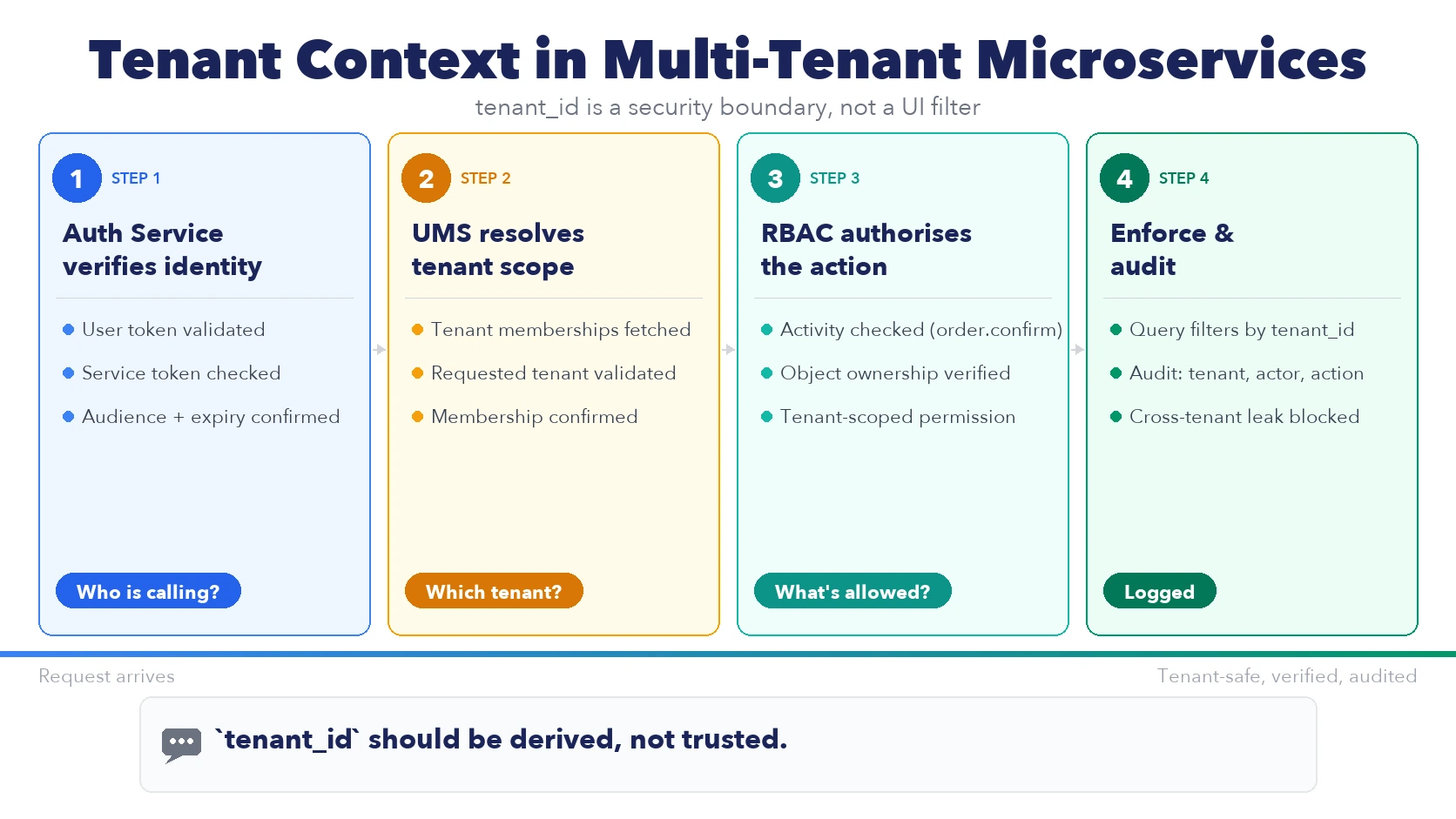
Table of contents
- What is tenant context in microservices?
- Why
tenant_idis not just another database column - Where should tenant context come from?
- Why frontend-provided
tenant_idshould not be trusted - User token vs service token vs tenant context
- How should Auth, UMS, and RBAC cooperate?
- How should tenant context flow in service-to-service calls?
- How should tenant context be enforced in database queries?
- How should background jobs handle tenant context?
- How should webhooks resolve tenant context safely?
- How should audit and error logs include tenant context?
- What usually fails in tenant-aware microservices?
- Tenant context checklist for microservices
- Frequently Asked Questions About Tenant Context in Microservices
- Key Takeaways
What is tenant context in microservices?
Tenant context is the verified business boundary under which a request is allowed to operate.It answers:
Which tenant does this request belong to?But in real systems, that question expands into several operational questions:
- Which organization or customer owns this data?
- Which tenant membership does the user have?
- Which tenant has enabled this product or module?
- Which tenant-specific configuration should be used?
- Which tenant's pricing, wallet, policy, or limits apply?
- Which tenant should appear in audit logs?
- Which tenant's database rows can be read or changed?
- Which tenant should be used in downstream service calls?
- a customer organization;
- a franchise, location, or business unit;
- a corporate account;
- a partner account;
- an enterprise workspace;
- a legal entity;
- a billing entity;
- a product environment.
That is why tenant context must be explicit.
Why tenant_id is not just another database column
A tenant_id column is only one expression of tenant context.Tenant context affects the whole request lifecycle.
| Area | Why tenant context matters |
|---|---|
| Authentication | User identity must be resolved into one or more tenant memberships. |
| Authorization | Permissions are usually tenant-scoped. |
| API contracts | Requests must define how tenant context is derived. |
| Database queries | Queries must filter by tenant scope. |
| Service calls | Tenant context must propagate safely downstream. |
| Configuration | Tenant-specific feature flags, module access, pricing, and policies may apply. |
| Audit logs | Every action should show which tenant was affected. |
| Error logs | Debugging cross-tenant bugs requires tenant visibility. |
| Billing | Orders, invoices, wallets, and payee accounts may depend on tenant context. |
| Reporting | Reports must aggregate within correct tenant boundaries. |
We added tenant_id to every table. We are now multi-tenant.That is not enough.
A safe design needs:
tenant-aware authentication
+ tenant-aware authorization
+ tenant-scoped APIs
+ tenant-scoped queries
+ tenant-aware service calls
+ tenant-specific configuration
+ tenant-aware audit logs
+ tenant isolation tests
The database column is the last mile. The tenant boundary starts earlier.
Where should tenant context come from?
Tenant context should come from a verified source.Valid sources include:
- Verified user identity plus membership resolution.
- Verified service identity plus scoped job or workflow context.
- Trusted internal workflow state.
- Provider configuration after webhook signature verification.
- Administrative platform context with explicit elevated scope.
- Raw request body.
- Raw query parameter.
- Hidden frontend field.
- Route parameter without membership validation.
- Tool output or imported file content.
- Unauthenticated webhook payload.
- Developer-provided debug override.
- Default tenant fallback.
Tenant context flow
A practical tenant context flow looks like this:
Incoming Request
   |
   v
Auth Verification
   |
   v
User / Service Identity
   |
   v
UMS Membership Resolution
   |
   v
Tenant Context
   |
   v
RBAC / Policy Check
   |
   v
Service Endpoint
   |
   v
Tenant-Scoped Query + Audit Log
The important design point:
The endpoint should receive resolved tenant context, not invent it.
In a Python/FastAPI service, that usually means middleware or dependencies attach something like this to the request:
request.state.identity
request.state.tenant_context
request.state.permissions
request.state.correlation_id
Then endpoint code uses that context instead of reading tenant authority from payload.
Why frontend-provided tenant_id should not be trusted
The frontend may need to send a tenant identifier for routing, user experience, or explicit workspace selection.That is acceptable.
What is not acceptable is treating that value as authoritative.
Bad pattern
{
  "tenant_id": "tenant_123",
  "order_id": "order_456",
  "action": "confirm"
}
Then the backend does:
tenant_id = payload["tenant_id"]
confirm_order(tenant_id, order_id)
This allows the caller to choose the tenant boundary.
Better pattern
requested_tenant_id = payload.get("tenant_id")
verified_memberships = request.state.identity.tenant_membershipstenant_context = resolve_allowed_tenant(
    requested_tenant_id=requested_tenant_id,
    memberships=verified_memberships
)
The frontend may request a tenant. The backend must verify that the user is allowed to operate in that tenant.
Stronger rule
If the user has only one tenant, derive it from identity and membership and do not accept it from the request.
If the user belongs to multiple tenants, require explicit tenant selection but validate it against UMS membership and RBAC.
If a service-only job acts on a tenant, require tenant scope in the job definition, workflow state, or service-token scope.
Never silently default to the first tenant.
User token vs service token vs tenant context
User identity, service identity, and tenant context are different things.User token
A user token answers:
Who is the human actor?Example: user_123
Service token
A service token answers:
Which service is calling?Example: orders-service
Tenant context
Tenant context answers:
Which tenant boundary applies to this operation?Example: tenant_789
Permission decision
RBAC answers:
Is this actor allowed to perform this action in this tenant?Example: user_123 can perform order.confirm in tenant_789
Comparison
| Concept | Answers | Should be trusted from request body? |
|---|---|---|
| User token | Which human user? | No |
| Service token | Which service? | No |
| Tenant context | Which tenant boundary? | No |
| RBAC decision | Is action allowed? | No |
| Request payload | What does caller want to do? | Partially, after validation |
How should Auth, UMS, and RBAC cooperate?
A clean multi-tenant design separates Auth, UMS, and RBAC responsibilities.Responsibility split
| Service | Owns | Tenant-context role |
|---|---|---|
| Auth Service | Login identity, token issuance, token verification, service identity | Proves actor or service identity |
| UMS | Users, organizations, tenants, user-tenant memberships, profile attributes | Resolves which tenants the user belongs to |
| RBAC | Roles, permissions, activities, role bindings | Decides whether actor can perform action in tenant |
| Business service | Domain rules and object-level checks | Enforces tenant-scoped operation |
| Audit/logging service | Access logs, error logs, action logs | Records tenant, actor, service, action, outcome |
Practical request flow
1. Request arrives at Orders Service.
- Middleware verifies user token.
- Middleware verifies service token if internal call.
- UMS resolves tenant membership.
- Tenant context is selected and validated.
- RBAC checks required activity, e.g. order.confirm.
- Orders Service checks object belongs to tenant.
- Orders Service executes operation.
- Audit log records tenant_id, actor_id, service_id, action, result.
This prevents a dangerous anti-pattern:
The frontend sends tenant_id.
The service trusts it.
The database query filters by it.
A query filter is necessary, but it is not enough. The tenant value itself must be trustworthy.
How should tenant context flow in service-to-service calls?
Tenant context should flow downstream as verified context, not as an untrusted free-form field.A service-to-service call should usually carry:
X-Service-Token: <calling-service-token>
Authorization: Bearer <user-token>
X-Correlation-Id: <correlation-id>
The downstream service should derive or validate tenant context from trusted claims and membership, not just from a body field.
Example: user confirms order
Frontend
  -> Orders Service
  -> Pricing Service
  -> Wallet Service
  -> Billing Service
The flow:
1. User token proves user identity.
- Orders Service resolves tenant context.
- Orders checks user permission.
- Orders calls Pricing with service identity + user context + correlation ID.
- Pricing validates service identity and tenant context.
- Pricing computes within tenant-specific rules.
- Orders calls Wallet and Billing with same tenant boundary.
- Every service logs tenant_id and correlation_id.
What should not happen
Orders Service should not call downstream services with:
{ "tenant_id": "tenant_789" }and expect them to trust it blindly.
Downstream services can accept tenant ID as a parameter, but they must validate it against verified user context, service scope, workflow context, resource ownership, or trusted internal claims.
Service-only calls
For scheduled jobs or workers with no human user, the job must carry explicit tenant scope:
{
  "job_id": "billing-retry-2026-07-19",
  "service_id": "scheduler-service",
  "tenant_scope": "tenant_789",
  "operation": "invoice.retry",
  "correlation_id": "corr_123"
}
Do not let service-only jobs run as "all tenants" unless that is explicitly required, permissioned, and audited.
How should tenant context be enforced in database queries?
Every tenant-scoped query should include tenant context.But the deeper question is: how do you make forgetting tenant context hard?
Weak pattern
db.execute("SELECT * FROM orders WHERE id = :order_id", {"order_id": order_id})This query can return another tenant's order if IDs are guessable, leaked, or reused.
Better pattern
db.execute(
    "SELECT * FROM orders WHERE tenant_id = :tenant_id AND id = :order_id",
    {"tenant_id": ctx.tenant_id, "order_id": order_id}
)
Stronger pattern
Wrap tenant filtering into repository methods:
orders_repo.get_order(
    tenant_id=ctx.tenant_id,
    order_id=order_id
)
Then code review can reject raw cross-tenant queries.
Query enforcement rules
| Rule | Reason |
|---|---|
Every tenant-scoped table should have tenant_id | Makes boundary explicit |
| Every tenant-scoped query should filter by tenant | Prevents accidental leakage |
| Every mutation should include tenant scope | Prevents cross-tenant writes |
| Every object lookup should validate tenant ownership | Prevents ID-based access bugs |
| Every repository method should require tenant context | Prevents missing filters |
| Every audit log should include tenant ID | Supports investigation |
| Raw SQL should be reviewed for tenant filters | Prevents bypass |
Role of row-level security
Database row-level security can add another layer of protection in some systems. It is not a replacement for application-level tenant context, RBAC, and audit.
Use it as a defense-in-depth mechanism where appropriate. The application still needs to know which tenant is in scope, which user is acting, which permission is required, which action was taken, and which audit event should be recorded.
How should background jobs handle tenant context?
Background jobs are a common source of tenant leakage because there is often no user request.Examples: invoice generation, wallet reconciliation, subscription renewals, notification sending, report generation, inventory sync, failed payment retry, data cleanup, scheduled exports.
Bad pattern
Run job across all tenants using admin connection.This creates unnecessary blast radius.
Better pattern
Create tenant-scoped job units.
Process one tenant at a time.
Record tenant_id, job_id, correlation_id, status, and result.
Job design checklist
| Question | Required answer |
|---|---|
| Is this job tenant-scoped or platform-wide? | Explicit |
| Which tenants can it operate on? | Defined |
| Which service identity runs it? | Known |
| Does it need user context? | Usually no, but sometimes yes |
| Does it write tenant data? | If yes, audit |
| Can it be retried safely? | Idempotency required |
| Can one tenant failure block others? | Should not |
| Are logs tenant-scoped? | Yes |
| Are outputs tenant-scoped? | Yes |
Recommended job unit structure
{
  "job_id": "invoice-run-2026-07-19-tenant-789",
  "job_type": "invoice_generation",
  "tenant_id": "tenant_789",
  "service_id": "billing-worker",
  "status": "pending",
  "correlation_id": "corr_abc123",
  "attempt": 1
}
This makes tenant context explicit before the job starts. Do not derive tenant context from whichever row the job happens to process first.
How should webhooks resolve tenant context safely?
Webhooks are different from normal user requests. A webhook may come from a payment gateway, logistics provider, email provider, identity provider, external CRM, document-signing platform, or messaging provider.There is usually no user token. Tenant context must be resolved from verified provider configuration, not from untrusted payload text.
Bad webhook flow
1. Receive webhook.
- Parse JSON.
- Read tenant_id from payload.
- Query tenant data.
- Verify signature later.
This is unsafe.
Better webhook flow
1. Receive webhook.
- Read raw body bytes.
- Identify provider route or configured endpoint.
- Verify provider signature.
- Resolve tenant from trusted provider configuration.
- Deduplicate provider event ID.
- Process event inside resolved tenant context.
- Write audit, payment, or event log.
Payment webhook example
A payment webhook may contain order or payment identifiers. The system should not trust a tenant ID inside the payload until the signature and provider configuration are verified.
The Payment Service should own: webhook signature verification, provider event ID deduplication, tenant resolution, payment attempt lookup, payment status update, and audit event.
Orders or Billing can react after Payment has validated and recorded the event. This preserves data ownership and tenant isolation.
How should audit and error logs include tenant context?
Audit and error logs should include tenant context because cross-tenant issues are otherwise hard to investigate.Minimum audit fields
| Field | Purpose |
|---|---|
tenant_id | Which tenant boundary was affected |
actor_user_id | Which human actor initiated, if any |
service_id | Which service acted |
action | What operation was attempted |
resource_type | What kind of object was affected |
resource_id | Which object was affected |
permission_checked | Which RBAC activity or policy applied |
decision | Allowed, denied, approval required, or failed |
correlation_id | Cross-service trace |
request_id | Specific request attempt |
timestamp_utc | Time of event |
result | Success, failure, or no-op |
Error logs should include
- Tenant ID, service name, endpoint, error code, correlation ID, request ID, actor or service identity, sanitized payload reference, stack trace where safe.
Do not log
- Raw tokens, service secrets, passwords, payment secrets, full PII payloads, unredacted documents, raw authorization headers, confidential cross-tenant data.
What usually fails in tenant-aware microservices?
Failure 1: Tenant ID is trusted from request body
The frontend sends tenant_id, and the backend accepts it. This is the most basic tenant spoofing problem.
Failure 2: Query misses tenant filter
A developer writes SELECT * FROM invoices WHERE invoice_id = ? instead of filtering by tenant_id as well. If IDs are exposed, guessed, reused, or leaked, this becomes a cross-tenant access bug.
Failure 3: RBAC is global instead of tenant-scoped
User has role admin, but the system does not ask: Admin of which tenant? A user may be admin in one tenant and ordinary member in another.
Failure 4: Service-to-service calls drop tenant context
Orders resolves tenant correctly, but calls Billing without passing or enabling Billing to resolve tenant safely. Billing then re-derives tenant incorrectly or falls back to payload.
Failure 5: Background jobs run with global power
A worker runs across all tenants with broad access. One bug affects every tenant. Tenant-scoped job units reduce blast radius.
Failure 6: Webhooks trust external payloads too early
The webhook payload contains tenant-like data. The service reads it before signature verification or provider-account mapping. This can corrupt tenant resolution.
Failure 7: Audit logs miss tenant ID
The action is logged, but not the tenant. During incident investigation, teams cannot tell which tenant was affected.
Failure 8: Admin tools bypass tenant rules
Internal admin screens often become the biggest cross-tenant risk because they are treated as "trusted tools." Admin tools need stronger tenant selection, reason capture, approval, and audit.
Failure 9: Reporting bypasses tenant isolation
Reports query operational tables directly and forget tenant filters. Reporting needs its own tenant-aware read models or warehouse rules.
Failure 10: Corporate membership complicates payee context
In some systems, the user consuming a service is not the same as the entity paying for it. An individual user belongs to a corporate membership, the corporate account pays, the corporate wallet may apply, the corporate promotion may apply, the invoice belongs to the payee account, the order belongs to the consuming user, and reporting must show both.
This is where a single tenant_id field may not be enough. You may need separate fields:
tenant_id
consumer_account_id
payee_account_id
corporate_membership_id
funding_source_id
invoice_account_id
The rule remains the same: each context must be derived, validated, and audited.
Tenant context checklist for microservices
Use this before approving a new endpoint, table, worker, webhook, or report.API checklist
- Does the endpoint require tenant context?
- Where does tenant context come from?
- Is frontend-provided
tenant_idvalidated? - Is tenant context attached by middleware or dependency?
- Does the endpoint declare required RBAC activity?
- Is object-level tenant ownership checked?
- Is tenant ID included in audit logs?
- Are error logs tenant-aware?
- Are raw tokens and secrets masked?
Database checklist
- Does every tenant-scoped table include
tenant_id? - Does every query filter by tenant ID?
- Does every update and delete include tenant scope?
- Are repository methods tenant-aware?
- Are raw SQL queries reviewed for tenant filters?
- Are migrations safe across tenants?
- Are SCD2 and effective-dated rows tenant-scoped?
- Are read models tenant-aware?
Service-to-service checklist
- Does the request carry service identity?
- Does user-scoped work preserve user context?
- Can the downstream service derive or validate tenant context?
- Are service scopes checked?
- Is correlation ID propagated?
- Are downstream audit logs tenant-aware?
Background job checklist
- Is the job tenant-scoped or platform-wide?
- Is tenant scope explicit before execution?
- Can one tenant failure affect others?
- Is the job idempotent?
- Are job logs tenant-scoped?
- Are outputs stored in tenant-safe locations?
Webhook checklist
- Is signature verified before tenant data access?
- Is tenant resolved from trusted provider configuration?
- Is provider event ID deduplicated?
- Is the event processed inside resolved tenant context?
- Is webhook processing audited?
- Are suspicious or unmatched events quarantined?
Admin-tool checklist
- Does admin action require explicit tenant selection?
- Is tenant selection validated?
- Is the admin actor logged?
- Is reason captured for sensitive actions?
- Are high-risk actions approval-gated?
- Can admin views accidentally show cross-tenant data?
Frequently Asked Questions About Tenant Context in Microservices
What is tenant context in microservices?
Tenant context is the verified tenant boundary under which a request, service call, query, job, webhook, or audit event operates. It determines which tenant's data, permissions, configuration, and business rules apply.
Is tenant_id the same as tenant context?
No. tenant_id is usually one field or column. Tenant context includes the verified source of that tenant ID, the actor, membership, permissions, service scope, object ownership, and audit requirements.
Should the frontend send tenant_id?
The frontend may send a requested tenant ID when a user belongs to multiple tenants. The backend should not trust it directly. It must validate the requested tenant against verified user identity, membership, and permissions.
How should tenant context be passed between microservices?
Tenant context should be derived or validated through verified user and service identity and propagated through standard middleware, service tokens, user context, workflow state, or trusted internal claims. Downstream services should not blindly trust a body field.
How do tenant context and RBAC work together?
Tenant context tells the system which tenant boundary applies. RBAC decides whether the actor can perform a specific action within that tenant. A user can have different roles in different tenants.
How should database queries enforce tenant context?
Tenant-scoped queries should filter by tenant ID, and tenant-aware repository methods should require tenant context. Every read, update, and delete on tenant-owned data should include tenant scope.
How should background jobs handle tenant context?
Background jobs should be explicitly tenant-scoped where possible. A job unit should include tenant ID, job ID, service identity, correlation ID, attempt count, and status before processing starts.
How should webhooks resolve tenant context?
Webhooks should verify provider signature first, then resolve tenant context from trusted provider configuration or stored payment and provider account mapping. They should not trust tenant-like fields from the webhook payload before verification.
Key Takeaways
- Tenant context is a security boundary, not just a database column.
tenant_idshould be derived, validated, enforced, and audited.- Frontend-provided
tenant_idcan express requested context, but it should not establish authority. - Auth proves identity, UMS resolves membership, RBAC checks permission, and business services enforce tenant-scoped rules.
- Every tenant-scoped query should include tenant context.
- Service-to-service calls must preserve or validate tenant scope.
- Background jobs and webhooks need explicit tenant-resolution rules.
- Audit and error logs should include tenant ID, actor, service, action, result, and correlation ID.
- Corporate membership, wallets, promotions, payee accounts, and invoicing can require more than one account or tenant-like field.
This article is part of the Practical Microservices Field Manual.
Recommended next reads:
Use the Tenant Context Checklist before adding a new endpoint, table, worker, webhook, report, or admin screen to a multi-tenant microservice system.Part of the series
Designing Scalable Microservices- 1.Microservices Architecture Design: Why Services Fail, When to Avoid Them, and How to Draw Boundaries That Survive Production
- 2.API Contracts in Microservices: How to Design Interfaces That Survive Production
- 3.Database Ownership in Microservices: Beyond the Database-per-Service Rule
- 4.Service-to-Service Authentication in Microservices: A Practical Architecture Guide
- 5.Tenant Context in Multi-Tenant Microservices: How to Design Safe Tenant Boundaries← you are here
- 6.Observability for Microservices Before Productioncoming soon

Aakash Ahuja
Enterprise AI, Cybersecurity & Platform Engineering
Aakash writes about secure AI agents, microservices architecture, enterprise platforms, and production engineering. He has 20+ years of experience building and operating software systems across banking, cloud, cybersecurity, AI, and enterprise workflow automation. He is Director of Technology at itmtb Technologies and teaches AI, Big Data, and Reinforcement Learning at top institutes in India.