
AI Adoption Is an Operating-Model Change, Not a Software Installation
AI adoption fails when leaders treat it like installing software. Buying an AI tool, launching a pilot, or giving employees access to a model does not change how decisions are made, how work flows, how risk is controlled, or how outcomes are measured.
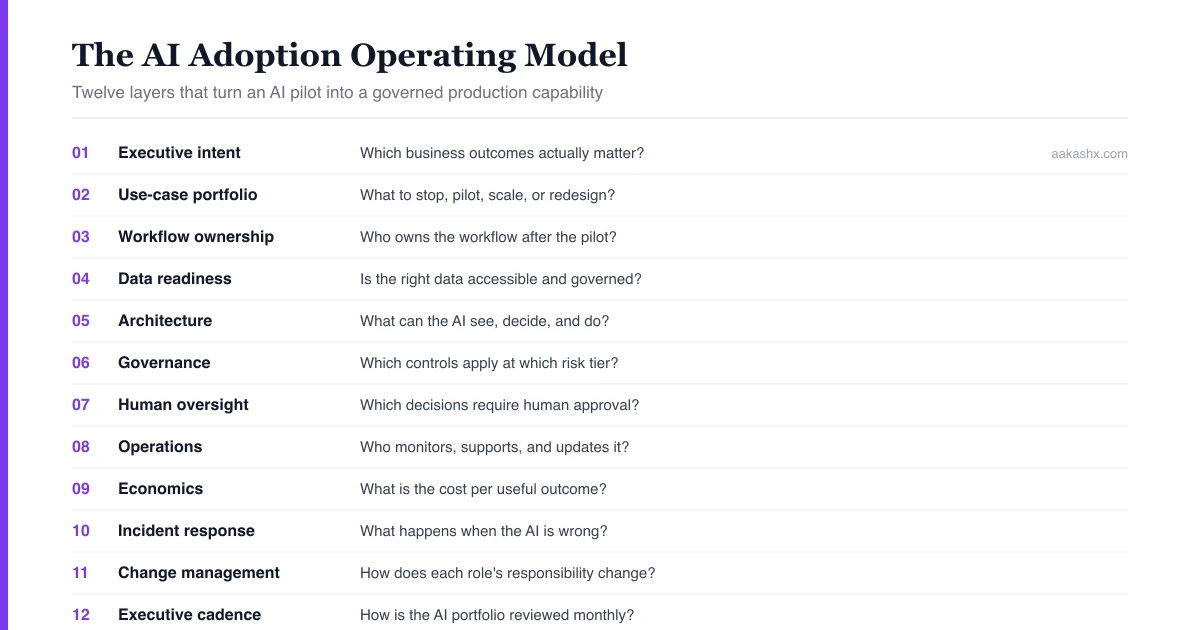
That is why enterprise AI adoption is an operating-model change. An AI adoption operating model defines who owns AI, how use cases are chosen, how workflows change, how data is prepared, how risk is governed, how humans stay in control, how cost is measured, and how production AI is supported after launch.
MIT Project NANDA's report The GenAI Divide: State of AI in Business 2025 found that about 95 percent of enterprise generative AI pilots delivered no measurable profit-and-loss impact. Its central finding is not that the models are weak. It is that the gap sits in how organisations adopt AI: the winners embed it into real workflows with ownership and feedback, while the rest stall at generic pilots that never change how work is done. That is an operating-model problem, and it is what this article is about.
This is the opening piece in the Enterprise AI Strategy series. It sets the frame the rest of the series builds on: ownership, use-case prioritisation, data readiness, pilot-to-production gates, governance, operations, incidents, economics, and vendor decisions.
What this article covers
- What "operating-model change" actually means
- Why pilots work in demos but fail in production
- What changes when AI enters real workflows
- Who should own AI adoption after the pilot
- The operating-model layers that must change
- AI installation versus AI adoption
- The practical twelve-part operating model
- How to redesign workflows around AI
- Risk-tiered governance without a committee
- How to measure adoption success
- What to check before approving production AI
- Common mistakes
- The adoption operating-model checklist
- FAQ
- Key takeaways
What does it mean to say AI adoption is an operating-model change?
An operating model is the way an organisation turns intent into repeatable execution. It includes ownership, roles, decision rights, workflows, data, systems, controls, measurement, support, escalation, and review cadence.When AI enters an organisation, it changes more than the technology layer. It changes how work is performed. For example:
- A customer-support AI changes triage, escalation, quality review, and accountability.
- A coding agent changes development, code review, testing, documentation, and release control.
- A document-review AI changes evidence handling, exception review, auditability, and legal risk.
- A sales proposal assistant changes pricing discipline, approval flow, customer communication, and margin control.
- A retrieval assistant changes knowledge ownership, source quality, answer validation, and user trust.
Why do AI pilots work in demos but fail in production?
AI pilots often work because the pilot environment is controlled. The data is selected. The users are friendly. The scope is narrow. The errors are tolerated. The cost is small. The consequences are limited. The workflow is not yet business-critical.Production is different. Production introduces messy data, impatient users, edge cases, access control, audit requirements, cost pressure, reliability expectations, security review, compliance concerns, customer impact, integration complexity, support responsibility, and executive accountability.
A pilot asks:
Can AI perform this task once under controlled conditions?
Production asks:
Can this AI capability perform reliably inside a real workflow, with owners, controls, exceptions, cost discipline, monitoring, and support?
Those are different questions. This is why AI adoption must be designed as an operating-model change from the beginning. The pilot should not only test the model. It should test whether the organisation can operate the workflow. The specific gates that separate a passing pilot from a production system are covered later in this series in the pilot-to-production article.
What changes when AI enters real business workflows?
AI changes workflow behaviour in at least seven ways.| Workflow layer | What changes with AI |
|---|---|
| Input | Work may start from documents, messages, tickets, transcripts, images, code, or structured data |
| Decisioning | The system may classify, rank, summarize, recommend, draft, or decide |
| Human role | People shift from doing every step to reviewing, approving, correcting, and handling exceptions |
| Data dependency | Output quality depends heavily on source quality, metadata, access, and context |
| Risk profile | Errors may be probabilistic, subtle, hard to reproduce, or context-dependent |
| Audit requirement | The organisation must know what data was used, what output was generated, and who approved action |
| Cost model | Cost may depend on tokens, context, retrieval, tool calls, retries, human review, and infrastructure |
Who should own AI adoption after the pilot?
The wrong answer is "the AI team." The AI team can build the capability. It cannot own every business outcome. A sustainable AI operating model usually requires shared ownership.| Owner | What they should own |
|---|---|
| Business owner | Outcome, workflow adoption, process redesign, acceptance criteria |
| AI/product team | Use-case design, model capability, user experience, productisation |
| Engineering/platform team | Architecture, integration, runtime controls, reliability, observability |
| Data team | Data quality, access, lineage, metadata, retrieval, knowledge freshness |
| Security team | Access control, data exposure, threat model, approval gates, logging |
| Compliance/legal team | Policy, evidence, retention, regulated use, review requirements |
| Operations/support team | Incident handling, exception management, user support, feedback loops |
| Finance/FinOps | Cost allocation, budget, unit economics, cost per useful outcome |
| Executive sponsor | Priority, funding, tradeoffs, risk acceptance, escalation resolution |
The operating model needs a clear split:
Business teams own outcomes. Platform teams own shared capability. Governance teams own guardrails. Executives own tradeoffs.
Ownership is the first real production problem, and it is deep enough to deserve its own treatment: who owns AI after the pilot works through the full ownership map, a production RACI, and the centralised-versus-embedded decision.
What operating-model layers must change for enterprise AI?
Enterprise AI adoption requires changes across multiple layers. The most useful way to think about it is as a stack.| Layer | Operating question |
|---|---|
| Executive intent | Why are we using AI, and which business outcomes matter? |
| Portfolio | Which use cases should be stopped, scaled, redesigned, or funded? |
| Ownership | Who owns the workflow after the pilot? |
| Workflow design | How does the actual business process change? |
| Data readiness | Is the required data accessible, accurate, governed, and usable? |
| Architecture | How will AI integrate with systems, APIs, tools, identity, and logs? |
| Governance | What policies, review gates, and approval paths are required? |
| Human oversight | Which decisions require human review or approval? |
| Operations | Who monitors, supports, updates, and fixes the AI system? |
| Economics | What is the cost per useful business outcome? |
| Incident response | What happens when the AI system is wrong? |
| Executive cadence | How is progress reviewed every month? |
How should executives distinguish AI installation from AI adoption?
AI installation is tool access. AI adoption is changed behaviour.| AI installation | AI adoption |
|---|---|
| Users get access to a tool | Workflows are redesigned |
| A model is selected | Model choice is tied to risk, cost, and quality |
| A pilot is launched | A production path is defined |
| A demo works | Operations can support it |
| Employees are trained | Roles and review responsibilities change |
| Prompt examples are shared | Governance, data, and approval rules are embedded |
| Usage is counted | Outcomes are measured |
| Cost is tracked at vendor level | Cost is traced to workflow and business result |
| Errors are handled informally | Incidents, escalations, and rollback paths exist |
If the AI system disappeared tomorrow, would the business process continue exactly as before?
If yes, adoption probably has not happened. The organisation has added a tool, not changed the operating model.
What is the practical AI adoption operating model?
A practical AI adoption operating model has twelve parts.1. Executive intent
Define why AI is being adopted. Avoid vague objectives such as "improve productivity" or "use AI across the organisation." Use sharper intent: reduce support triage backlog, improve proposal turnaround time, shorten engineering review cycles, reduce compliance review effort, improve knowledge retrieval accuracy, reduce manual exception handling, or improve decision quality in a specific workflow. Executive intent should define the outcome, not the tool.
2. Use-case portfolio
Every AI idea should not become a project. Classify use cases by business value, implementation feasibility, data readiness, risk, cost, workflow ownership, production support effort, and measurable outcome. The hard executive skill is not approving AI projects. It is stopping weak ones early.
A practical portfolio should have four states:
| State | Meaning |
|---|---|
| Explore | Worth investigation; not yet approved for production |
| Pilot | Narrow test with success criteria |
| Scale | Proven enough for controlled production rollout |
| Stop/redesign | Not valuable, not feasible, too risky, or poorly owned |
3. Workflow ownership
Every AI workflow needs a business owner, accountable for the desired outcome, process change, acceptance criteria, exception handling, user adoption, and business review. Without workflow ownership, AI becomes a technology experiment looking for a process.
4. Data readiness
AI systems depend on context. Data readiness is not only about whether data exists. It is about whether the right data can be safely used for the right purpose. Check source quality, freshness, completeness, access permissions, metadata, lineage, duplication, sensitive fields, document structure, business definitions, and ownership.
For retrieval systems, knowledge quality matters as much as model quality. A strong model connected to stale or conflicting knowledge will produce confident confusion. This is exactly the class of failure covered in what breaks when RAG reaches production.
5. Architecture and integration
Production AI must fit into enterprise architecture. The architecture should define the model provider, application layer, retrieval layer, prompt and version management, identity and access control, tool permissions, API integration, data stores, logging, observability, human approval gates, fallback path, and incident handling.
Architecture is especially important for AI agents, because agents can call tools, read data, write outputs, trigger workflows, or propose system changes. The design question is not only "can the AI answer?" It is: what is the AI allowed to see, decide, and do? The secure AI agent design series treats trust boundaries and scoped tool access in depth.
6. Governance
AI governance should not mean turning every decision into a committee. It should mean defining risk-based rules. Low-risk AI use cases may need light controls. High-risk or customer-facing use cases need stronger review, logging, approval, and monitoring.
Governance should define allowed use cases, prohibited use cases, data boundaries, model approval rules, human review requirements, audit evidence, escalation paths, testing requirements, vendor approval, incident response, and review cadence. Good governance is embedded into workflow. Bad governance appears only as a meeting.
7. Human oversight
Human-in-the-loop is not a slogan. It must define who reviews, what they review, when they review, what they can override, what evidence they receive, what they are accountable for, and when the system must stop.
| AI task | Human oversight needed |
|---|---|
| Meeting summary | Light review |
| Customer email draft | Human approval before sending |
| Code generation | Developer review and tests |
| Financial recommendation | Expert review and audit trail |
| Compliance issue detection | Human validation before action |
| AI agent tool execution | Approval gates based on risk |
8. Operations after go-live
AI does not become "done" when deployed. After go-live, someone must own monitoring, user feedback, model behaviour, prompt updates, data freshness, cost tracking, failure analysis, incident response, access changes, vendor changes, and policy updates.
This is managed AI operations. Production AI needs runbooks. It needs ownership. It needs logs. It needs escalation. It needs a way to stop or roll back.
9. Economics
AI adoption must be measured economically. Do not measure only usage. Measure cost per resolved ticket, cost per accepted code change, cost per approved document, cost per useful answer, cost per completed workflow, human review time, correction rate, retry rate, escalation rate, and business outcome improvement.
The question is not "how much did we spend on AI?" The question is: which AI workflows produced useful outcomes at acceptable cost, quality, and risk? The full discipline of measuring AI cost per useful business outcome is covered in the economics article.
10. Risk and incident response
Every production AI system needs an incident model. An AI incident may include a wrong answer, a bad recommendation, a hallucinated source, unauthorized data exposure, a wrong tool action, biased or unsafe output, an excessive cost spike, a broken integration, user overreliance, or silent degradation after a model, prompt, or data change.
The operating model must define what counts as an incident, who detects it, who responds, who communicates, how the workflow is paused, how evidence is preserved, how root cause is found, and when production can resume.
11. Change management
AI changes how people work. Some users will overtrust it. Some will avoid it. Some will use it for the wrong work. Some will bypass controls if the official workflow is too slow.
Change management should include role-specific training, examples of good and bad usage, review expectations, escalation paths, policy boundaries, feedback channels, and workflow redesign. Training users to "use the AI tool" is not enough. They must understand how their responsibility changes when AI enters the workflow.
12. Executive review cadence
AI adoption needs regular executive review. A monthly AI programme review should cover the use-case portfolio, production workflows, blocked pilots, cost trends, risk incidents, user adoption, quality metrics, data issues, governance exceptions, business outcomes, and decisions required.
Executives should not review AI as a collection of demos. They should review it as a portfolio of business capabilities moving through readiness, production, and continuous improvement.
How should teams redesign workflows around AI?
The most important adoption work happens inside the workflow. A practical redesign process looks like this:- Map the current workflow.
- Identify the decision points.
- Identify manual handoffs.
- Identify data sources.
- Identify failure points.
- Decide what AI should assist, draft, classify, retrieve, recommend, or automate.
- Decide what humans must approve.
- Define exceptions.
- Define success metrics.
- Define logs and evidence.
- Define support ownership.
- Pilot on a narrow workflow.
- Expand only after quality and ownership are proven.
What governance is needed without slowing every decision?
AI governance should be risk-tiered. A lightweight internal writing assistant should not go through the same governance path as an AI agent that can trigger customer refunds or change production data.| Risk tier | Example | Governance level |
|---|---|---|
| Low | Internal summarization, brainstorming, first drafts | Usage policy, data rules, basic training |
| Medium | Internal RAG assistant, support triage, code assistant | Owner, evals, logging, quality review |
| High | Customer-facing AI, compliance review, pricing recommendations | Formal approval, monitoring, audit trail, human review |
| Critical | AI agents taking actions in business or production systems | Strict tool permissions, approval gates, incident runbook, executive risk acceptance |
How should enterprises measure AI adoption success?
AI adoption should be measured through outcomes, not enthusiasm. Avoid weak metrics such as the number of AI tools purchased, employees trained, prompts used, pilots launched, or demos created. Those metrics may show activity. They do not prove adoption.Better metrics include:
| Area | Better metric |
|---|---|
| Support | Cost per resolved ticket, escalation rate, first response time, quality score |
| Engineering | Accepted PR rate, review time, test pass rate, production defects, rework |
| Sales | Proposal turnaround time, approval rate, margin discipline, revision cycles |
| Compliance | Validated issue detection, false positives, review time, audit evidence |
| Knowledge work | Correct cited answers, time to find information, source freshness |
| Operations | Exception handling time, queue backlog, handoff reduction |
| Finance | Cost per useful outcome, budget variance, forecast accuracy |
What should executives check before approving production AI?
Before moving an AI pilot into production, executives should ask twelve questions. These are the same gates that decide whether an AI programme is scaling or merely accumulating pilots. The full twelve gates before production AI get a dedicated flagship article in this series.| Gate | Executive question |
|---|---|
| Business outcome | What measurable outcome will this improve? |
| Owner | Which business owner is accountable after launch? |
| Workflow | What exact process changes? |
| Data | Is the required data ready, governed, and accessible? |
| Architecture | How does this integrate with existing systems? |
| Access | What can the AI see, decide, and do? |
| Human review | Which outputs or actions require approval? |
| Quality | How was the system evaluated? |
| Cost | What is the expected cost per useful outcome? |
| Risk | What can go wrong, and what is the severity? |
| Operations | Who monitors, supports, and updates it? |
| Incident response | What happens when the AI is wrong? |
What mistakes make AI adoption look successful but fail operationally?
Counting pilots as progress. A pilot is progress only if it teaches the organisation whether the use case should be scaled, stopped, or redesigned. Many pilots exist because nobody wants to say no.Buying tools before defining workflows. AI tools do not create adoption by themselves. The organisation must define where AI fits into actual work.
Letting the AI team own the business outcome. The AI team can build and support capability. The business must own the workflow outcome.
Ignoring data readiness. Bad source data, stale documents, missing metadata, and unclear ownership can break even strong models. Data readiness is adoption readiness.
Treating governance as paperwork. Governance that lives in a policy document but not in the workflow will not control risk. It must show up as permissions, approval gates, logs, evaluations, and escalation paths.
Measuring usage instead of usefulness. Usage can increase because people are curious, forced, or inefficient. Useful adoption means the workflow becomes better.
Forgetting operations after launch. AI systems need monitoring, support, updates, and incident response. Go-live is the beginning of AI operations, not the end of the project.
AI adoption operating-model checklist
Use this checklist before calling an AI initiative "adopted."Executive intent
- Is the business outcome clearly defined?
- Is the use case tied to a real operational pain?
- Is there an executive sponsor?
- Is there a decision on what will not be pursued?
- Is there a business owner, a technical owner, a data owner, a support owner, and a risk or governance owner?
- Has the current workflow been mapped?
- Has the future AI-assisted workflow been mapped?
- Are handoffs, approvals, and exceptions defined?
- Are users trained on the changed process?
- Are source systems identified?
- Is data quality acceptable?
- Is data access controlled?
- Is sensitive data handled correctly?
- Is knowledge freshness owned?
- Is the AI system integrated with the right applications?
- Are identity and access controls defined?
- Are prompts, retrieval, tools, and model versions managed?
- Are logs and observability in place?
- Is there a fallback path?
- Is the use case risk-tiered?
- Are human review requirements defined?
- Are approval gates implemented?
- Are audit logs available?
- Are policies embedded into workflow?
- Is expected cost understood?
- Is cost tracked by workflow?
- Is success measured beyond usage?
- Is cost per useful outcome measured?
- Is there a budget owner?
- Is monitoring in place?
- Is there a support runbook?
- Is there an incident-response path?
- Is feedback captured?
- Is there a monthly review cadence?
Frequently Asked Questions About AI Adoption Operating Models
What is an AI adoption operating model?
An AI adoption operating model defines how an organisation owns, governs, funds, operates, measures, and improves AI-enabled workflows. It covers roles, decision rights, data readiness, architecture, risk controls, human oversight, support, and executive review cadence.
Why is AI adoption not just a software installation?
AI changes how work is performed, reviewed, approved, measured, and supported. Installing a tool gives users access; adoption changes the workflow and creates accountability for outcomes, risks, cost, and operations.
Why do AI pilots fail after the demo?
AI pilots often fail after the demo because the pilot does not test production realities such as messy data, integration, access control, user behaviour, cost, monitoring, governance, support, and incident response. A successful demo proves possibility, not operating readiness.
Who should own enterprise AI adoption?
Enterprise AI adoption should have shared ownership. Business teams own outcomes and workflows; technology teams own architecture and integration; data teams own source quality; security and compliance own risk controls; finance owns cost discipline; executives own tradeoffs and prioritisation.
What is the difference between AI governance and an AI committee?
AI governance defines practical rules, permissions, review gates, risk tiers, logs, and escalation paths. An AI committee is only one possible governance mechanism. If every decision requires a committee but no workflow control exists, governance becomes theatre.
How should companies measure AI adoption?
Companies should measure AI adoption through useful outcomes, not tool usage alone. Better metrics include cost per resolved ticket, accepted code change, approved document, correct cited answer, reduced review time, lower escalation rate, and measurable workflow improvement.
What should be checked before moving AI to production?
Before production, check business outcome, ownership, workflow redesign, data readiness, architecture, access control, human review, evaluations, cost model, risk assessment, operations support, and incident response. If those are missing, the organisation has a pilot, not a production-ready AI capability.
Is a central AI team enough for enterprise AI adoption?
A central AI team is useful for shared platforms, standards, governance, tooling, and expertise. It is not enough by itself, because business teams must own workflow change, adoption, acceptance criteria, and outcomes.
Key Takeaways
- AI adoption is an operating-model change, not a software installation.
- A pilot proves technical possibility; production requires ownership, workflow redesign, data readiness, governance, operations, cost control, and incident response.
- The business must own AI outcomes; technology teams cannot own every business workflow.
- AI governance should be risk-tiered and embedded into workflow, not reduced to committee approvals.
- AI success should be measured through cost, quality, risk, and useful business outcomes.
- Executives should review AI as a portfolio of business capabilities, not as a collection of demos.
- The right question is not "which AI tool should we buy?" but "which operating model must change for this AI capability to work?"
Continue in this series: Enterprise AI Strategy walks the full path from executive intent to production reality. The next production problems it takes on are ownership after the pilot, use-case prioritisation, and data readiness. Related deep dives already published: AI FinOps and cost per useful outcome, what breaks when RAG reaches production, evaluating LLM features before shipping, and the Designing Secure AI Agents series.
Sources
The frameworks and controls referenced here draw on the following public standards and research:
- McKinsey: The State of AI: annual survey of enterprise AI adoption and where scaling stalls.
- NIST AI Risk Management Framework 1.0: lifecycle approach to governing and controlling AI risk.
- ISO/IEC 42001:2023: the management-system standard for operating AI as a governed capability.
- Microsoft Responsible AI: operationalising responsible AI rather than treating it as a checklist.
- FinOps Foundation: FinOps for AI: cost policy, allocation, and optimization for AI workloads.
In the Handbook: The AI Architect Operating Model covers this in full architectural depth, as part of The Enterprise AI Architect's Handbook.
Part of the series
Enterprise AI Strategy- 1.AI Adoption Is an Operating-Model Change, Not a Software Installation← you are here
- 2.Enterprise AI Operating Model: Who Owns AI After the Pilot?
- 3.How to Prioritise AI Use Cases by Value, Feasibility and Risk
- 4.Data Readiness for Enterprise AI: What Ready Actually Means
- 5.From AI Pilot to Production: The Twelve Gates That Prevent Expensive Failure
- 6.The AI Architecture Review: What a CTO Should Demand Before Productioncoming soon
- 7.How Enterprises Evaluate LLM Features Before Shipping: Evals, Regression Tests, and Acceptance Criteria
- 8.RAG in Production: What Breaks at Enterprise Scale
- 9.AI Governance Without Turning the AI Team into a Committeecoming soon
- 10.Managed AI Operations: What Happens After the Agent Goes Livecoming soon
- 11.AI Incident Management: When an Agent Makes the Wrong Decisioncoming soon
- 12.How Executives Should Review an AI Programme Every Monthcoming soon
- 13.AI FinOps: A Practical Framework to Control Enterprise AI Cost Without Killing Adoption
- 14.Build vs Buy vs Platform: A Decision Framework for Enterprise AI Agentscoming soon
- 15.AI Vendor Due Diligence: Questions to Ask Before Signingcoming soon
- 16.When AI Becomes Common, the Advantage Moves to How Work Is Orchestrated

Aakash Ahuja
Enterprise AI, Cybersecurity & Platform Engineering
Aakash writes about secure AI agents, microservices architecture, enterprise platforms, and production engineering. He has 20+ years of experience building and operating software systems across banking, cloud, cybersecurity, AI, and enterprise workflow automation. He is Director of Technology at itmtb Technologies and teaches AI, Big Data, and Reinforcement Learning at top institutes in India.